
Upwork's AI-Enabled Marketplace: Growth Prospects Amid Heightened Market and Operational Challenges in 2026
Upwork leverages AI to transform talent discovery while navigating intensifying competition, evolving risks, and growth execution hurdles.
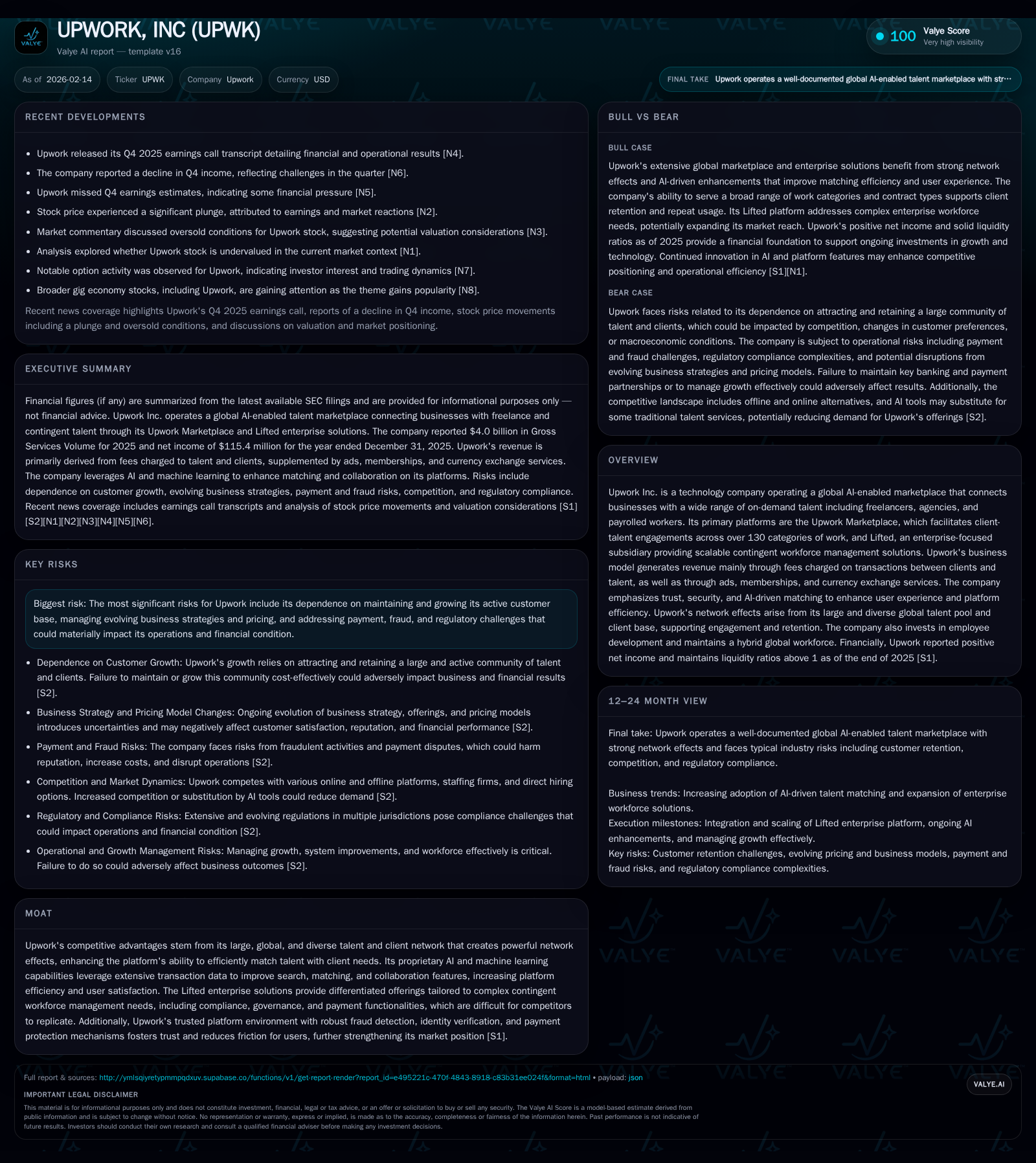
Upwork Inc. operates a leading global AI-powered freelance marketplace supplemented by its enterprise subsidiary Lifted, facilitating on-demand access to diverse talent worldwide. Despite robust revenue expansion and network effects driven by proprietary AI matching and secure platform design, the company recently grappled with an earnings miss and investor skepticism reflecting operational and regulatory headwinds. Competitive pressures from peers like Fiverr, marketplace circumvention risks, payment fraud challenges, and evolving business strategies add layers of complexity to sustaining growth levels. Upwork's ability to maintain active customer growth cost-effectively and expand enterprise offerings via Lifted will be pivotal as it balances innovation-driven opportunities with regulatory, financial, and competitive realities shaping its trajectory in 2026.
Upwork’s AI-Driven Marketplace: Innovating Talent Discovery
In an era defined by the accelerating gig economy and evolving workforce models, Upwork Inc. positions itself at the forefront through its AI-enabled global talent marketplace. The company's core offering—the Upwork Marketplace—leverages proprietary machine learning algorithms trained on vast transaction data sets to deliver high-quality matches between clients’ needs and a diverse pool of freelancers, agencies, fractional workers, and payrolled talent across more than 130 categories.
This technological underpinning is more than mere automation; it creates meaningful network effects whereby the breadth of talent attracts varied clients, whose engagement data further refines algorithmic precision. The result is a virtuous cycle enhancing platform efficiency that benefits all users by reducing search friction while increasing satisfaction [S1]. Furthermore, features such as real-time opportunity visibility enable talent to align their skill development with market demand trends—invaluable in fast-moving fields such as AI, software development, and digital marketing.
Trust forms another pillar of this ecosystem. Upwork’s investment in identity verification, fraud detection frameworks, and payment protection infrastructure builds confidence critical for remote engagements across geographies. These security mechanisms help mitigate common freelancing pain points like nonpayment or misrepresentation—barriers that historically dissuaded clients from fully embracing independent workforce solutions [S1]. Thus, Upwork does not simply connect supply and demand but fosters an environment where transactions can occur securely at scale.
Financial Pulse: Parsing Q4 2025 Earnings and Profitability
Despite these strategic advantages, Upwork’s latest quarterly results reflect the tension inherent in balancing growth with profitability. The Q4 2025 earnings announcement revealed a revenue increase consistent with prior quarters — driven largely by expanding Gross Services Volume (GSV) as more engagements flow through its platforms [F1]. However, net income declined relative to expectations to $115 million for the full year [F1], signaling margin pressures possibly linked to heightened investments or operational inefficiencies highlighted during the earnings call [N2][N3][N8].
The earnings miss precipitated a sharp stock price reaction amid investor concerns over the company’s ability to sustain scalable profitability in light of emerging costs associated with advanced AI initiatives and marketplace expansion efforts [N6]. Such volatility underscores how incremental execution hiccups can sharply impact sentiment despite otherwise promising top-line metrics.
Moreover, cash reserves remain robust at approximately $294 million as of year-end 2025 [F1], providing a cushion for ongoing strategic investments. Yet this liquidity advantage must be weighed against current liabilities near $650 million—a leverage point that necessitates disciplined financial stewardship moving forward [F1].
Competitive Landscape: Differentiators Amid Escalating Market Pressure
In a rapidly fragmenting gig economy ecosystem intensified by surging AI adoption demand, Upwork faces increasingly fierce rivalry notably from Fiverr—a marketplace focusing on smaller task-based engagements but aggressively scaling tech verticals tied to emergent AI capabilities [N1][N4]. While Fiverr's recent plunge in share price demonstrates vulnerability amid mixed execution reports [N10][N11], both players compete intensely for client mindshare over pricing models, service quality, and feature innovation.
Upwork distinguishes itself through enterprise-grade solutions via Lifted alongside its expansive freelance network—a contrast to Fiverr’s more transactional model. This bifurcated approach allows Upwork to address diverse client needs ranging from small businesses seeking quick freelance hires to large corporations demanding integrated contingent workforce management tools embedded with compliance protocols.
However, marketplace friction remains an issue as competitors explore hybrid approaches combining gig platforms with managed services or agency partnerships—pressuring margins further while raising customer expectations for seamless AI-powered experiences [N4]. How well Upwork navigates these dynamics will define its competitive moat resilience.
Operational Risks and Regulatory Complexities Facing Upwork
Underpinning these growth opportunities are significant operational challenges detailed extensively in SEC filings that could impact business continuity if inadequately managed. Chief among these are regulatory compliance requirements varying across jurisdictions as Upwork scales internationally; failures here could trigger fines or operational restrictions constraining flexibility [S1][S2].
Additionally, payment processing risks accompanied by ongoing fraud threats present latent vulnerabilities. Even minor lapses may undermine platform trust rapidly—a critical intangible asset in this segment. As customers sometimes attempt direct circumvention of the platform to avoid fees—commonly observed in gig marketplaces—Upwork confronts threats that could erode revenue bases unless countermeasures effectively evolve [S1][S2].
Compounding these are internal risks linked to continuous business strategy evolution including pricing changes or new feature rollouts that carry execution uncertainty impacting customer retention patterns [S1]. Managing this complexity demands agile risk frameworks tightly integrated with product development cycles.
Network Effects and Platform Trust: Cornerstones of Upwork’s Moat
Despite challenges, Upwork's most defensible asset remains its richly interconnected ecosystem where scale uniquely enables superior experience outcomes. Each additional client or talent contributor sharpens AI capabilities—the platform's informational advantage—which competitors without similar scale struggle to replicate credibly.
Moreover, trusted interaction frameworks foster user retention through reduced friction across payment security layers and verified identities—features imperative for scaling remote work globally under varying legal regimes [S1]. This combination of technological sophistication intertwined with rigorous security standards undergirds sustained engagement advantages protecting market share against pure volume-driven rivals.
The Strategic Value of Lifted: Enterprise Engagements Demystified
Lifted represents a bold pivot extending Upwork’s reach beyond traditional freelancing into comprehensive enterprise contingent workforce management territory. With functionality encompassing sourcing automation, contract compliance monitoring, governance controls tailored for large organizations, plus integrated payroll processes aligned with complex vendor requirements—Lifted addresses pain points often unmet by standard gig platforms.
This capability allows enterprises centralized control over diverse labor models encompassing freelancers, agencies, fractional teams or payrolled workers—all managed under one technological umbrella thus streamlining operational overhead while maintaining regulatory adherence—a critical selling point rarely matched elsewhere [S1].
By bridging independent contractor flexibility with corporate rigor demands, Lifted could drive higher spend per client relationships while diversifying revenue streams away from purely transactional freelancer fees.
Growth Trajectory and Customer Base Dynamics
Yet even as gross volumes escalate across Upwork’s portfolio inclusive of Lifted deployments, sustaining active customer growth without severely escalating acquisition costs presents a persistent obstacle flagged internally [S1][S2]. Evolving marketplace conditions combined with buyer sensitivity toward fee adjustments challenge straightforward expansion.
Moreover, churn risk intensifies when clients perceive pricing shifts or product complexity increases absent corresponding improvements in user experience. Retaining freelancers similarly requires constant recalibration of community incentives against rising alternative work options ubiquitous globally.
Thus organizational focus oscillates between features enhancing client value propositions versus controlling scaling expense ratios—a classic tension impinging forecast predictability amidst fiercely competitive dynamics.
Valuation Debate: Is Upwork Undervalued or Fundamentally Challenged?
Market analysts hold divergent views on whether recent selloffs represent buying opportunities given underlying fundamentals or signal deeper structural headwinds constraining sustainable profit generation. Some argue oversold technical price conditions suggest potential rebounds aligned with long-term secular gig economy tailwinds supporting autonomous workforces interconnected by intelligent digital platforms [N5][N7]. Others caution that margin pressures compounded by intensifying competition alongside unresolved regulatory exposures argue for tempered outlooks absent clear inflection points.
This valuation conundrum underscores the necessity for investors and stakeholders alike to appreciate nuanced trade-offs inherent in high-growth technology marketplaces undergoing rapid innovation cycles yet confronted simultaneously by emerging systemic risks.
Outlook: Navigating Future Growth While Managing Industry Disruptions
Looking ahead into 2026 and beyond, Upwork stands poised at a crossroads embodying opportunity married to complexity. Its use of AI-powered solutions—not merely augmenting but redefining work discovery paradigms—positions it favorably within the expanding freelance economy backdrop characterized by remote work normalization.
However success hinges critically on managing multifaceted challenges spanning regulatory compliance across international jurisdictions; combating evolving fraud tactics imperiling platform trust; executing coherent pricing strategies balancing growth incentives with monetization; defending against aggressive competitors refining hybrid service models; plus leveraging Lifted’s enterprise promise without detracting focus from core marketplace quality.
Only by integrating innovative technological advancement with robust operational discipline can Upwork hope to retain its leadership mantle as a preeminent destination where global talent meets opportunity securely at scale—thus shaping the future contours of contingent work ecosystems worldwide.
This analysis is for informational purposes only based on publicly available data as of February 14th, 2026. It does not constitute investment advice or recommendations.
Disclaimer: This is research-only, informational analysis and not investment advice. It may include AI-generated interpretation and general industry context. Always verify important details using primary sources.

Comments