
Nu Skin’s Integrated Model Faces Headwinds Amid Tariff Pressures and Earnings Miss
A deep dive into how Nu Skin's manufacturing footprint and direct sales strategy interact with external tariff risks and recent financial setbacks.
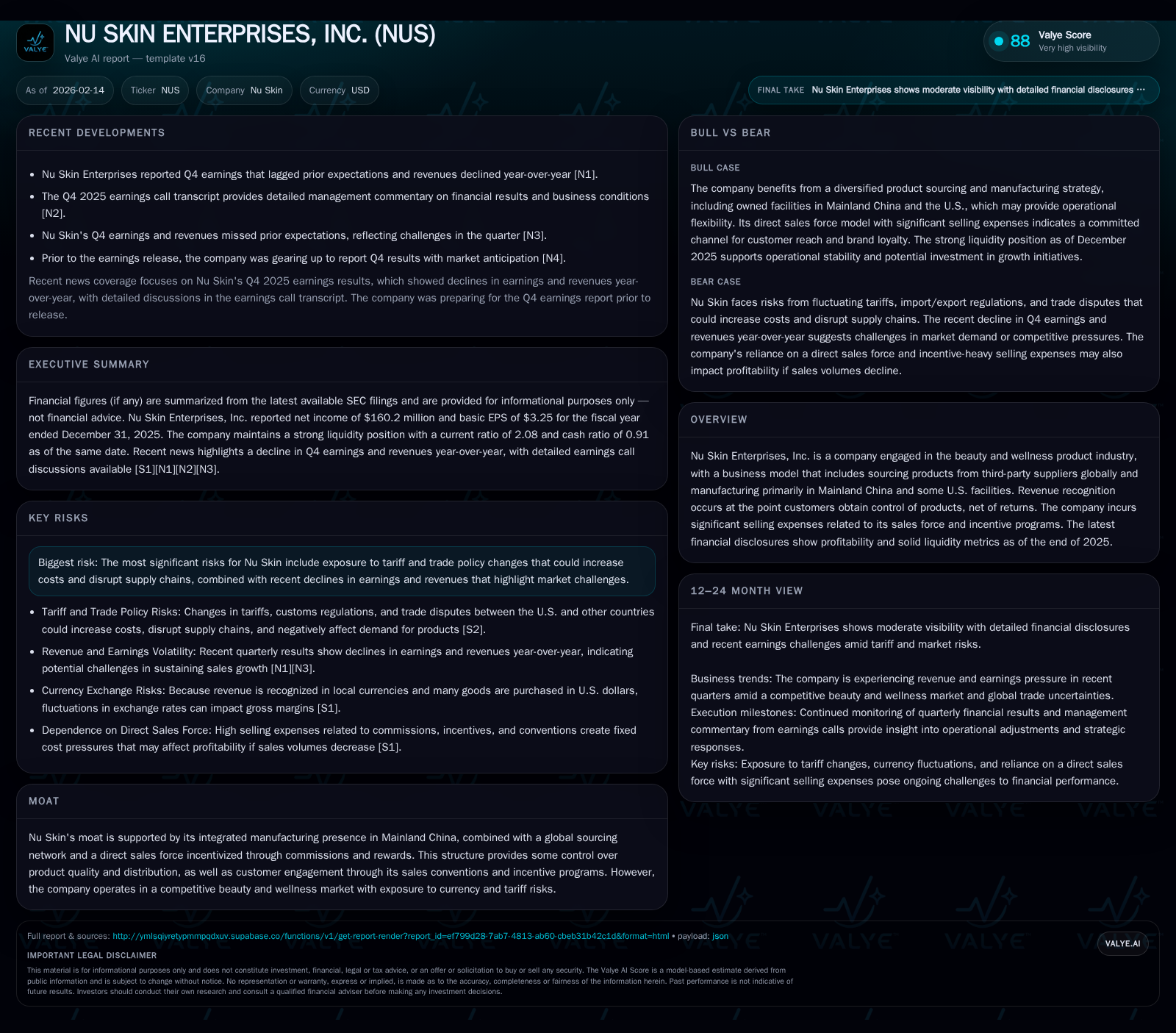
Nu Skin Enterprises reported a Q4 earnings and revenue miss that underscores challenges within its integrated business model. Rooted in Mainland China manufacturing combined with global sourcing and a commission-based direct sales force, the company is navigating significant near-term margin pressure exacerbated by escalating tariff uncertainties. While liquidity remains solid and the company maintains control over production quality, competition within the beauty and wellness sector alongside trade policy volatility cloud near-term prospects. Strategic moves ahead will be critical as Nu Skin prepares for its next global sales convention in Q3 2026 and seeks to stabilize profit trends.
From Factory Floors to Global Customers: Nu Skin’s Operational Backbone
Nu Skin Enterprises embodies a complex operational ecosystem anchored by its manufacturing facilities in Mainland China coupled with a vast global sourcing network. This arrangement provides dual advantages: substantial control over product quality through in-house production of key beauty and wellness items in China, while maintaining flexibility by sourcing elsewhere for non-China markets [S1]. Their manufacturing also extends to certain U.S.-based plants, notably the Rhyz Manufacturing entities. This mixture allows Nu Skin to balance cost efficiency against risk diversification.
This manufacturing integration underpins Nu Skin's moat by providing a foundation for consistent quality and reliable supply chains. However, their reliance on Chinese facilities is a double-edged sword given current geopolitical tensions affecting tariffs and trade policies globally. The company’s direct sales force further complements this backbone; incentivized through commissions and multilevel compensation schemes, it fosters deep customer relationships worldwide but also increments considerably their selling costs [valye_report_excerpt]
Behind the Numbers: Unpacking the Q4 Earnings Miss
The recently reported Q4 2025 earnings revealed revenue of approximately $3.18 billion for the full year, yet the quarter failed to meet analyst projections on both revenue and net income fronts [F1][N1][N3]. Specific factors cited include shifts in product mix adversely impacting margins and elevated costs linked primarily to raw materials and logistics amid inflationary pressures.
Revenue recognition follows a point-in-time model pegged at customers gaining control, but returns—which have historically been below 5% annually—continue to weigh on net sales calculation [S1]. Margins were pressured additionally by currency translation effects given sales occur globally but many purchases are USD-denominated.
This earnings miss mirrors broader challenges faced across the sector but highlights particular vulnerabilities in Nu Skin’s operating segments where tariff impacts manifest more acutely.
Direct Sales as a Double-Edged Sword: Incentives, Costs, and Customer Engagement
Nu Skin’s multi-level compensation system fuels an extensive sales network by awarding commissions not only for personal sales but also for those generated by recruited consumers and sub-leaders—a critical retention and growth tool outside Mainland China [S1]. Selling expenses accounted for the most significant portion of operating costs, encompassing commissions, bonuses, incentive trips, and convention expenses.
These conventions—held globally but only intermittently—introduce pronounced expense swings from year to year; Nu Skin hosted their last major global event in Q3 of 2024 across South Korea and the United States with the next scheduled for Q3 2026 [S1]. Consequently, quarterly comparisons often reflect this lumpy expense pattern.
While these expenditures propel engagement and loyalty within the sales force, they contribute to margin compression especially when top-line growth slows.
The China Connection: Manufacturing Strengths and Supply Chain Vulnerabilities
Mainland China's role as Nu Skin's key manufacturing hub confers distinct benefits including cost advantages in labor and materials alongside streamlined coordination processes [S1][valye_report_excerpt]. Producing most products sold domestically—and some exported abroad—the company leverages this facility for quality oversight.
Nonetheless, this concentration amplifies exposure to tariffs, customs regulations, and evolving trade policies that can disrupt operations abruptly [S2]. Political shifts have led to unpredictable duty rates changes between the U.S. and China, increasing raw material costs or delaying shipments. While Nu Skin attempts mitigation via alternate sourcing or logistics adjustments, these measures carry limitations without assured success.
Such fragility necessitates constant vigilance over regulatory landscapes impacting manufacturing economics.
Tariff Turbulence: Navigating Trade Policy Risks in 2026
Trade policy represents one of Nu Skin’s thorniest external risks. Recent years have seen fluctuating U.S. tariffs aimed at Mainland China products remain active or poised for re-implementation [S2]. Retaliatory responses from China add layers of complexity impacting customs expenses directly tied to cost of goods sold.
This creates an environment where pricing pressures could escalate beyond what consumer demand tolerates. Furthermore, import bans or stricter licensing requirements might constrict access to specific suppliers or marketplaces abruptly [S2].
Even Free Trade Agreements benefit is uncertain given potential suspensions or cancellations hindering preferred tariff treatments. As such, tariff unpredictability materially threatens margins absent effective countermeasures.
Liquidity and Profitability: Financial Health Amid Market Headwinds
Despite the adverse operating backdrop, Nu Skin maintains robust liquidity metrics with cash reserves nearing $239 million complemented by a current ratio above 2.0 as of year-end 2025 [F1][S1]. This signifies ample short-term asset coverage of current liabilities — a buffer against unforeseen cash flow disruptions stemming from market volatility.
Net income amounted to roughly $160 million during 2025 despite revenue pressures signaling constrained profit expansion possibilities going forward. Healthy liquidity thus remains pivotal for funding working capital requirements including inventory procurement amid fluctuating supplier terms.
Borrowing capacity coupled with solid cash flow management may afford flexibility as management explores cost controls alongside growth initiatives.
Global Beauty Industry Dynamics: Nu Skin vs. Competitors
Contextualizing Nu Skin’s performance against peers reveals industry-wide headwinds compounded by diverse strategic approaches. Estee Lauder recently posted better-than-expected earnings underscoring stronger pricing power or brand equity enabling margin preservation [N5]. By comparison, Nu Skin grapples with intensified competition from both large multinational brands and nimble digital-first entrants reshaping consumer preferences.
Direct selling channels add complexity whereby consumer acquisition costs can surge unexpectedly amidst social media proliferation accelerating trend cycles. This sector dynamism mandates continuous innovation alongside prudent expense management—a delicate tightrope for Nu Skin as smaller scale limits financial muscle relative to giants.
Looking Ahead: Strategic Responses and Upcoming Catalysts
Management's roadmap includes holding the next global sales convention in Q3 2026—a pivotal event intended not just for recognition but also energizing distribution networks critical for revenue recovery [S1][N2]. Given past conventions’ significant expense impact, balancing these investments with return-on-effort becomes increasingly vital amid tighter earnings environments.
Additional initiatives likely involve optimizing sourcing strategies potentially extending beyond China where feasible to soften tariff shocks while reinforcing inventory management precision. Enhancing digital tools within the sales force ecosystem may also feature prominently as ongoing efforts aim to lower cost-to-serve without impairing pipeline momentum.
In summary, nuanced tactical adjustments coupled with vigilant macroeconomic monitoring will define Nu Skin’s ability to steer through this challenging juncture within the intensely competitive beauty landscape.
Disclaimer: This report is based solely on publicly available information as referenced herein and does not constitute investment advice or recommendations.
Disclaimer: This is research-only, informational analysis and not investment advice. It may include AI-generated interpretation and general industry context. Always verify important details using primary sources.

Comments