
Foxx Development Holdings: Strategic Growth Amid Liquidity and Regulatory Challenges
An in-depth look into Foxx Development’s rise, financial dynamics, and evolving strategy in the U.S. communications hardware space.
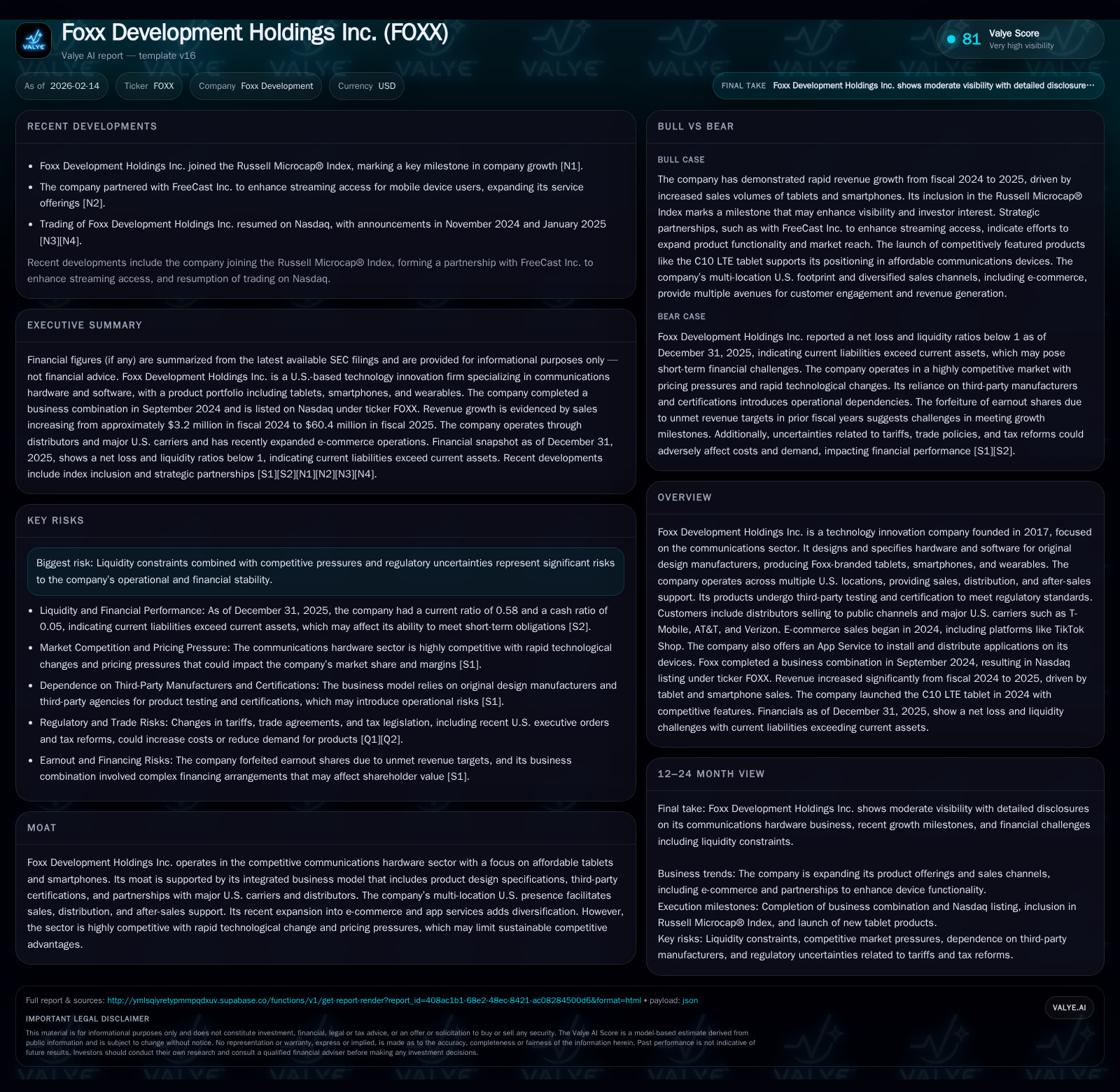
Since its founding in 2017, Foxx Development Holdings has aggressively expanded its footprint in the competitive communications sector with a unique integrated business model combining design, certification, and distribution. Its partnerships with major U.S. carriers underpin its market presence but also expose it to dependency risks amidst intense pricing pressures. The 2024 Nasdaq listing via a business combination boosted the company's visibility yet introduced complexities. Despite significant revenue growth by the end of 2025, Foxx faces notable liquidity constraints evidenced by a current ratio below 0.6 and ongoing net losses. Regulatory uncertainties, including tariffs and tax reforms, add layers of operational risk as the company pivots into e-commerce and app services to diversify its revenue streams.
Origins and Business Model: Building on Innovation and Integration
Foxx Development Holdings Inc., established in Texas in 2017, entered the communications sector with a focused ambition: to innovate within the crowded landscape of affordable mobile devices by controlling both hardware design specifications and software ecosystems. Their business model deviates from pure manufacturing; instead, they conduct detailed product design specs that they supply to original design manufacturers (ODMs). Once products are built, Foxx secures critical third-party certifications such as FCC Equipment Authorizations and Global Mobile Suppliers Association approvals. This layered approach ensures regulatory compliance while enabling rapid time-to-market.
Operating from multiple U.S. hubs — including tech-centered cities like San Francisco and Dallas — Foxx's distributed infrastructure supports sales teams close to key markets and provides localized after-sales support — a vital differentiator in a sector plagued by commoditization. This integrated model aims to bridge innovation aspirations with pragmatic distribution logistics, positioning Foxx uniquely as both a designer and brand overseer rather than just a supplier [S1], [valye_report_excerpt].
Growth Through Strategic Partnerships with Major U.S. Carriers
A crucial engine for Foxx’s growth is its strategic alliances with leading U.S. wireless carriers: T-Mobile, AT&T, and Verizon. These partnerships afford Foxx branded products direct access into highly competitive retail channels nationwide. Major carriers act not only as volume distributors but as de facto quality validators within consumer markets.
However, this carrier reliance is a double-edged sword. While these relationships enhance brand legitimacy and scale potential, they tether Foxx’s fortunes tightly to carrier purchasing cycles, often fraught with stringent pricing negotiations given hardware commoditization trends [S1], [valye_report_excerpt]. The risk here lies in potential over-dependence on a limited set of distribution partners vulnerable to shifts in carrier device strategies or new supplier entrants.
Navigating the Competitive Landscape: Pricing and Product Portfolio
Foxx operates predominantly within the affordable segment offering tablets, smartphones, and wearables—a market characterized by razor-thin margins and relentless price competition from Asian ODMs and established multinational brands.
Their product pricing reflects a careful consideration of manufacturing costs, development investments, regulatory burden from certifications/testing, plus logistics expenses—all balanced against market expectations for low-cost devices [valye_report_excerpt]. Yet inherent margin compression persists; sustaining profitability demands continuous innovation not only in product features but also cost efficiencies.
Foxx attempts differentiation through ongoing R&D focusing on customizable device standards and complementary software via its App Service initiative—a move intended to create stickiness beyond hardware alone [S1]. Nonetheless, preserving any pricing power remains an uphill battle entrenched by external competitive forces.
The Implications of the 2024 Nasdaq Listing via Business Combination
The September 2024 listing marked a pivotal milestone achieved through a reverse merger with Acri Capital Acquisition Corporation (ACAC). This structure facilitated public market access without a traditional IPO process—fast-tracking capital inflows while catalyzing investor attention on their growth story [S1].
Transitioning from a private startup to a public entity introduced amplified scrutiny requirements including rigorous financial disclosures under SEC rules alongside higher operational governance obligations. The dual-entity structure post-merger—with Merger Sub surviving as an operating subsidiary—adds complexity for management when consolidating reporting lines and communicating unified narratives to stakeholders.
While listing opened up fresh financing opportunities potentially needed for scaling production or marketing efforts, it simultaneously subjected Foxx to volatility drivers common among recently merged tech firms competing in low-margin industries.
Financial Health Check: Revenue Growth versus Liquidity Challenges
The latest financial snapshot reveals mixed signals. Fiscal year ending December 31, 2025 shows revenues climbing sharply past $16.7 million—an impressive top-line expansion indicating growing acceptance of Foxx’s branded devices [F1]. Yet this growth belies deeper financial strains:
- Net loss stood at approximately $4.3 million pointing towards ongoing challenges converting sales momentum into profitability.
- Cash reserves remain modest at roughly $1.77 million constraining the ability to fund operations without external capital infusions immediately.
- Most concerning is the liquidity position: current assets tallying about $19.8 million versus current liabilities near $33.95 million yields a current ratio around 0.58—a clear warning sign of difficulty meeting short-term obligations seamlessly [F1].
This imbalance underscores intensified working capital needs possibly amplified by inventory buildups or accounts receivable elongations tied to channel partners.
Regulatory and Trade Policy Risks Confronting Foxx
External policy landscapes exert substantial influence on Foxx’s cost structure and operational risk profile. Following Executive Order 14257 issued in April 2025 aimed at recalibrating trade imbalances via reciprocal tariffs, Foxx confronts elevated import costs for components sourced globally [S2]. Retaliatory tariffs imposed by foreign governments further complicate cross-border supply chains.
These evolving trade dynamics threaten cost escalations that may compress already thin margins if not passed along effectively via pricing adjustments—a tall order given sector competition intensity.
Moreover, tax reform enacted under The One Big Beautiful Bill Act (OBBBA) introduces nuanced impacts: provision for immediate expensing of domestic R&D investments can provide some tax relief on innovation outlays but also inject uncertainty about long-term tax liabilities amid ongoing international base erosion efforts aligned with OECD guidelines [S2].
Expansion into E-Commerce and App Services: New Frontiers
Recognizing limitations inherent in traditional carrier/distributor channels alone for growth sustainability, Foxx initiated e-commerce operations starting March 2024 with platforms including TikTok Shop among initial partners [S1], [valye_report_excerpt]. This strategic pivot targets emerging digital consumer segments increasingly purchasing electronics online—allowing more direct brand control over customer experiences.
Complementing e-commerce is the rollout of an App Service that preloads partner applications onto devices and manages their distribution digitally—seeking to create ecosystem lock-in potential beyond hardware margins.
These initiatives represent early diversification steps designed to reduce dependency risks linked strictly to physical device sales through conventional brick-and-mortar or wholesale routes.
Outlook: Balancing Innovation Ambitions Against Market Realities
Foxx Development Holdings sits at an intersection of ambition tempered by heightened financial caution amid an unforgiving communications hardware market.
Its integrated model combining design control with multi-channel distribution including legacy carriers and new digital avenues offers distinct advantages over pure ODM competitors lacking brand identity or direct customer access.
However, liquidity constraints coupled with regulatory headwinds from tariffs/tax shifts impose stringent limits on operational flexibility. Achieving sustainable profitability will require meticulous working capital management while maintaining innovation pace—especially cultivating proprietary software add-ons through its App Service that could evolve into differentiated offerings commanding premium valuations.
In this high-velocity sector dominated by large incumbents wielding deep resources, Foxx must navigate carefully to secure a defensible niche without succumbing entirely to commoditization pressures or exposing itself excessively to partner concentration risk.
This analysis is based solely on information publicly available through February 2026 filings and company disclosures; it does not intend investment advice but aims to provide comprehensive understanding grounded in factual data.
Disclaimer: This is research-only, informational analysis and not investment advice. It may include AI-generated interpretation and general industry context. Always verify important details using primary sources.

Comments