
Hercules Capital: Strategic Positioning and Risk Management in Tech-Focused BDC Investing
An in-depth analysis of Hercules Capital's unique tech-centric business development company model and its resilience amid evolving economic conditions.
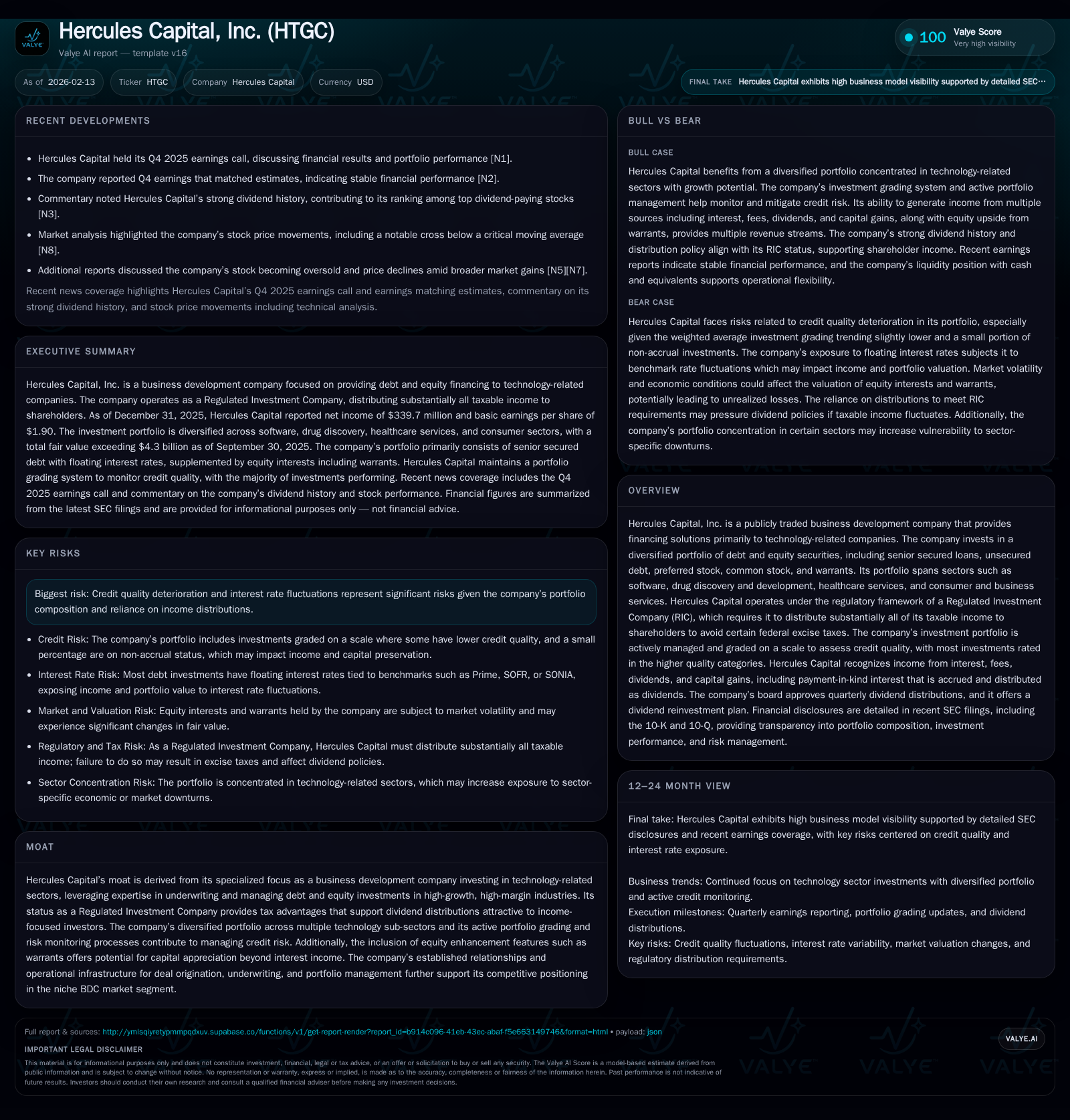
Hercules Capital, Inc. (HTGC) operates as a technology-focused business development company (BDC), leveraging its niche specialization to generate diversified income streams through debt and equity instruments, including warrants. The company's regulated investment company (RIC) status introduces regulatory constraints but also tax advantages, shaping its dividend strategy and capital deployment. A disciplined approach to portfolio diversification, credit quality grading, and active risk management underpins its resilient income generation amid interest rate volatility and credit risks. Leveraging relationships and operational infrastructure further strengthens its moat, positioning it distinctively among peers in the shifting market landscape.
Hercules Capital’s Tech-Centric Investment DNA
Hercules Capital embraces a distinctive position within the business development company universe by channeling its investment activities primarily toward technology-related sectors. This includes sub-sectors such as software development platforms, drug discovery methodologies, healthcare service providers, and various consumer/business service entities. Unlike more broadly diversified BDCs that may spread their investable dollars across traditional industries or parts of the energy or financial sectors, HTGC's concentration aims at companies characterized by rapid innovation cycles, imbedded intellectual property assets, and scalable growth profiles.
This focused mandate translates into a portfolio composed of debt and equity securities including senior secured loans—often forming the backbone of cash flow generation—unsecured debt instruments offering enhanced yield via incremental risk profiles, preferred stock positions that combine fixed income attributes with potential equity upside, common stock stakes enabling participation in growth phases, and importantly warrants or options functioning as embedded equity kickers. These equity enhancement features are particularly relevant for venture-stage companies or those requiring flexible capital structures where HTGC can negotiate participatory upside beyond standard interest yields.
To manage inherent sector risks tied to innovation volatility and commercialization challenges prevalent in technology-driven businesses, Hercules employs an active grading system for its investments. This scale-oriented credit quality assessment supports dynamic portfolio adjustments aimed at preserving asset quality while capturing attractive yields commensurate with risk appetite. This nuanced underwriting expertise functions as a moat by combining specialized knowledge with tailored credit structuring uncommon among generalist lenders or investment vehicles [S1][S2].
Navigating the Business Development Company Regulatory Maze
Operating under the Business Development Company framework governed by the Investment Company Act of 1940 imparts specific operational boundaries on Hercules Capital. As a Registered Investment Company (RIC), HTGC must comply with diversification requirements but perhaps most notably is subject to rigorous distribution mandates requiring nearly all taxable income to be passed through to shareholders in order to avoid federal excise taxation. Specifically, it must distribute at least 98% of ordinary income and 98.2% of capital gain net income within defined calendar year timeframes.
These rules necessitate careful quarterly dividend declarations aligned closely with estimated earnings to remain compliant. While this model restricts large-scale reinvestment without concomitant capital raises—which themselves are managed cautiously given NAV-based pricing limitations—it simultaneously appeals strongly to income-focused investors seeking predictable distributions bolstered by underlying portfolio earnings [S1].
Additional regulatory constraints include limitations on affiliate transactions requiring board oversight to prevent conflicts of interest, mandatory fidelity bond coverage safeguarding against embezzlement risks, adoption of robust compliance policies overseen by a Chief Compliance Officer, and prescribed prohibitions protecting shareholders from bad faith actions by management or directors [S1]. These governance elements embed operational discipline that supports long-term shareholder confidence.
Income Streams: Beyond Traditional Interest
While interest income from debt portfolios remains the core revenue driver for HTGC, the company diversifies its income sources substantially. Loan agreements frequently embed ancillary fees such as exit fees payable upon loan maturities or prepayments, commitment fees earned upon facility establishment regardless of drawn amounts, balloon payment fees for deferred amortization structures, success fees triggered by milestone achievements in borrowers’ pathways, and occasionally PIK (payment-in-kind) interest provisions.
PIK interest merits particular attention because it represents non-cash accretion whereby unpaid interest compounds into principal balances at contractual rates during certain periods—commonly aligned with initial growth stages of borrowers’ operational ramp-ups. Although this elevates reported interest income before cash receipt materializes historically required distributions must include these non-cash accruals to maintain RIC tax status; thus Hercules may need to deploy available liquidity or realizations from other asset sales to cover dividends reflecting PIK income portions [S2].
Equity components offer separate yet complementary revenue lines. Dividend receipts on preferred stock or common stock positions generate periodic cash flows when companies mature sufficiently; meanwhile realized capital gains arise intermittently from warrant or option exercises linked to portfolio exits or markups in affiliated securities' market prices.
This multi-faceted revenue architecture provides resilience across varying economic cycles—a critical factor given potential volatility in technology company cash flows—and enhances total investment returns beyond pure interest yield metrics [S2][F1].
Portfolio Diversification and Credit Quality Insight
HTGC's portfolio spans multiple segments within the technology ecosystem rather than concentrating heavily in narrow niches; this strategic diversification reduces single-sector concentration risk yet maintains thematic cohesion central to its mission. Key sectors include high-growth software providers addressing enterprise demand shifts; cutting-edge biotech firms involved in drug discovery pipelines where financing stages are staggered according to clinical milestones; healthcare services adapting digital transformation technologies; plus consumer-facing businesses that leverage platform economies.
Underlying credit quality is actively monitored using internal grading scales that categorize investments primarily into higher-quality ratings—indicative of sound collateral coverage or strong borrower fundamentals—and lower-risk exposure buckets. This grading guides portfolio protective actions such as restructuring negotiations or selective exits prior to material impairment realizations.
Consistent application of covenants embedded in loan agreements alongside thorough due diligence ingrains prudent risk mitigation safeguards ranging from financial ratio thresholds through governance board observer rights—each contributing elements strengthening loss protection frameworks important amid macroeconomic uncertainties [valye_report_excerpt][S1].
Dividend Strategy and Shareholder Value Creation
Dividend distribution continuity forms a hallmark of Hercules Capital’s appeal within investor communities prioritizing steady income flows. The policy framework balances payment consistency with underlying earnings variability acknowledging that occasional returns of capital might occur if realized earnings fall short of declared distributions—a distinction important for tax treatment considerations among shareholders.
Historical data confirms a robust track record of sustained dividends fostering inclusion among top BDCs ranked for yield reliability [N5]. Board discretion exercised quarterly aligns declared dividends closely with internal taxable income estimates while retaining flexibility to address timing mismatches caused by accrued but not yet received PIK components.
Given prevailing low-interest-rate environments historically attractive for yield securities now challenged by rising rates globally, Hercules’ ability to maintain dividend levels despite these headwinds signifies effective portfolio management underpinning shareholder value philosophies anchored in predictable payout streams rather than opportunistic speculative allocations [S1][N5].
Leverage and Capital Structure Under the Microscope
Leverage amplifies both return potentials and risk exposures—a duality acknowledged explicitly within Hercules’ SEC disclosures referencing "substantial borrowings" magnifying gains or losses on invested amounts [S1]. The company utilizes borrowed funds alongside shareholder equity to finance loan origination activities enabling scale advantages economically vital given market competition from larger credit providers.
Critically Hector operates within guidelines restricting issuance prices for common stock relative to Net Asset Value (NAV), limiting capacity to dilute at discounts except upon board determination backed by shareholder approval mechanisms—options which currently are outside routine authorization scopes [S1]. This preserves NAV dilution discipline yet constrains agile capital raising during periods of price weakness necessitating alternative financing structuring approaches.
The balance sheet also reveals meaningful cash reserves held for operational liquidity needs including dividend coverage when timing dislocations arise between accrued PIK income recognition versus cash collections [F1][S1]. Properly managing this interplay constitutes a vital element ensuring sustainable capital structure integrity over time.
Market Sentiment and Stock Movement in Early 2026
Throughout early 2026 trading sessions HTGC’s share price exhibited heightened technical pressure evidenced by breaking below key moving averages (including the critical 200-day MA)—signals often interpreted by technical analysts as bearish momentum indicators [N8][N13]. Concurrent news commentary describes episodes where HTGC shares declined despite broad market advances creating perception gaps between fundamentals and sentiment drivers [N7][N14].
Adding complexity was classification among oversold categories per technical oscillators suggesting potential short-term rebounds driven more by market psychology than substantive shifts in underlying asset performance [N6][N11]. Such dynamics require investors parsing volatility-induced deviations versus structural change considerations highlighting importance of long-view portfolio health assessment juxtaposed against noisy trading landscapes [N6][N7][N11].
Risk Profile: Interest Rate Sensitivity and Credit Risks
Interest rate fluctuations represent significant risk levers due to their impact on borrowing costs coupled with borrower repayment capacities influencing default probabilities—a reality well outlined in Hercules’ annual filings emphasizing leverage-induced magnification effects [S1]. Rising rates can compress asset valuations triggering repricing across credit instruments potentially heightening non-accrual incidences demanding watchful scrutiny.
Credit quality deterioration stemming from sectoral weaknesses or borrower-specific headwinds remains equally critical given exposure concentrations within innovative but sometimes volatile technology segments requiring adaptive workout strategies supported by active grading models described earlier [valye_report_excerpt][S1]. Maintaining rigorous underwriting standards combined with ongoing monitoring serves as primary defense mitigating downside surprises limiting loss severity.
Stakeholders benefit from transparent communications regarding risk factors allowing appropriately calibrated expectations balanced between return opportunities versus inherent uncertainties characteristic of venture-style lending environments typical for tech-focused BDCs [S1][valye_report_excerpt].
Competitive Landscape: Benchmarking Against Peers ARCC and Ares Capital
When positioned relative to other major BDCs like Ares Capital Corporation (ARCC) and Ares Capital (ARCC’s peer mentioned) which tend toward broader industrial or middle-market lending platforms HTGC’s specialization presents both differentiated growth potential owing to higher margin tech-enabled businesses alongside unique sectoral cyclicality sensitivities [N3][N4][N12].
While ARCC exhibits scale advantages benefiting provisioning efficiencies coupled with more stable industrial grade client bases ARCC's broader exposure contrasts with Hercules’ deeper-tech orientation yielding different risk/return profiles inviting comparative analyses focused on niche expertise versus diversification breadth trade-offs.
As noted in recent coverage discussions around earnings results these peer comparisons illuminate strategic positioning nuances shaping investor perceptions influencing share valuation trends distinctively [N3][N4][N12].
Governance, Compliance, and Ethical Framework
Governance structures at Hercules Capital emphasize strict adherence to regulatory frameworks accompanying BDC operations including maintaining fidelity bonds against malfeasance risks alongside formalized codes of ethics regulating personal investment activities by personnel involved in decision making processes thereby aligning interests suitably avoiding conflicts.[S1]
Proxy voting policies executed by investment teams seek optimal outcomes maximizing shareholder value while carefully navigating proposal impacts demonstrating thoughtful engagement balancing short- versus long-term portfolio implications.[S1]
Privacy principles safeguard non-public shareholder information restricting access only internally on essential needs basis underscoring organizational commitment toward data protection consistent with modern fiduciary expectations.[S1]
Overall these governance pillars serve as foundational bedrocks buttressing confidence amongst investors cognizant that compliance rigor accompanies financial performance objectives establishing an integrative operating ethos supporting sustainable success.[S1]
Disclaimer: This report is intended solely for informational purposes based on publicly available data as of February 13th, 2026. It does not contain investment advice nor recommend any action regarding Hercules Capital shares or securities discussed herein. Readers should conduct their own due diligence before making financial decisions.
Disclaimer: This is research-only, informational analysis and not investment advice. It may include AI-generated interpretation and general industry context. Always verify important details using primary sources.

Comments