
LendingClub Corp: Assessing Strategic Resilience Amid Market Volatility and Fintech Competition
A comprehensive analysis of LendingClub’s digital marketplace banking model, capital strength, and risk management amid interest rate challenges and competitive fintech dynamics.
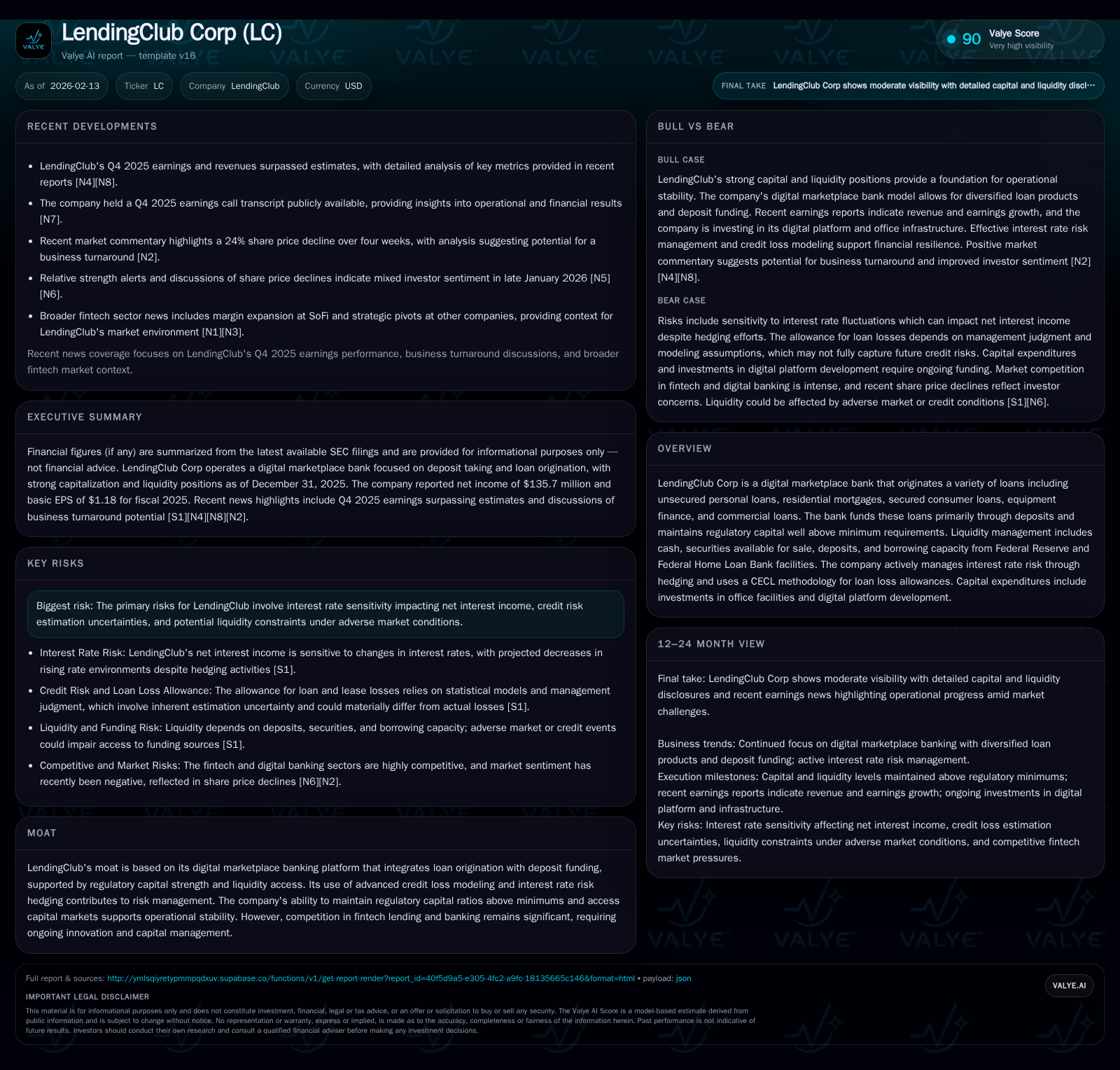
LendingClub’s shares have experienced notable volatility recently despite consistent earnings beats over the past four quarters, reflecting broader fintech market anxieties intertwined with macroeconomic uncertainties. At its core, LendingClub operates a hybrid digital marketplace bank integrating diverse loan origination with deposit-driven funding, supported by robust regulatory capital buffers and liquidity facilities. The firm’s sophisticated CECL credit loss modeling and interest rate hedging provide important mitigants to credit and interest rate risk exposures. However, ongoing competition from agile fintech peers and interest rate sensitivities pose persistent challenges requiring continued innovation and prudent capital management.
Navigating Market Volatility: LendingClub's Recent Stock Movements
In the early weeks of 2026, LendingClub's share price contracted by approximately 24%, a sharp pullback that appears disproportionate when juxtaposed against the company's string of positive earnings surprises over the prior four quarters [N9][N5]. This stark divergence between operational performance and market valuation underscores an elevated investor apprehension anchored in broader fintech sector volatility compounded by macroeconomic uncertainties such as fluctuating interest rates and cautious lending environments.
Analyst discourse balanced hopes for LendingClub’s turnaround potential—with its improving fundamentals—against prevailing risks of near-term headwinds curtailing momentum. Peer fintech stocks experienced similar turbulence during the period, adding contextual layers to LC’s price action reflective not just of company-specific factors but also wider ecosystem sentiment [N3][N12].
Business Model Dissection: The Digital Marketplace Bank Unpacked
LendingClub distinguishes itself through an integrated digital marketplace banking model that goes beyond traditional online lending aggregators. It originates an array of loan products spanning unsecured personal loans, residential mortgages, secured consumer loans, equipment finance, and commercial loans. Financing these diverse loan assets primarily through deposits situates LendingClub within a banking regulatory framework—contrasting with many fintech lenders reliant on capital markets or securitizations—and provides a unique structural advantage given the relatively stable deposit funding source [valye_report_excerpt].
This hybridization blends marketplace lending efficiency with traditional banking prudence enabled by consistent regulatory oversight. The platform’s digital architecture supports seamless borrower origination and underwriting while aligned funding mechanisms via deposits reinforce balance sheet stability—a foundational moat distinguishing LendingClub from pure-play online lenders.
Capital Fortitude: Are Liquidity and Regulatory Buffers Enough?
As of December 31, 2025, LendingClub reported Common Equity Tier 1 (CET1) capital of $1.34 billion translating to a CET1 ratio of 17.4%, markedly above the regulatory minimum of 7.0% [S1]. Tier 1 capital stood in parity with CET1 at $1.34 billion (17.4%), well over the requisite minimum threshold of 8.5%. Total capital was $1.44 billion (18.7%), comfortably exceeding both minimum requirements and well-capitalized standards.
Liquidity metrics reinforce this strength; cash and cash equivalents totaled approximately $901 million supplemented by available-for-sale securities close to $385 million. Deposit balances reached nearly $10 billion underpinning stable funding sources. Additionally, substantial borrowing capacities remain accessible through the Federal Reserve Discount Window ($3.29 billion) and Federal Home Loan Bank advances ($679 million) providing contingent liquidity cushions under stress scenarios [S1].
Such robust capital adequacy combined with multi-channel liquidity avenues equips LendingClub with operational durability to absorb shocks arising from economic or market fluctuations.
Interest Rate Environment: A Double-Edged Sword for LendingClub
Interest rate movements have manifested as a nuanced factor impacting LendingClub’s financials. Rising rates traditionally compress net interest margins on fixed-rate loan products given higher funding costs unless asset yields adjust correspondingly. This dynamic has introduced earnings volatility pressures noted in recent reporting cycles [valye_report_excerpt].
However, LendingClub actively manages this exposure through an established interest rate risk hedging framework employing derivative instruments designed to stabilize net interest income streams amidst volatile rate backdrops [S1]. This sophistication tempers downside exposure but does not fully neutralize inherent business model sensitivities linked to duration mismatches between lending assets and deposit liabilities.
Hence, while rising rates present challenges—especially if sustained or abrupt—the company's proactive risk mitigation enhances resilience compared to less hedged competitors.
Credit Risk & CECL Methodology: Innovation in Loss Allowance
Navigating credit risk constitutes a centerpiece of LendingClub’s risk management philosophy. Adoption of the Current Expected Credit Loss (CECL) accounting standard reflects an advanced approach integrating forward-looking macroeconomic variables into loan loss provisioning rather than relying on historical incurred loss paradigms alone.
This methodology aims for more timely recognition of expected impairments thereby facilitating prudent reserve levels calibrated to changing economic conditions characteristic of credit cycles [valye_report_excerpt].
By embedding this enhanced predictive lens into allowance calculations, LendingClub potentially gains an edge in managing portfolio quality proactively relative to peers slower or less methodical in CECL adoption.
Growth Engines & Competitive Pressures in Fintech Lending
Though foundational strengths exist, LendingClub confronts escalated competition especially from fintech firms exploiting partnership ecosystems or leveraging operational leverage gains.
Upstart’s accelerated credit union partnerships exemplify network-driven growth avenues enabling outsized revenue expansions through expanded distribution channels inaccessible to purely captive models [N6][N7]. Concurrently, SoFi demonstrates ongoing operating margin improvements indicative of scalable cost efficiencies paired with diversified financial offerings bolstering profitability profiles [N1][N14].
Against this backdrop, LendingClub must maintain innovation momentum not only on product breadth but also on underwriting sophistication and customer experience enhancements to preserve relevancy within an intensifying fintech landscape.
Strategic Capital Deployment: Real Estate and Digital Investment
Capital expenditures underscore strategic priorities balancing physical infrastructure permanence with digital agility. In April 2025, LC acquired a sizeable office complex in San Francisco totaling over 230,000 square feet intended as its primary headquarters starting Q2 2026—signaling long-term geographic anchoring in a major tech hub influencing talent retention and brand stature [S1].
Simultaneously, ongoing commitments toward digital platform development manifest continued investment in technology stacks needed to scale loan originations efficiently while optimizing user interactions across borrower and lender segments [valye_report_excerpt].
This dual-pronged approach reflects cognizance that physical presence complements—but does not supplant—the necessity for advanced digital capabilities central to competing effectively in marketplace banking.
Shareholder Value Moves: Repurchase Program Insights
In November 2025, the Board authorized up to $100 million for share repurchases under the Repurchase and Acquisition Program which includes provisions for withholding common stock related to employee tax obligations on restricted units vested [S1]. By year-end 2025 approximately $11.9 million had been deployed acquiring nearly 677 thousand shares at an average price around $17.65.
This buyback activity amidst share price softness can be interpreted as management signaling conviction in intrinsic value while prudently utilizing excess capital resources without compromising liquidity or regulatory buffers—an illustrative alignment between capital stewardship and shareholder return priorities.
Future Risks and Opportunities on the Horizon
Looking forward, principal risks cluster around heightened interest rate sensitivity possibly compressing net interest income if hedges prove insufficient coupled with uncertainties embedded within credit loss estimations notwithstanding CECL enhancements. Additionally, unexpected liquidity strains could arise under more severe macro-financial perturbations altering deposit behaviors or funding market access dynamics [valye_report_excerpt][S1].
Conversely, continued platform innovation leveraging machine learning for underwriting precision or expanding commercial loan segments could unlock new growth vectors enhancing profit mix diversification—particularly if matched with scalable operational infrastructures.
Balancing evolving regulatory capital expectations alongside ambitions for aggressive growth will remain pivotal determinants shaping LendingClub’s trajectory amid ongoing fintech disruption dynamics.
This analysis synthesizes publicly available information as of February 13, 2026 from SEC filings and credible financial news sources without speculative assertions beyond disclosed data points. It provides an objective assessment without investment advice or recommendation.
Disclaimer: This is research-only, informational analysis and not investment advice. It may include AI-generated interpretation and general industry context. Always verify important details using primary sources.

Comments