
Lake Superior Acquisition Corp: Navigating Governance and Sponsor Dynamics in the SPAC Race Against Time
A deep dive into how LKSP's governance framework and sponsor incentives heighten risks and shape its value potential as it approaches a critical business combination deadline.
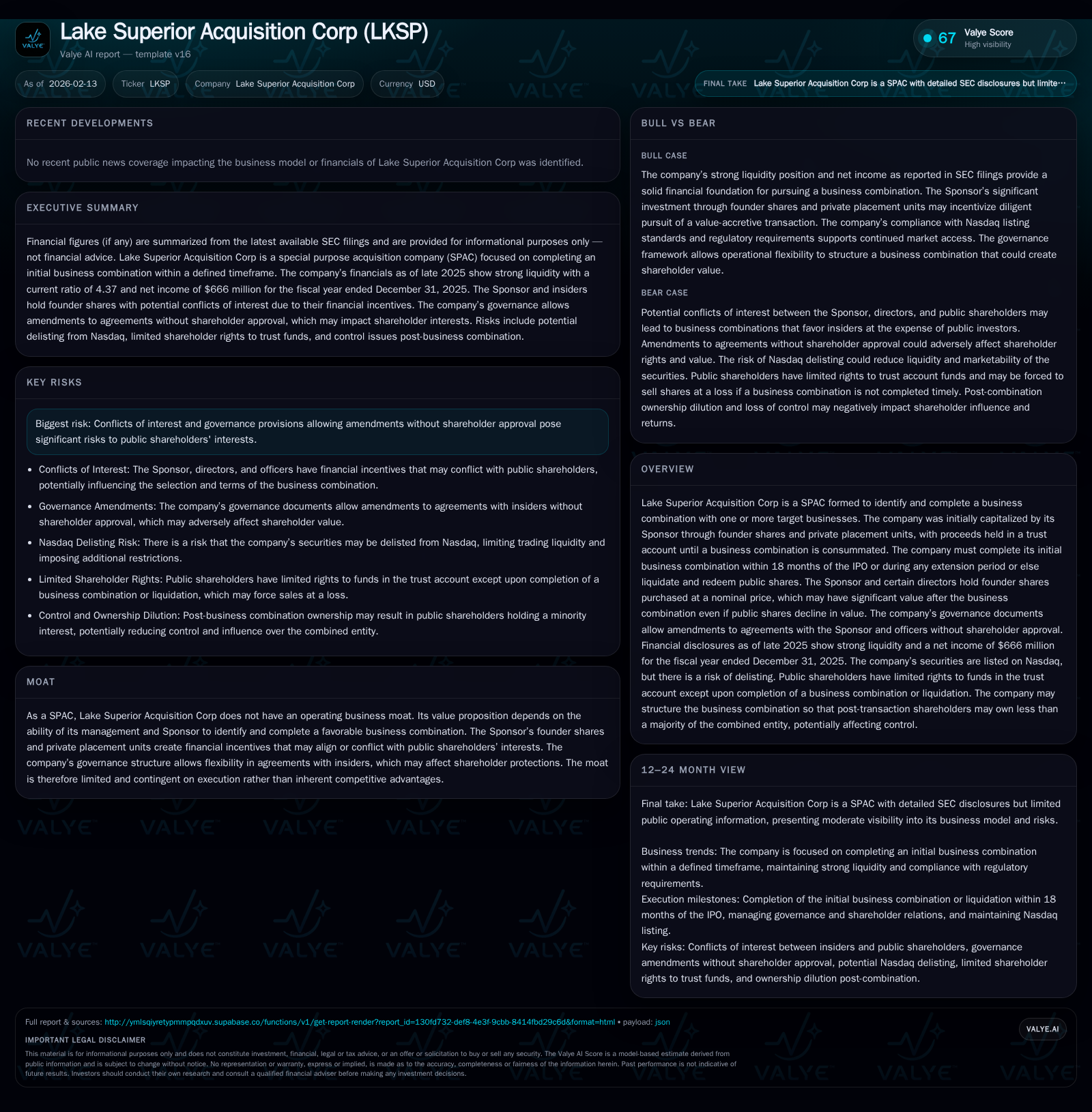
Lake Superior Acquisition Corp operates as a blank-check SPAC, relying fundamentally on the management team's ability to identify and execute an initial business combination within regulatory time constraints. Its flexible governance provisions permit agreement amendments without shareholder consent, which amplifies investor risk by diluting control and complicating transparency. The Sponsor’s substantial ownership of founder shares purchased at minimal cost aligns interests to some degree but also creates potential conflicts given their disproportionate upside post-merger compared to public shareholders. Financial disclosures underscore robust liquidity ratios juxtaposed with a limited cash runway, underscoring urgency amid looming deadlines and going-concern doubts.
Lake Superior Acquisition Corp: A Blank-Check Journey
Lake Superior Acquisition Corp (ticker: LKSP) epitomizes the structural essence of Special Purpose Acquisition Companies (SPACs). Formed specifically to pursue and consummate one or more business combinations, LKSP commenced operations with no prior revenue streams or operational history [S1]. Its initial capitalization was achieved through founder shares and private placement units funded by its Sponsor. These proceeds are held securely in a trust account until a targeted merger or acquisition completes successfully [F1]. Absent such completion within the stipulated regulatory window—18 months post-IPO plus any authorized extension—LKSP is contractually bound to liquidate and redeem its public shareholders’ capital.
Unlike traditional corporations building moats through product innovation or market penetration, LKSP's value is completely contingent on execution agility. It has no inherent competitive advantage; it is purely a financial vehicle betting on managerial acumen to identify compelling acquisition targets. This reliance places heightened emphasis on sponsorship quality, strategic deal sourcing, and timing precision.
Governance Realities: Flexibility or Shareholder Risk?
Delving into LKSP’s corporate governance reveals provisions that strike at the heart of investor safeguards. According to recent SEC disclosures, the company can amend its letter agreements with Sponsors, officers, and directors without requiring shareholder approval [S1]. Such agreements set forth critical terms—including transfer restrictions on founder shares, indemnities related to trust accounts, waivers of redemption rights, and participation allocations in liquidating distributions.
While management suggests these flexibilities facilitate nimble decision-making during complex negotiations, they simultaneously dilute minority investor influence. Amendments executed absent shareholder consent open avenues where conflicts might be resolved internally at terms adverse to public holders. This kind of governance agility is paradoxically both strength and vulnerability: it may accelerate deal structuring but undermines transparency and dilutes checks on Sponsor authority. In an environment where deals often hinge on nuanced valuations and subjective fairness opinions, this structural looseness adds layers of uncertainty around the final equity value creation for outside investors.
Sponsor Incentives: Alignment or Conflict?
The Sponsor’s ownership dynamics further color this governance mosaic. The Sponsor initially purchased founder shares at approximately $0.0043 per share—a nominal price point—accumulating nearly 3.8 million Class B ordinary shares after partial cancellations [S1]. Such deeply discounted entry positions the Sponsor for substantial upside if a transaction successfully closes.
However, this asymmetry creates incentive conflicts. The Sponsor loses its entire investment if no deal consummates but stands to reap outsized gains otherwise—even scenarios where public shareholders might incur losses due to deal structure or valuation premium. While theoretically aligning interests towards deal completion, this misalignment could skew target selection criteria toward expediency rather than long-term value creation. The public shareholders—bearing acquisition risk without comparable upside participation—face an inherently uneven risk-reward landscape that must be factored heavily into any valuation or engagement analysis.
Financial Snapshot Amid Uncertainty
Anchoring these qualitative considerations requires grounding in LKSP’s latest financial metrics [F1]. As of late 2025, the company reported net income of approximately $666 thousand—a figure largely reflective of SPAC accounting conventions rather than operational profitability. More importantly, current assets stood near $560 thousand against current liabilities around $128 thousand, yielding a favorable current ratio of approximately 4.37—a traditional hallmark of liquidity strength.
Yet the cash balance itself presents challenges: at just under $50 thousand reported by September end [F1], LKSP lacks ample liquid reserves needed to sustain prolonged merger negotiations or cover unexpected transactional costs adequately. Given that pursuit expenses tend to mount substantially as targets are sourced and diligence intensifies, cash scarcity introduces operational strain amid tightening timelines.
The Clock is Ticking: Deadline Pressures and Liquidity Constraints
LKSP confronts time-bound imperatives codified under its founding documents mandating an initial business combination by April 8, 2027—or earlier if defined extension windows lapse [S1]. Failure to meet this deadline triggers mandatory liquidation protocols that effectively cap investor recoveries near trust-account levels minus fees.
This temporal pressure interacts directly with financial sustainability concerns highlighted by auditors’ inclusion of substantial doubt over LKSP’s ability to continue as a going concern absent consummation or liquidation [S1]. The company disclosed minimal working capital ($~432 thousand) as of year-end 2025 coupled with low cash reserves [F1], insufficient for indefinite runway in deal-making activities. This confluence forces management into a constricted strategic corridor where rapid progress toward transaction closure becomes existential.
Navigating Shareholder Rights in Vote-Lite Settings
Further complicating stakeholder dynamics is LKSP’s shareholder voting framework surrounding its initial combination proposals. Nasdaq listing rules currently permit tender offers in lieu of formal meetings if share issuance thresholds are met—specifically where less than 20% new share issuance occurs to the target entity [S1]. Even then, pursuing shareholder approval remains discretionary under LKSP’s governance criteria.
This latitude allows potentially completing mergers even when majority public shareholder support is lacking or muted. Minority holders thus face diminished power to block perceived unfavorable deals via vote dilution or procedural inertia.[S1] Such settings raise questions about equitable treatment amid fundamental decisions shaping post-merger capital structures and valuation outcomes.
Competitive Landscape for Business Combinations
Within the broader market context, LKSP competes against an expanding roster of SPACs armed with deeper pockets, longer track records, and stronger sponsor networks capable of accessing privileged deal flow [analysis]. The sheer volume of SPAC-sponsored transactions heightens competitive pressures for attractive targets with growth trajectories appealing enough for public market investors post-combination.
LKSP’s relatively modest size combined with limited operating history may handicap its negotiating leverage versus better-capitalized peers boasting proven execution credibility. Market conditions characterized by fluctuating interest rates and shifting investor appetites exacerbate these headwinds [analysis]. Collectively they compel management not only to identify viable targets but also engineer financing arrangements adept enough to survive rigorous due diligence checkpoints while satisfying disparate stakeholder expectations.
Assessing LKSP’s Path Forward: Catalysts and Pitfalls
Looking ahead, Lake Superior Acquisition Corp’s trajectory crystallizes around several defining variables:
- Catalysts include uncovering synergistic business combinations that realign sponsor-public interests positively through transparent valuations; negotiation leverage expanding alongside supportive credit markets; strategic amendments enhancing flexibility without sacrificing minority protections.
- Pitfalls hinge on timing failure risking forced liquidation; amendments diluting voting rights leading to contentious investor relations; sponsor conflicts driving suboptimal target selections; marginal liquidity constraining transaction agility amid elevated pursuit costs.
Investors ought to closely monitor upcoming disclosures revealing deal progress timelines alongside any board deliberations regarding governance amendments or financing innovations. Equally critical will be evaluating Sponsor track record completeness relative to recently announced transactions in analogous sectors—a meaningful signal for assessing execution probabilities.
In sum, LKSP captures the quintessential SPAC paradox—a vehicle offering accelerated access but laden with structural nuances requiring vigilant risk management balanced against episodic opportunity windows. Its journey underscores that success depends less on intrinsic moats than on deft orchestration of governance frameworks, sponsor incentives, regulatory compliance timelines, and competitive positioning.
This analysis synthesizes available data sources as of February 2026 without consideration of subsequent developments or confidential information. It abstains from investment recommendations while seeking to elucidate critical factors shaping Lake Superior Acquisition Corp's profile within its evolving market landscape.
Disclaimer: This is research-only, informational analysis and not investment advice. It may include AI-generated interpretation and general industry context. Always verify important details using primary sources.

Comments