
American Well Corp: Navigating Regulation and Strategic Refocus in Digital Healthcare
American Well sharpens strategy through divestitures while managing complex regulatory risks in telehealth.
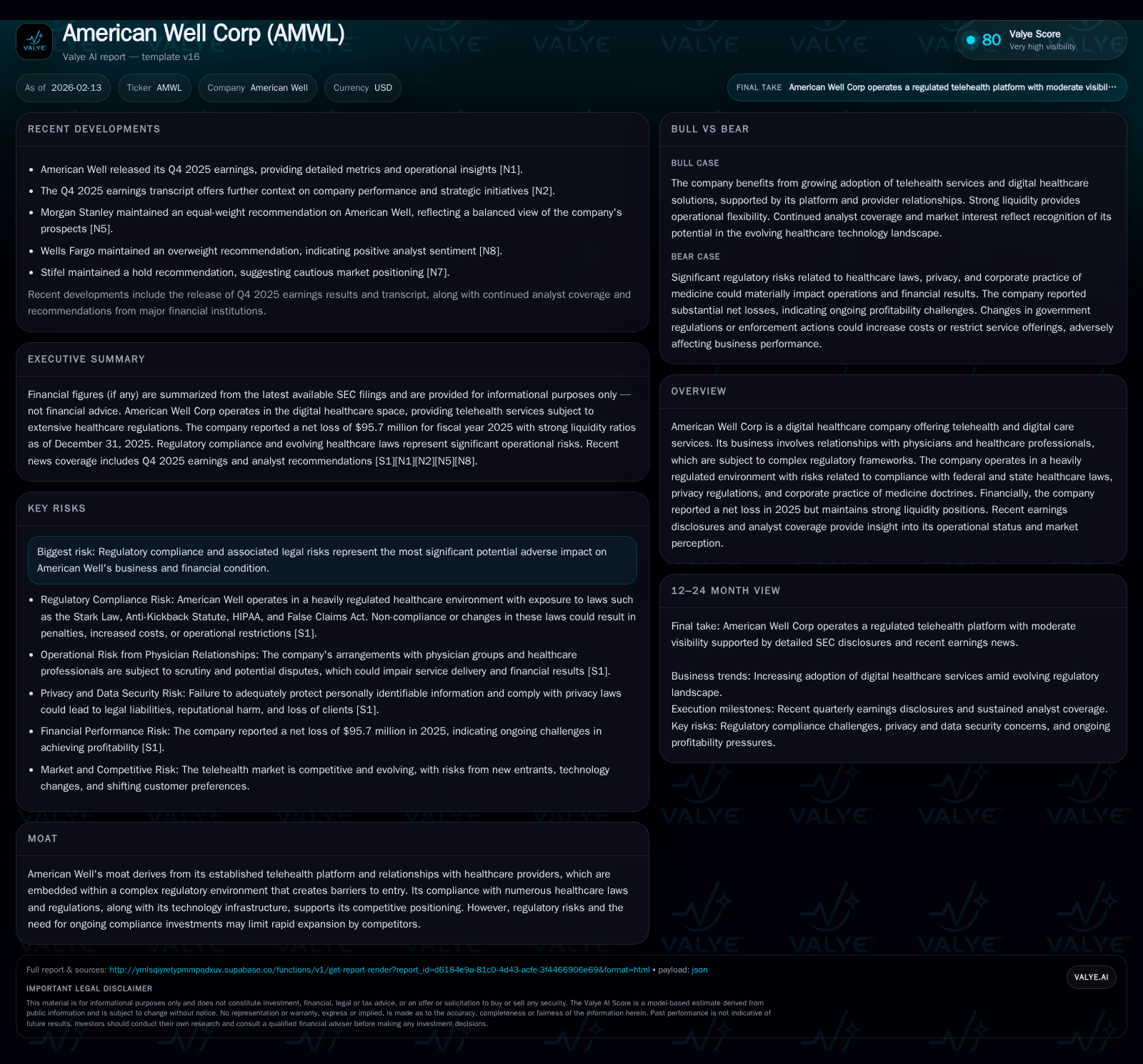
American Well Corp operates a comprehensive telehealth platform embedded with a broad network of health systems and payers, navigating a challenging and evolving regulatory environment. Recent divestitures, including the telepsychiatry business, illustrate a strategic pivot towards its scalable Amwell Platform software offerings to improve profitability. Despite sustained net losses exceeding $95 million in 2025, the company maintains robust liquidity supported by strong cash reserves and a solid current ratio. Its competitive positioning rests on integrated technology solutions, extensive client relationships, and ongoing adaptation to regulatory frameworks shaping digital healthcare delivery.
Strategic Streamlining: Divestitures Sharpen Focus on Core Platform
American Well’s January 2025 sale of its telepsychiatry business via Aligned Telehealth marks a decisive shift toward concentrating resources on its Amwell Platform’s scalable software offerings [S1]. This divestiture, finalized with a cash payment upfront plus additional contingent payments tied to future revenues, reflects management's recognition that peripheral service lines—specifically telepsychiatry delivered through hospitals and correctional facilities—no longer aligned with the company's aspirations for profitable growth. Removing these capital- and labor-intensive segments permits more focused investment into platform innovation and customer expansion efforts.
Additionally, the dissolution of the longstanding joint venture with Cleveland Clinic under CCAW JV LLC during 2025 exemplifies adaptive governance. Rather than ceasing collaboration outright, American Well transitioned care service delivery from joint venture operations back to strategic partnership models while maintaining virtual second opinion services [S1]. This structural realignment demonstrates flexibility in operating within highly regulated care delivery frameworks without sacrificing key clinical capabilities.
Regulatory Terrain: Compliance Risks Shaping Operations
Amwell’s business thrives at the confluence of technology and clinical care, a nexus burdened by multifaceted regulatory oversight. The company confronts an evolving array of federal and state laws governing corporate practice of medicine doctrines, physician licensure requirements, online prescription regulations, privacy mandates such as HIPAA, and employment classification rules [S1]. These areas carry risk not only because noncompliance may invite penalties or litigation but also due to potential disruptions if American Well must modify or curtail offerings to align with shifting statutes.
For example, the arrangement with AMG (Affiliated Medical Group) providing clinical services exposes AMWL to scrutiny around fraud and abuse laws that could necessitate costly operational restructuring [S1]. Moreover, regulatory uncertainties may compel heightened spending on compliance infrastructure, audits, and legal defenses—expenses subtracting from margins during an already challenging path toward profitability. The complexity is compounded by jurisdictional variations which could force service withdrawals from certain markets if adherence is untenable.
Financial Snapshot: Liquidity Strength Amid Continuing Losses
Despite systemic fiscal pressures within telehealth broadly, American Well reported a net loss exceeding $95 million for the full year 2025 [F1]. However, this headline masks an encouraging liquidity posture underpinning short-term stability. The company ended December 2025 with $182 million in cash and equivalents alongside $246.7 million total current assets against $73.2 million current liabilities—a calculated current ratio of approximately 3.37 [F1]. Such metrics highlight sufficient operating runway that enables continued investment in technology development and regulatory navigation.
Revenue figures trailing prior years suggest growth challenges remain; however, management gestures toward disciplined spending combined with strategic divestitures as routes to improved margin profiles [N1][S1]. Monitoring how incremental cash flow trends unfold post-divestiture will be crucial for stakeholders assessing sustainability.
Client Ecosystem: Embedded Networks Across Health Systems and Payers
Amwell’s entrenched client network distinguishes it from emerging pure-play competitors. As of year-end 2025, the firm powered digital care for roughly 50 health plans representing over 90 million covered lives plus approximately 80 leading health systems nationwide [S1]. Though health system customers contracted from 107 to 88 between recent years—possibly reflecting industry consolidation or portfolio pruning—these clients comprise substantial breadth across inpatient and outpatient settings.
Such embeddedness allows tailored deployment of the Amwell Platform across disparate healthcare systems facilitating virtual visits scaling up to millions annually [S1]. This extensive footprint fortifies barriers for new entrants needing clinical partnerships while enabling data-driven insights critical for iterative product enhancement.
Technology and Service Integration: The Amwell Platform’s Competitive Edge
At its core lies the Amwell Platform—a modular subscription-based SaaS environment adaptable over time allowing clients to incrementally add digital care modules aligned with evolving needs [S1]. This architectural agility differentiates American Well amid prevailing demands for interoperability across in-person, virtual, and automated channels.
Complementing software are patient-facing Carepoint devices which enable remote vital monitoring bridging hospital-home settings [S1][N2]. This hardware-software convergence empowers comprehensive hybrid care solutions that deepen provider-patient engagement beyond episodic interactions—a notable competitive advantage in fostering longitudinal relationships.
Furthermore, professional services rendered on fee-for-service bases supplement platform deployments supporting customization and implementation expertise. Together these elements yield an integrated offering designed to drive better clinical outcomes at optimized cost structures.
Market Dynamics: Competitive Pressures and Industry Developments
The telehealth industry has witnessed rapid expansion catalyzed by consumer demand shifts accelerated during recent years’ public health crises. Concurrently new entrants like Hims & Hers are broadening platform-led digital healthcare access targeting niche segments with vertically integrated offerings encompassing mental health, primary care screening, and more [N3].
For American Well this translates into intensified competitive headwinds pressing innovation acceleration coupled with ongoing regulatory vigilance. Maintaining differentiation demands continuous enhancement of multi-modal care delivery capability balanced against cost-effective compliance investment—a high-wire act where missteps could erode market share or invite sanctions.
Hence industry developments underscore the imperative for AMWL’s strategic realignments including honing platform features while leveraging scale advantages inherent in deep payer-provider integrations.
Governance and Partnerships: Evolving Collaborations and Impact
Evolving governance trends surfaced notably via cessation of the Cleveland Clinic joint venture without discontinuing cooperation entirely [S1]. This transition illustrates sophisticated partnership models evolving under regulatory constraints allowing operational simplification but retention of clinical expertise pathways.
Such changes also signal readiness to adapt contractual frameworks or service modalities responsive to shifting laws or market conditions without wholesale disruption. In tightly controlled healthcare ecosystems such agility is essential for sustaining service continuity while moderating financial exposure.
Evaluating future partnership initiatives will be pivotal to understanding how American Well navigates potential expansion opportunities or alliance reconfigurations shaped by competitive positioning imperatives.
Outlook and Growth Trajectory: Balancing Innovation with Regulation
Forward-looking commentary from management reveals measured optimism tempered by prudence given regulatory complexities coupled with challenging profitability landscapes [N1][N2][S1]. Investment focus gravitates toward refining platform scalability alongside disciplined cost management aimed at rendering digital health solutions more mainstream within large-scale provider networks.
Risks remain prominent particularly relating to ongoing compliance expenditures and legal uncertainties surrounding physician practice arrangements through AMG affiliations. Nonetheless the company’s strategic pivots—highlighted by divestitures reducing peripheral distractions—suggest calculated repositioning committed to sustainable growth paths rather than aggressive expansion risking regulatory friction.
In aggregate American Well appears positioned to leverage longstanding institutional ties within healthcare while innovating modular technology stacks responsive both commercially and legally—representing a nuanced player navigating one of healthcare’s most dynamic frontiers.
This analysis is based on publicly available information including SEC filings and industry reports as cited. It does not constitute investment advice or recommendations.
Disclaimer: This is research-only, informational analysis and not investment advice. It may include AI-generated interpretation and general industry context. Always verify important details using primary sources.

Comments