
Crocs Inc: Brand Revival and Strategic Diversification Amid Margin Pressures and Trade Risks
Crocs’ strong Q4 earnings pulse contrasts with broader operational challenges presented by HEYDUDE struggles and rising tariff costs.
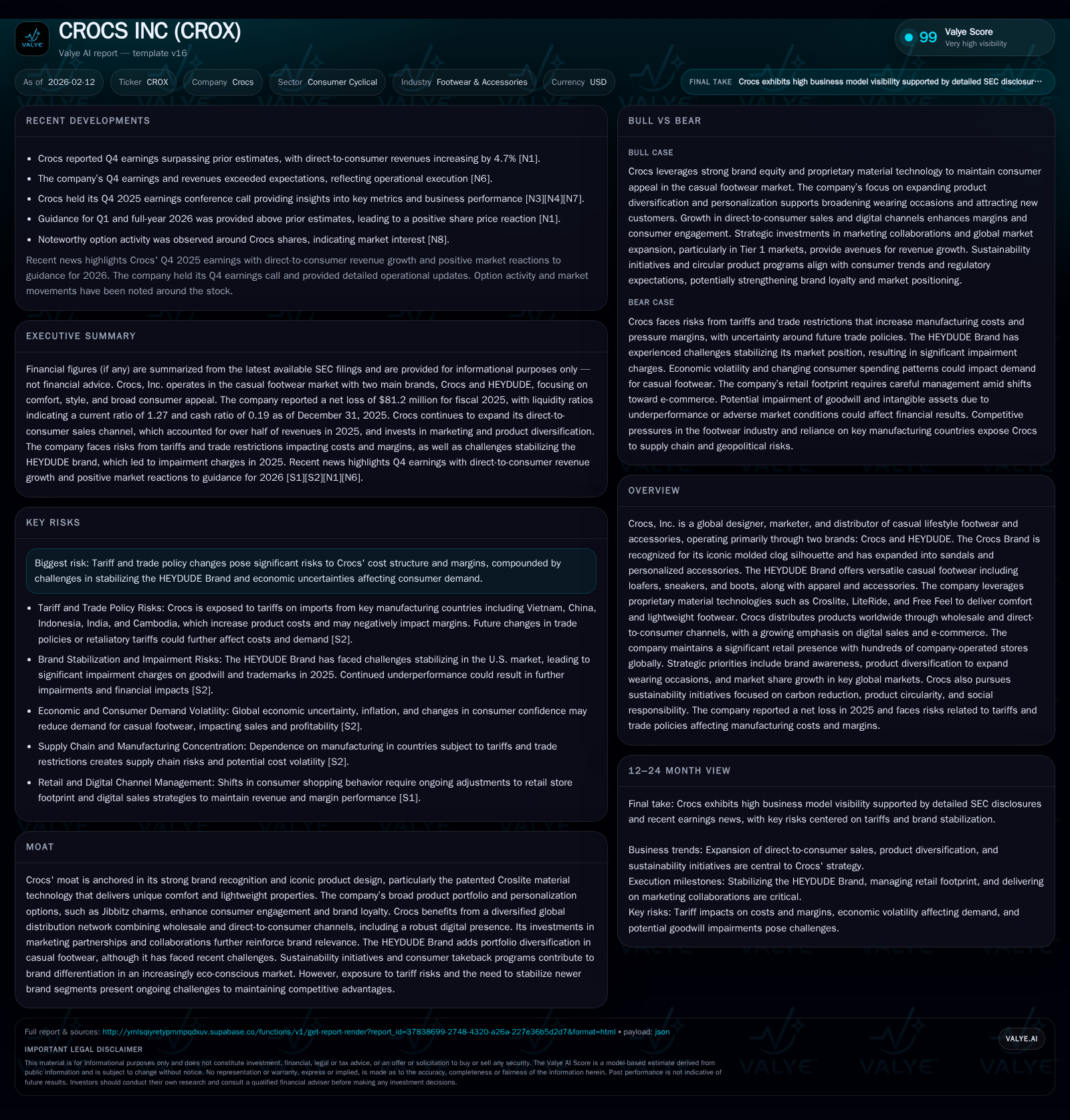
In early 2026, Crocs Inc. surprised markets with a better-than-expected Q4 earnings report driven by solid direct-to-consumer growth and brand momentum. Despite this, underlying financial results revealed persistent net losses influenced by margin compression and elevated operating costs. The company’s strategic efforts focus on expanding its iconic clog-based portfolio, integrating new lifestyle categories, reinforcing digital channels, and stabilizing the HEYDUDE brand amid uneven performance. Meanwhile, rising U.S. tariffs on key manufacturing countries introduce significant supply chain challenges that could pressure margins further. Crocs continues to emphasize innovation through proprietary materials and personalization while targeting global Tier 1 markets to support long-term growth.
From Iconic Clogs to New Footwear Frontiers: Crocs Brand Evolution
Crocs’ transformation beyond its trademark molded clog has been deliberate and multifaceted. At its core lies the Classic Clog — an unmistakable design coupled with patented Croslite™ technology that delivers unparalleled lightweight comfort. Over recent years, the company has broadened this foundation by developing complementary footwear silhouettes such as sandals and extending into lifestyle categories. This expansion taps into growing consumer desires for personalized fashion experiences; Jibbitz™ charms remain a standout example, allowing wearers to customize their clogs with vibrant accessories that fuse self-expression with tradition.
Simultaneously, Crocs pursues diversification within its categories — rolling out new colors, graphic designs, licensed collaborations, and refreshed silhouettes — all framed to preserve the clutch of its iconic DNA while appealing to younger demographics and evolving style sensibilities [S1][N14]. This approach strengthens brand saliency in an increasingly cluttered casual footwear market.
Financial Pulse Check: Earnings Beat vs. Net Loss Puzzle
Crocs reported a robust Q4 2025 earnings beat that lifted investor sentiment significantly. Direct-to-consumer revenues grew by approximately 4.7%, reflecting relative strength in digital channels and rich engagement at retail stores [N1][N3]. Yet beneath this topline vigor lurked the persistent challenge of profitability: the company booked a net loss totaling $81.2 million for the full year ending December 31, 2025 [F1].
The dichotomy stems largely from escalating operating costs including marketing expenditures deploying collaborations and activations to maintain brand momentum, as well as tariff-driven inflation feeding through supply chains (discussed later). The wholesale channel also maintained significance but faced margin squeezes amid competitive pricing dynamics.
This juxtaposition underscores an important inflection point for Crocs — scaling revenues is achievable given strong brand resonance but converting volume into sustained bottom-line profitability remains a work in progress.
Digital Growth & Retail Footprint: Reevaluating Channel Strategy
Crocs approaches channel strategy with a hybrid mindset leveraging both broad physical retail presence (hundreds of company-operated stores worldwide) alongside aggressive investments to expand digital penetration. This duality addresses changing consumer buying habits favoring online convenience yet values immersive brick-and-mortar experiences.
Digital sales constitute a growing share of overall revenue via e-commerce platforms operated directly or through third-party marketplaces [S1][N8]. The flexibility gained through digital also supports rapid personalization offerings — such as immediate Jibbitz customization during purchase — capitalizing on consumer trends towards bespoke products.
However, maintaining physical footprints incurs notable fixed costs amidst variable consumer traffic patterns requiring careful inventory management and store portfolio optimization moving forward.
HEYDUDE’s Stabilization Challenge: A Brand at Crossroads
Complementing Crocs’ core business is the HEYDUDE Brand targeting adjacent casual footwear segments such as loafers (Wally), slip-ons (Wendy), sneakers, boots, and sandals focused largely on versatility and ease of wear.
Despite intrinsic potential and distinct product attributes emphasizing comfort similar to its sister brand but with different style DNA, HEYDUDE has encountered headwinds recently particularly within the U.S. market [S1][S2]. Sequential quarterly results show ongoing efforts are needed to stabilize sales volumes and rebuild marketing presence.
Management continues committing resources towards brand awareness campaigns including collaborations designed to rekindle interest while pursuing measured diversification across product lines within HEYDUDE’s icon silhouettes.
Tariff Troubles and Supply Chain Pressures: Navigating Rising Costs
Among the most salient risks on Crocs' horizon are escalating tariffs imposed by the U.S. government on key manufacturing hubs — Vietnam (20%), China (30%), Indonesia (19%), India (50%), Cambodia (19%) — countries constituting the backbone of Crocs’ global production network [S2].
These measures sharply elevate landed product costs which have not been fully offset yet by price increases without harming consumer demand elasticity. This squeeze creates a precarious balancing act between sustaining affordable pricing power while preserving margin structures.
Exacerbating issues are potential retaliatory tariffs from affected countries impacting exports or raw material costs upward shifts exacerbated by geopolitical uncertainty; although future trade policy shifts remain opaque, the specter of further supply chain disruption persists.
Global Market Penetration: The Tier 1 Geography Focus
Crocs concentrates international sales efforts primarily across six Tier 1 markets: China, India, Japan, South Korea, the U.S., and Western Europe — accounting for close to 49% of Crocs Brand revenues in 2025 up from prior years indicating increasing success abroad [S1].
This geographic prioritization reflects deliberate allocation of marketing capital and product innovations tailored per region’s unique cultural preferences and economic conditions. Sustained investment supports penetration while mitigating regional competition risks.
International expansion poses complexities regarding trade logistics but also offers diverse revenue streams cushioning domestic market vulnerabilities.
Innovation Through Materials and Personalization: The Croslite Advantage
Technological innovation remains central to Crocs’ value proposition. At the heart is Croslite™, an exclusive closed-cell resin material that imparts lightweight cushioning unmatched by typical synthetic or leather counterparts [S1]. Recent innovations have expanded this repertoire with LiteRide ™ foam inserts introducing enhanced softness without sacrificing durability alongside Free Feel™ constructions elevating flexibility.
Such proprietary IP journeys beyond mere technology; it interlocks with customer loyalty via product comfort perceptions heavily influencing repeat purchases.
Personalization tools like Jibbitz™ charms further build emotional connection differentiating Crocs from commoditized footwear vendors.
Outlook & Guidance: What Management Foresees for FY26
In its latest investor communications following Q4 earnings release, management outlined guidance that notably exceeds Wall Street consensus for both Q1 and full-year fiscal 2026 revenue forecasts highlighting confidence in brand strength and channel growth trajectories [N14].
Nonetheless, caveats accompany optimism including recognition of tariff impacts pressuring margins plus lingering uncertainties related to macroeconomic conditions including inflationary forces affecting discretionary spend.
Additionally, HEYDUDE’s ongoing turnaround remains pivotal to realizing full portfolio synergies complementing core Crocs business expansion.
Sustainability Initiatives: Aligning With Consumer Conscience
Crocs integrates sustainability activities increasingly into its corporate narrative addressing consumer expectations around environmental stewardship [S1]. Initiatives include consumer product takeback programs enabling recycling efforts aligned with circular economy principles designed to reduce waste footprint.
Such programs serve dual purposes: demonstrating genuine ESG commitment important for long-term brand health while differentiating Crocs within an industry facing heightened scrutiny over sustainability practices.
Valuation Implications and Investment Thesis Considerations
Synthesizing Crocs' performance profile reveals a company in pivotal transition — powered by revitalized brand equity yet contending with significant margin headwinds amplified by external tariff-driven cost pressures.
Financial metrics showing solid revenue advancement juxtaposed against continued net losses highlight operational leverage constraints requiring resolution either through pricing power improvement or cost structure efficiencies.
The global footprint concentrated in Tier 1 markets supplemented by strong digital acceleration underscores scalable growth avenues; meanwhile sustained innovation coupled with successful HEYDUDE stabilization would enrich long-term revenue diversification.
From an industry vantage point analysis, Crocs occupies a defensible niche bolstered by patented materials technologies uncommon among peers who largely compete on fashion cycles rather than functional comfort enhancements.
At the same time geopolitical trade tensions introduce volatility necessitating vigilant supply chain management adaptations going forward.
In totality, stakeholders should monitor evolving tariff regimes closely alongside execution progress in HEYDUDE revitalization as key informs shaping Crocs’ trajectory over FY26 horizon.
Disclaimer: This report does not constitute investment advice or recommendations. It is intended solely for informational purposes based on publicly available data as of February 12, 2026. Investors should conduct their own due diligence before making any financial decisions.
Disclaimer: This is research-only, informational analysis and not investment advice. It may include AI-generated interpretation and general industry context. Always verify important details using primary sources.

Comments