
Wabtec’s Contract Wins and Earnings Spotlight a Durable Rail Technology Moat Amid Sector Challenges
Recent multi-hundred-million-dollar contracts with CSX and Union Pacific underscore Wabtec's moat as its Q4 earnings beat navigates rail industry cyclicality and margin pressures.
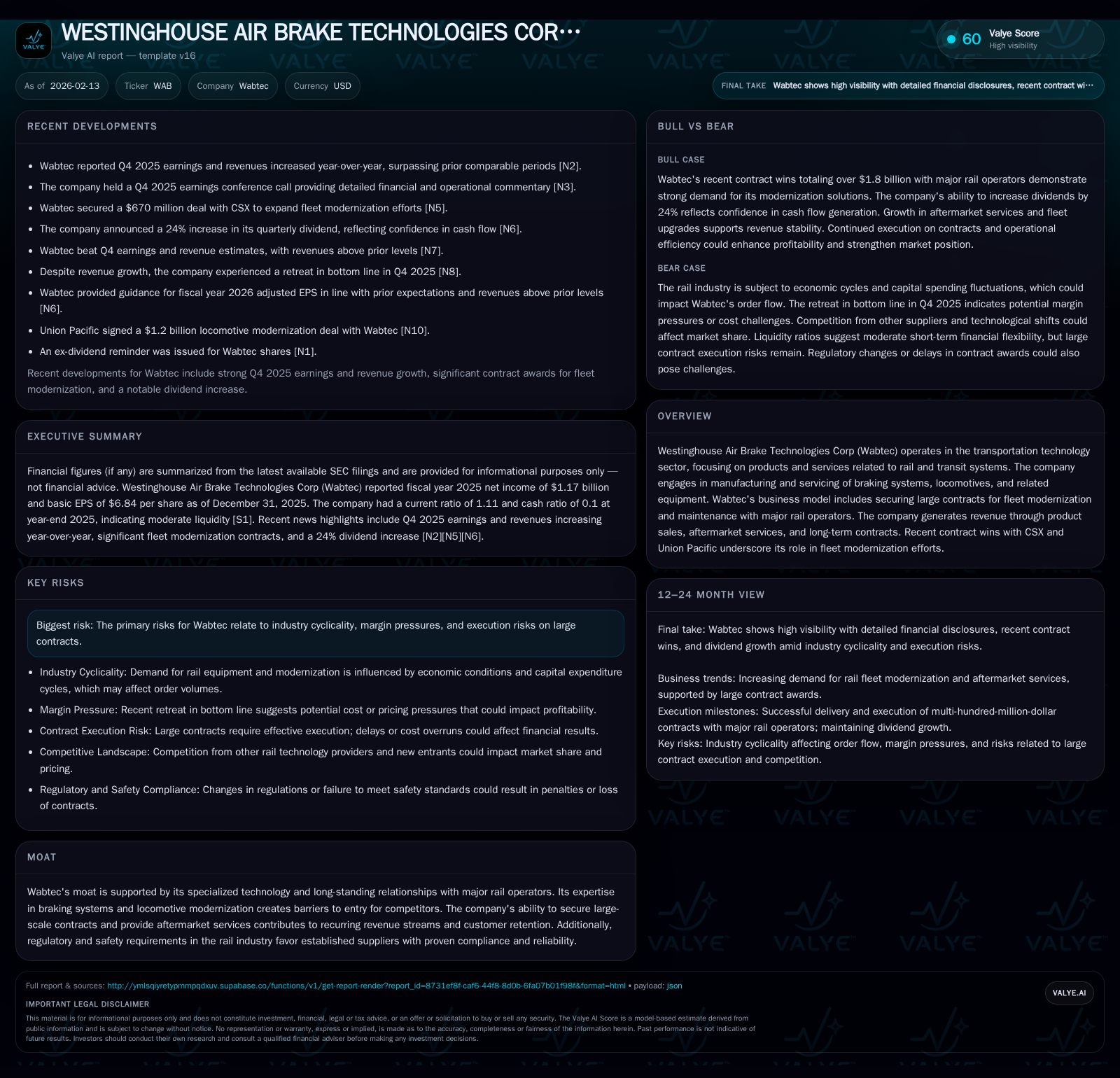
Westinghouse Air Brake Technologies Corp (Wabtec) has reinforced its position as a leading rail technology provider through sizable contracts totaling nearly $1.9 billion from CSX and Union Pacific. These deals highlight Wabtec’s critical role in railroad fleet modernization, contributing to robust revenue growth evident in its Q4 2025 earnings beat despite prevailing sector headwinds. Wabtec’s moat stems from its specialized braking technology, longstanding customer relationships, and regulatory alignment that create barriers for competitors. While the company faces risks tied to execution challenges and margin pressure, its recurring aftermarket services and healthy dividend increase signal operational resilience and shareholder focus.
Modernizing Railroads: The Foundation of Wabtec’s Growth
Wabtec operates at the nexus of transportation technology focused on rail and transit system modernization. The company’s manufacturing and servicing of braking systems along with locomotive refurbishments form the backbone of its business model [valye_report_excerpt]. This core mission recently manifested in two substantial contract wins: a $670 million agreement with CSX to expand its fleet modernization program [N7], followed closely by a $1.2 billion locomotive modernization deal with Union Pacific [N8]. These orders not only add significant revenue but also reinforce Wabtec’s strategic role amid an increasing push by rail operators to upgrade aging fleets for efficiency and compliance reasons.
These contracts are emblematic of wider industry trends where capital-intensive investments focus on extending asset lifecycles while integrating advanced technologies for improved performance. Such large-scale fleet modernizations enable Wabtec to secure multi-year revenue visibility while cementing partnerships central to its growth narrative.
Decoding the Moat: Technology, Relationships, and Regulatory Barriers
Wabtec’s competitive advantage—or moat—rests fundamentally on specialized technological expertise in braking systems integrated into locomotives and transit applications [valye_report_excerpt]. This expertise is paired with deep-rooted relationships developed over decades spanning major North American rail operators and global transit authorities, creating strong customer fidelity difficult for new entrants to replicate.
Additionally, the rail industry’s stringent regulatory environment concerning safety standards serves as a natural barrier to entry. Wabtec’s proven track record of compliance builds trust with customers who must adhere to government-mandated equipment certifications. This confluence of technology leadership, customer integration, and regulatory adherence undergirds recurring aftermarket service contracts that drive stable revenue streams beyond the initial product sales cycle [S1].
Big Contracts Close-Up: CSX and Union Pacific Deals as Growth Catalysts
The recent contracts with CSX ($670M) [N7] and Union Pacific ($1.2B) [N8] stand out not only for their substantial size but also for what they indicate about operator confidence in Wabtec’s solutions amid evolving fleet needs. These deals accelerate momentum in modernizing locomotives that are central to operational efficiency gains in freight movement.
Together totaling nearly $1.9 billion, these agreements likely represent multi-year commitments providing important backlog visibility that supports top-line stability against cyclical order fluctuations common in capital goods markets. Moreover, these partnerships may create embedded relationships fostering upsell potential in aftermarket servicing or future retrofit opportunities.
Earnings Above Estimates: Navigating Industry Cyclicality and Margin Pressures
Despite challenging macroeconomic factors often affecting heavy industrial sectors, Wabtec delivered a Q4 2025 earnings report that surpassed consensus estimates for both revenue and adjusted earnings per share [N1][N3][N4]. Revenues increased year over year, driven by solid execution across newly signed contracts.
However, the bottom-line picture is nuanced as net income saw a retreat compared to prior periods reflecting persistent margin pressures likely stemming from raw material costs inflation, supply chain complexities, or contract execution overheads [N12]. This dichotomy underscores operational resilience while signaling areas management must address to protect profitability amid sector headwinds.
The Dividend Hike Signal: Shareholder Value Amid Operational Challenges
In conjunction with steady earnings guidance aligned largely with market expectations, Wabtec announced a noteworthy 24% increase in its quarterly dividend rate [N11][N13]. Such an outsized hike signals management’s confidence in sustainable free cash flow generation despite ongoing industrial volatility.
This move also reflects a strategic priority on returning value to shareholders consistently while balancing prudent investment back into modernization initiatives necessary for long-term competitiveness [N10]. It emphasizes that operational challenges have not dampened commitment to shareholder-friendly policies.
Back-End Strength: Aftermarket Services and Recurring Revenue Streams
A critical pillar supporting Wabtec’s financial stability is its extensive aftermarket services business [valye_report_excerpt][S1]. Service contracts encompassing maintenance, upgrades, spare parts supply, and technical support generate recurring revenues that tend to be more resilient during periods when new equipment orders may wane.
This stable income source helps smooth cyclicality inherent in manufacturing segments while deepening customer relationships through ongoing engagement beyond initial sales transactions. It plays an essential role in preserving margins and securing repeat business crucial to sustaining the company’s moat.
Potential Execution Risks: What Could Trip Up Wabtec’s Momentum?
No discussion of Wabtec’s outlook is complete without acknowledging risks tied principally to industry cyclicality which can impact order timing and volume. Furthermore, margin pressure remains an ongoing concern stemming from cost inflation or inefficiencies during large-scale contract fulfillment [valye_report_excerpt].
The inherent complexity in executing extensive modernization programs means delays or cost overruns could impair profitability or erode customer goodwill if not managed carefully. Such risks require vigilant operational oversight yet do not detract from the structural advantages underpinning the company’s market-leading position.
Financial Health Snapshot: Liquidity and Balance Sheet Considerations
As of the latest filings ending December 31, 2025, Wabtec maintains a current ratio of approximately 1.11 (Current assets of $5.69 billion versus current liabilities near $5.15 billion) indicating reasonable short-term liquidity coverage [F1][S1]. Cash and cash equivalents stand at $514 million providing additional financial flexibility to fund working capital needs or strategic investments without undue pressure.
This financial footing lends credibility to management’s ability to advance modernization projects while preserving dividend policies amidst sector cyclicality or unexpected market shifts.
Looking Ahead: Guidance, Industry Trends, and Investor Sentiment
Guidance for FY26 reflects adjusted EPS expected broadly inline with estimates alongside revenues anticipated above consensus levels pointing toward continued demand strength from fleet modernization activities [N11]. This forecast aligns well with broader market views highlighting persistent infrastructure investment trends driving rail equipment upgrades nationally.
Investor sentiment has responded favorably as demonstrated by WAB rallying above average analyst price targets in recent sessions [N14]. This momentum reflects recognition of Wabtec's durable competitive positioning cemented through key contracts coupled with resilient earnings performance navigating external challenges.
Conclusion
Wabtec exemplifies a company whose specialized technology platform combined with entrenched customer relationships forms a durable moat protecting it amid cyclical fluctuations typical of heavy transportation sectors. Its recent contract wins totaling nearly $1.9 billion underscore both strategic relevance in rail fleet renewal programs and ability to capture growth opportunities shaping fiscal year outcomes. Execution risks remain real but appear manageable within an overall framework supported by recurring aftermarket services revenue streams alongside a healthy balance sheet position highlighted by robust liquidity ratios. Management's significant dividend increase conveys confidence that operational results can sustain shareholder returns even as margin pressures persist. While macro factors warrant prudence, Wabtec’s fundamentals illustrate how entrenched expertise backed by regulatory adherence delivers resilient performance at the intersection of transportation innovation and infrastructure modernization.
This report is an informational analysis based on public data sources and does not constitute investment advice.
Disclaimer: This is research-only, informational analysis and not investment advice. It may include AI-generated interpretation and general industry context. Always verify important details using primary sources.

Comments