Freeport-McMoRan Inc.: Navigating Operational Setbacks and Market Cycles in the Copper Sector
An in-depth analysis of FCX's resilience amid the Grasberg mine incident, commodity volatility, and geopolitical complexities.
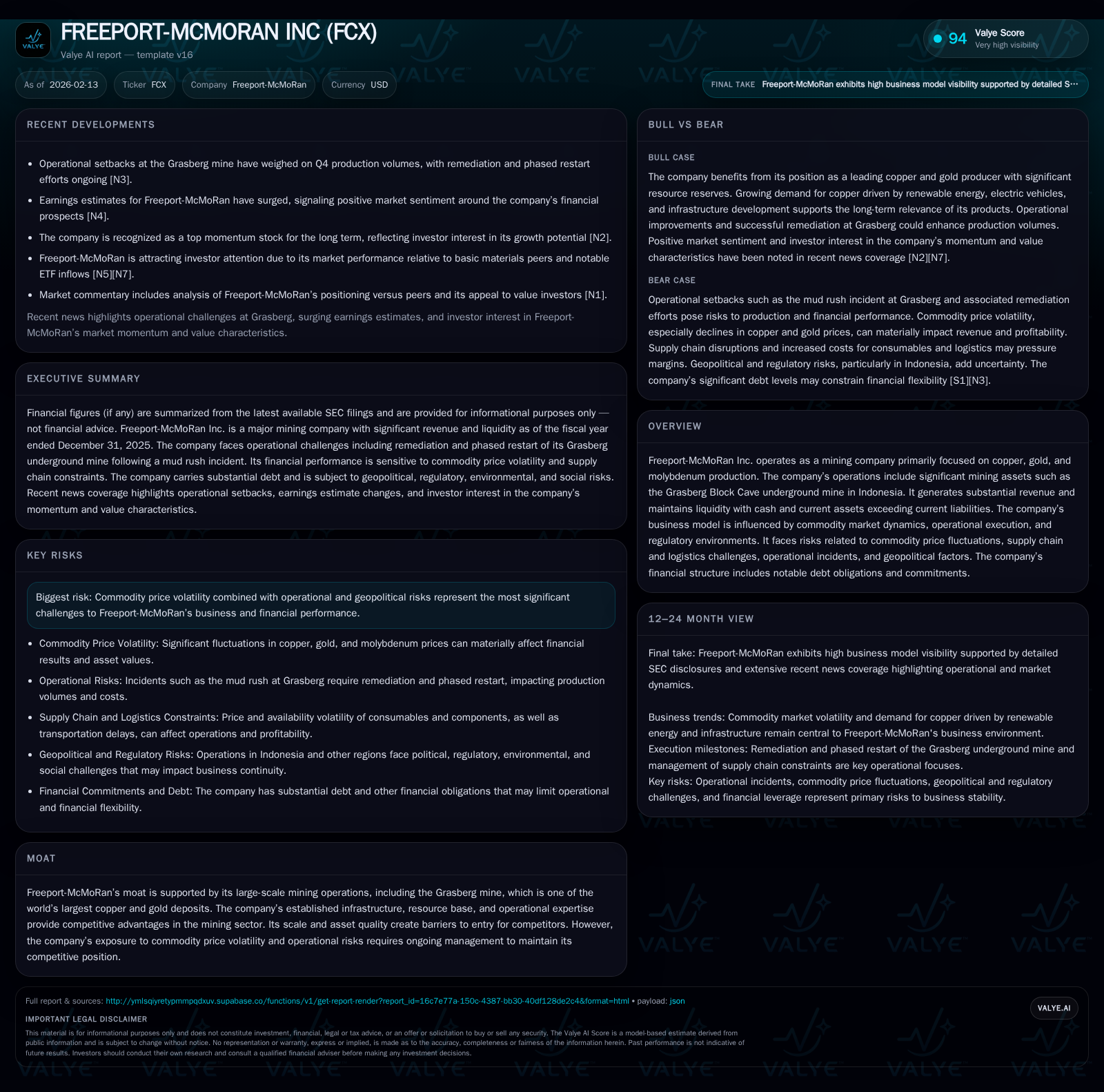
Freeport-McMoRan (FCX), a major player in copper, gold, and molybdenum mining, faced a significant operational disruption following a mud rush incident at its flagship Grasberg Block Cave mine in September 2025. Despite near-term production challenges, the company's substantial scale, extensive infrastructure, and ongoing remediation efforts underpin its competitive edge. Commodity price dynamics remain pivotal to revenue swings, while geopolitical factors in Indonesia add layers of uncertainty to long-term planning. FCX’s solid liquidity profile and active capital strategy support financial stability as it balances growth aspirations with inherent mining sector risks.
The Grasberg Incident: A Lens on Operational Challenges
September 2025 marked a critical juncture for Freeport-McMoRan with a mud rush incident at the Grasberg Block Cave underground mine in Indonesia. This safety event curtailed production volumes sharply toward year-end, as the company embarked on phased remediation and restart efforts [S1][N4]. The phased ramp-up has since been incremental rather than immediate, reflecting the complexity of restoring operational integrity underground while safeguarding personnel. These disruptions underscore inherent risks tied to large-scale underground mining—particularly where geological instability interacts with operational execution.
Management disclosures highlight an ongoing focus on engineering enhancements and safety protocols aimed at preventing recurrence [S1]. However, near-term output remains constrained relative to prior baselines, impacting fourth quarter volumes materially [N4]. The incident lays bare the delicate balance required between maximizing throughput and ensuring sustainable operational safety—a tension central to Freeport’s risk landscape.
Copper Supply Dynamics and Commodity Price Impact
Copper prices continue to dictate Freeport’s financial fortunes given the metal’s pivotal role in global electrification, infrastructure expansion, and clean energy deployment. Post-incident production limitations at Grasberg collide with tight market fundamentals characterized by constrained supply from other sources and growing demand from renewable energy sectors [S1][N2][N3]. Analysts have recently revised earnings estimates upward, anticipating recovery benefits alongside sustained copper demand momentum [N2].
Yet, volatility is an ever-present factor; price swings can rapidly erode margin stability given the capital-intensive nature of mining operations. Operational variability at Grasberg contributes additional supply-side uncertainty that markets digest alongside macroeconomic cues. In parallel, molybdenum and gold outputs provide diversification but remain secondary revenue contributors relative to copper [S1].
Financial Fortitude: Liquidity, Debt, and Capital Strategy
Despite operational headwinds, Freeport exhibits strong liquidity health with current assets totaling approximately $13.8 billion against $6 billion in current liabilities—a current ratio of 2.29—offering a cushion for near-term obligations [F1]. Cash and equivalents stand robust at $3.8 billion as of end-2025 [F1], providing ready capital flexibility amid remediation costs and capital expenditure programs.
The company carries significant debt levels reflective of prior acquisitions and development spending [S1], but operating cash flows support servicing these obligations without immediate distress signals. Furthermore, Freeport continues to deploy capital thoughtfully with investments aimed at sustaining long-life asset productivity while maintaining dividend distributions that appeal to income-focused stakeholder bases [S1][N7]. This balancing act between growth investment and returning capital underscores prudent financial stewardship.
Moat in Focus: Scale, Infrastructure, and Competitive Position
Freeport-McMoRan's competitive moat is anchored by its immense scale—most notably through the Grasberg mine which ranks among the world’s largest copper-gold deposits—and established infrastructure foundations including smelting and refining capabilities [valye_report_excerpt][S1]. This scale affords cost advantages through economies of scale and access to high-grade ore bodies that are not easily replicable by smaller peers.
Operational expertise accumulated over decades further strengthens entry barriers amid ongoing industry consolidation challenges. While cyclical market conditions pressure margins periodically, Freeport's asset base supports sustained production capacity unlike fringe players with less diversified portfolios. Continuous technology integration into mining processes also enhances unit cost competitiveness over time.
Geopolitical and Regulatory Terrain in Indonesia
Indonesia represents both an opportunity and a complexity layer for Freeport’s operations. The company operates under a special mining business license (IUPK) that currently extends through 2041. However, the prospect of renewal or extension remains uncertain due to evolving national policies emphasizing resource nationalism and community engagement requirements [S1].
Social-political dynamics pose risks including potential renegotiations or compliance mandates that could alter cost structures or operational scope. Freeport’s ability to maintain constructive government relations while meeting environmental standards is vital to securing long-term operational licenses [S1]. Geopolitical tensions also elevate risk premiums factored into valuation assumptions by investors globally.
Investor Sentiment and Market Positioning Amid Momentum
Recent months have seen an uptick in investor interest toward FCX shares reflected by notable ETF inflows targeting copper exposure alongside basic materials sectors [N11]. Momentum stock characterizations coexist with value investing narratives given Freeport's blend of cyclical upside potential and strong asset backing [N3][N12].
Comparisons with peers such as Southern Copper Corporation (SCCO) reveal outperformance in share price appreciation year-to-date amid broader commodity rallies [N5][N10]. Wall Street bulls express cautious optimism premised on recovery trajectories post-Grasberg incident balanced against macroeconomic uncertainties impacting industrial metals demand [N13]. This dual sentimentistic view encapsulates the challenges of modeling risk-reward profiles accurately given sudden supply shocks juxtaposed with structural demand drivers.
Forward-Looking Outlook: Sustainability and Growth Catalysts
Freeport positions sustainability at the core of its forward outlook aiming for climate targets aligned with a 2030 roadmap and aspirations toward net zero carbon emissions by 2050 [S1]. Responsible sourcing initiatives bolster reputational moats in an era where Environmental, Social & Governance (ESG) metrics shape capital allocation preferences across global markets.
Technology adoption—such as automation advancements underground—and exploration programs signal organic growth ambitions beyond immediate Grasberg remediation efforts. These initiatives potentially unlock new reserves or improve recovery rates contributing additional future optionality. Public commitments reinforce alignment with broader investor demands for transparency around environmental impact mitigation alongside profitability objectives.
Balancing Risks: Operational Hurdles vs Growth Opportunities
The multifaceted risk profile spans commodity price swings exacerbated by global economic cycles; operational setbacks exemplified by technical incidents at critical mines; regulatory uncertainties particularly in Indonesia; supply chain constraints; and environmental liabilities inherent to large-scale mining enterprises [S1].
Freeport acknowledges these interlocking risks explicitly within filings emphasizing their potential material impact while detailing management’s layered mitigation frameworks encompassing insurance coverages, engineering controls, stakeholder engagement strategies, and diversified geographic footprints where possible [S1]. Such comprehensive risk management remains pivotal in stewarding shareholder value through unpredictable external shocks.
Valuation Insights: Comparing FCX Against Peers
From a valuation standpoint, Freeport trades alongside competitors such as Southern Copper Corporation (SCCO) with metrics reflecting both premium positioning due to asset quality as well as discounts linked to cyclical exposure [N1][N10]. Relative performance indicators suggest FCX has outpaced certain peers during recent commodity upswings but continues to face volatility risks impacting short-term multiples.
For value investors seeking entry points within materials sectors driven by industrial metal demand surges, FCX presents a nuanced proposition—combining operational scale advantages with event-driven price sensitivity requiring active monitoring of production recoveries alongside macro inputs.
Conclusion: Navigating Complexity Toward Long-Term Value
Freeport-McMoRan finds itself at a strategic crossroads shaped by the recent Grasberg operational disruption layered atop complex commodity markets and geopolitical challenges intrinsic to its Indonesian footprint. Its formidable asset base anchored by one of the globe’s premier copper-gold deposits provides durable competitive advantages securing long-run viability despite episodic setbacks.
Financially sound liquidity positioning paired with disciplined capital deployment supports resilience enabling recovery phases while pursuing designated sustainability goals that align increasingly with stakeholder expectations.[valye_report_excerpt][S1][N7]
Investors closely tracking operational progress coupled with broader market fundamentals will likely view Freeport through a lens balancing cyclicality against structural growth catalysts inherent in global decarbonization trends driving copper demand upward. Prudence combined with adaptability will define Freeport's trajectory navigating complexities toward sustainable value creation.
This analysis is based exclusively on publicly available information including company reports filed with the SEC (Forms 10-K, 10-Q), recent industry news coverage from Nasdaq sources issued through February 2026, and proprietary summaries from Valye News research teams as of February 13, 2026. It does not constitute investment advice or recommendations.
Disclaimer: This is research-only, informational analysis and not investment advice. It may include AI-generated interpretation and general industry context. Always verify important details using primary sources.

Comments