
Group 1 Automotive: Navigating Tariffs, Market Shifts, and Operational Resilience in Automotive Retail
Group 1 Automotive reports robust revenue growth amid profit pressures reflecting supply chain challenges and trade policy impacts.
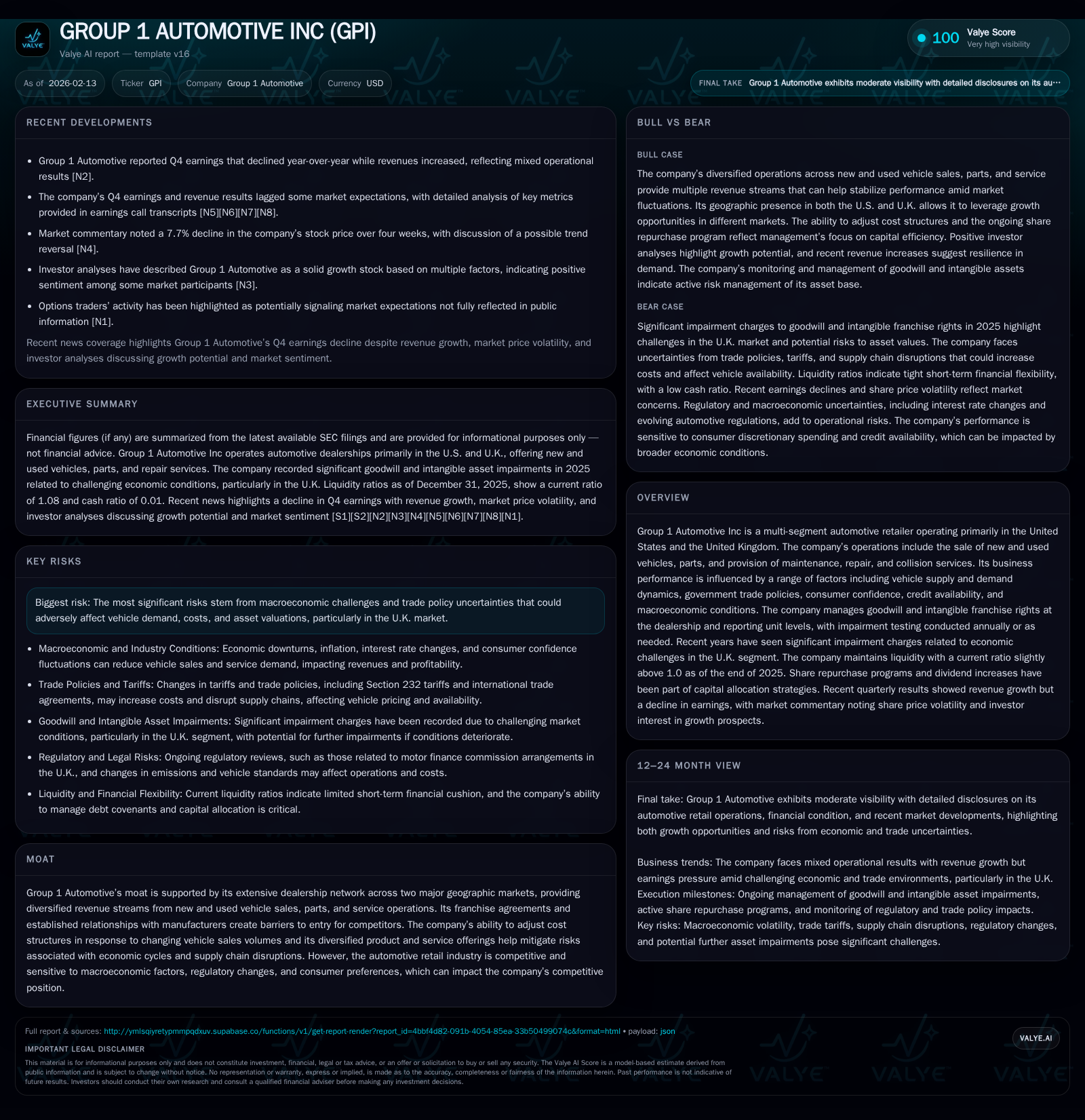
Group 1 Automotive Inc's latest Q4 results showed year-over-year revenue growth contrasting with an earnings shortfall that weighed on its shares. The company's U.K. operations continue to contend with economic headwinds and related asset impairments, while evolving U.S. trade policies impose new cost dynamics on vehicle sourcing. Leveraging an extensive dealership network and diversified product mix, Group 1 employs agile cost management and disciplined capital allocation to sustain liquidity and shareholder returns in a volatile macroeconomic environment. However, regulatory uncertainties and industry innovation present ongoing risks to future profitability and market positioning.
Q4 Earnings in Context: Revenue Growth Versus Profit Challenges
Group 1 Automotive's fiscal fourth quarter results for 2025 presented a mixed financial picture that underscores the complexities confronting automotive retailers today. Revenues increased year-over-year, signaling persistent consumer demand for vehicles and related services despite macroeconomic headwinds [N1][N3][N4]. However, net income declined relative to both consensus estimates and prior periods, leading to a noticeable dip in share price soon after the earnings release [N5]. This divergence suggests that while top-line momentum remains intact, operational pressures—largely stemming from cost inflations and supply issues—are compressing profitability.
Delving deeper reveals that the company's extensive product scope—encompassing new and used vehicle sales, parts distribution, as well as maintenance and collision services—helps underpin revenue growth despite turbulent market conditions. Nevertheless, margin erosion driven by tariff-induced cost increases, logistical disruptions, and currency fluctuations likely contributed to the earnings shortfall. Market reaction reflected investor sensitivity to these profit headwinds even amid steady sales expansion.
Looking ahead, sustaining this revenue trajectory will require continued focus on operational efficiency alongside vigilant cost control mechanisms reflecting evolving trade environments.
Decoding the U.K. Segment's Economic Headwinds and Asset Impairments
The U.K. operations continue to be a challenging theater for Group 1 Automotive. The company has historically recorded impairment charges tied to goodwill and intangible franchise rights within this segment—reflecting the broader economic disruptions post-Brexit coupled with tariff adjustments under recent trade arrangements [S1][valye_report_excerpt].
Economic uncertainties including fluctuating consumer confidence, currency depreciation risks, elevated input costs, and disrupted supply chains have precipitated these write-downs. Such impairment charges weigh directly on quarterly earnings volatility as asset valuations recalibrate to reflect diminished near-term performance expectations.
Moreover, ongoing tariff impositions such as those under Section 232 for automobiles exacerbate cost pressures within the U.K., tightening margins further outside the core U.S. market where higher volume scale partially offsets such impacts.
This dynamic necessitates prudent inventory management and capital allocation focused on preserving dealership values while adapting footprint strategies in anticipation of renewed market stabilization.
Tariffs, Trade Deals, and Tariff-Driven Supply Realignments Impacting Cost Structure
Drafted against a backdrop of shifting global tariffs, Group 1 must continuously navigate complex trade landscapes that materially affect its cost base and sourcing strategies [S1]. Key government interventions during 2025 include:
- President Trump's executive order modifying tariffs on Chinese-origin goods indirectly influencing OEM component pricing.
- The imposition of a 25% tariff via Section 232 on medium- and heavy-duty vehicles alongside incentives for domestically assembled engines creating bifurcated sourcing economies.
- The retroactive application of a generally lower but still consequential 15% duty on Japanese autos reducing prior surcharge regimes.
- The U.S.–U.K. Economic Prosperity Deal enabling limited quotas for reduced-tariff imports but maintaining punitive tariffs beyond thresholds.
Collectively, these measures compel Group 1 to recalibrate procurement channels balancing cost efficiencies against compliance while anticipating OEM pricing pass-throughs that impact dealer margins directly.
The company’s close monitoring of federal agency rulings ensures timely response capabilities; however, inherent uncertainty clouds precise outcome predictability. Flexibility in inventory acquisition timing alongside collaboration with manufacturers springs as critical strategies here.
The Moat Effect: Franchise Networks and Diversified Revenue Buffers
A considerable competitive advantage for Group 1 stems from its extensive dealership network spanning key geographic markets—the United States and the United Kingdom—and its entrenched franchise relationships [valye_report_excerpt]. These relationships yield exclusive rights that act as formidable entry barriers against less-established rivals.
Beyond new vehicle retailing, Group 1's diversification into used vehicles plus after-sale services including parts distribution, maintenance repairs, and body shop operations furnishes resilience against specific segment downturns or supply interruptions. When new vehicle demand weakens due to macroeconomic shifts or inventory shortages, revenue streams from used vehicles or service operations can stabilize overall performance.
This layered business model synergistically allows the firm to weather industry cyclicality with greater stability than mono-revenue enterprises might endure.
Capital Allocation in Focus: Share Repurchases, Dividends, and Liquidity Management
Capital stewardship emerges as a pivotal element in Group 1's financial narrative [S2]. Its Board authorizes large-scale share repurchase programs—increasing authorization up to $500 million—with nearly half utilized ($249 million) year-to-date through September 2025 at an average repurchase price around $425 per share. Such buybacks underline confidence in underlying fundamentals despite market headwinds.
Dividend policy also reflects measured growth ambitions with a recent increase of approximately six percent raising annual payouts to $2 per share alongside consistent quarterly distributions totaling $0.50 per share each period [S2].
Simultaneously, liquidity is prudently maintained with a current ratio standing at about 1.08 at fiscal year-end—indicating sufficient operational runway without excessive leverage risk [F1]. This balance empowers flexibility in navigating ongoing economic uncertainties while preserving shareholder value via both income streams and capital appreciation potential.
Macroeconomic Factors and Credit Environment: Influence on Consumer Demand
Broader macroeconomic variables significantly shape Group 1’s operating environment [S1][valye_report_excerpt]. Recent interest rate reductions by the Federal Reserve (25 basis points in December) alongside matching moves by the Bank of England aim to stimulate labor markets and economic confidence—potentially easing vehicle affordability thresholds for consumers.
However, these benefits are counteracted by inflationary trends affecting fuel prices and discretionary spending capacity which remain constricting forces on demand elasticity. Availability of consumer credit—a key enabler for auto purchases—is another critical factor, sensitive to both monetary policy shifts and lender risk appetites amid uncertain recovery trajectories.
Overall consumer confidence metrics thus oscillate within a narrow band influenced by these competing pressures leaving automotive purchase intent somewhat cautious yet not contracted deeply at this juncture.
Operational Agility: Cost Structure Adjustments Amid Vehicle Sales Volatility
Underpinning Group 1’s durability is its demonstrated operational agility [valye_report_excerpt][S1]. The company actively adjusts its cost structures promptly in response to fluctuations in new vehicle sales volumes—a vital capability given the inherent cyclicality in automotive retail markets.
This expedient responsiveness involves scaling fixed expenses tied to staffing levels or facility overheads as well as optimizing inventory holdings aligned tightly with anticipated demand curves.
Such flexibility mitigates profit volatility ensuring fixed cost burdens do not disproportionately inflate during sales downturns while enabling quick ramp-ups when market conditions improve.
Coupled with diversified revenue bases across multiple product lines (new/used vehicles plus services), this approach forms a cornerstone underpinning Group 1’s resilient operating model through cyclical troughs.
Future Outlook Amid Regulatory Uncertainty and Industry Innovation
Looking forward, Group 1 confronts an intricate regulatory tapestry combined with rapid technological evolution within automotive sectors [S1][N7][N13]. Persistent ambiguities surrounding ongoing tariff enforcement add layers of unpredictability impacting cost structures over multiple quarters ahead.
Simultaneously, sweeping innovations—from electrification rollouts through autonomous driving systems—introduce disruptive dynamics potentially altering consumer preferences as well as aftermarket service profiles critical to dealer economics.
While some analysts maintain optimistic stances grounded in fundamental strength (e.g., Evercore ISI Outperform initiation), derivatives market signals hint at possible near-term volatility underscoring persistent uncertainties [N7][N13].
In this context, management’s ability to adapt strategically—to pivot fleet mixes swiftly, engage with evolving manufacturer innovation pipelines, maintain capital flexibility, and refine geographic footprints—will be central determinants shaping Group 1’s medium-term trajectory.
Disclaimer: This report is for informational purposes only; it does not constitute investment advice or recommendations.
Disclaimer: This is research-only, informational analysis and not investment advice. It may include AI-generated interpretation and general industry context. Always verify important details using primary sources.

Comments