
Robert Half Inc.: Navigating Legacy Strengths and AI-Driven Evolution in a Cyclical Talent Market
Robert Half’s transformation from franchisor roots to a global tech-enabled talent solutions leader underscores resilience amid economic challenges and AI integration risks.
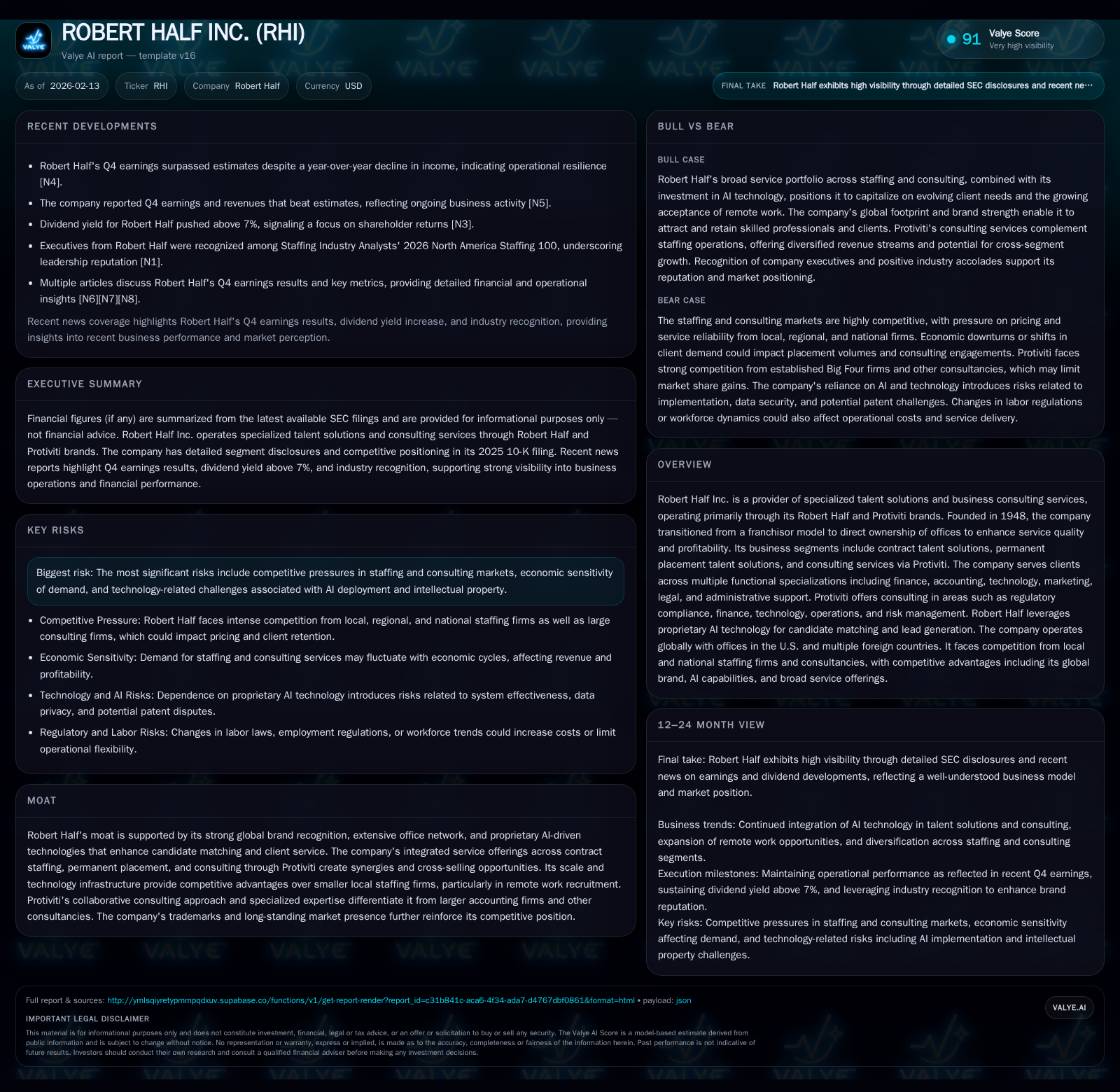
Robert Half Inc. (RHI) has evolved significantly from its original franchisor model, shifting to direct office ownership that enhanced brand consistency and operational control. Its three-pronged business—contract staffing, permanent placement, and Protiviti consulting—offers synergistic talent and advisory solutions across varied specialties. Leveraging proprietary AI technology, the company accelerates candidate matching and lead generation but faces execution risks in this digital transition. Despite recent earnings beats, Robert Half contends with year-over-year revenue pressures linked to economic cyclicality and competitive intensity. Its expansive global footprint and recognized brand create an enduring competitive moat, though investors should monitor cyclical sensitivities and AI-related challenges closely.
From Franchise Roots to Global Direct Ownership: A Strategic Transformation
Robert Half Inc.'s heritage as a franchisor of accounting and finance staffing under brands like Accountemps dates back to 1948 [S1]. However, a pivotal inflection came post-1986 when the company began acquiring these franchised locations outright. This strategic shift—from franchisee reliance to centralized ownership—has been fundamental in reinforcing brand integrity and elevating service consistency across its network. Centralizing operations enabled not only tighter administrative control but also expanded offering breadth beyond accounting into technology, marketing, legal, and administrative support functions.
This direct ownership model paved the way for scaling up hundreds of new offices and incorporating acquisitions of regional specialized staffing providers. Moreover, it laid the groundwork for seamless adoption of proprietary technologies that underpin today’s integrated talent solutions ecosystem. Rather than fragmenting client engagement across multiple brands—as was the case pre-2022 with divisions such as OfficeTeam, The Creative Group, and Robert Half Technology—the company unified under the singular Robert Half banner to maximize brand leverage and market clarity [S1].
Such evolution reflects a deliberate effort to transcend historical limitations of the franchise model where localized variances potentially diluted customer experience. The result is a more cohesive global talent platform — crucial when competing with both boutique agencies and multinational consultancies.
The Integrated Triad: How Contract, Permanent, and Protiviti Consulting Complement Each Other
Robert Half segments its business into three reportable units: contract talent solutions, permanent placement talent solutions, and consulting services through Protiviti [S1]. The interplay among these creates a diversified revenue matrix catering to full-cycle workforce needs.
Contract talent solutions are pivotal in providing scalable flexibility for clients managing fluctuating workloads or pilot projects. Professionals engaged contractually span finance & accounting, technology, marketing & creative, legal, as well as administrative roles. This segment addresses clients’ desires to convert fixed personnel costs into variable expenses while mitigating management burden since Robert Half assumes payroll responsibilities [S1]. Furthermore, contract placements often act as trial periods before potential conversion into permanent hires — generating additional one-time fees.
Permanent placement stabilizes client organizations seeking lasting hires across similar functional areas. This more traditional recruiting approach complements the agile contract model by enabling clients to lock in talent permanently with reduced search friction.
Protiviti fills specialized advisory gaps focusing on regulatory compliance, risk management, technology enablement, finance transformation, and operational consulting [S1]. Unlike traditional accounting firms or general consultancies that compete on scale or audit relationships respectively, Protiviti’s collaborative niche positioning provides differentiated value.
Collectively, these segments interlock strategically: flexible contract staffing supports short-term agility; permanent placements underpin workforce stability; while Protiviti enhances organizational capabilities addressing emerging compliance and operational complexity. Cross-selling across these verticals offers synergistic upsell potential amid evolving client demands.
AI at the Core: Leveraging Technology to Enhance Candidate Matching and Client Engagement
A defining aspect of Robert Half’s modern competitive advantage lies in its proprietary deployment of artificial intelligence within recruitment workflows [S1][valye_report_excerpt]. Automated candidate matching algorithms expedite identification of optimal candidates from extensive databases based on nuanced client requirements. Likewise, AI-powered lead generation optimizes sales funnel efficiency by prequalifying prospective customer engagements.
This technological backbone accelerates hiring cycles significantly compared to manual screening processes central to smaller agencies. Enhanced accuracy also reduces mismatch risk—minimizing costly turnover for clients.
However, integrating advanced AI tools also introduces complexities. Risks include technology implementation challenges that can undermine user experience if systems lack robustness or adaptability. Intellectual property protection emerges as another vulnerability as competitors may attempt replication or circumvention.
Hence while AI promises scalability improvements that enlarge Robert Half’s moat versus local firms lacking tech sophistication, it demands rigorous oversight to prevent operational disruptions or security breaches.
Earnings Highlights: Beating Estimates Amid Year-Over-Year Revenue Pressures
Despite macroeconomic headwinds impacting corporate hiring appetites during parts of 2025, Robert Half reported Q4 earnings surpassing analyst consensus [N1][N2][N3][N4]. Notably though revenues declined relative to prior-year periods—a signal of underlying demand cyclicality prevalent in staffing industries [N10].
Gross income pressures primarily stemmed from softer activity in key contract segments subject to client budget tightening amid economic uncertainty. Yet disciplined cost management alongside favorable pricing dynamics helped protect margins enabling net income beats [F1][N10].
Segment-level disclosures indicate Protiviti’s consulting business maintained steadier demand compared with more volatile temporary staffing lines—reflecting differing sensitivity to economic cycles. This underscores Protiviti’s role in moderating group-wide earnings volatility.
Looking ahead, cautious forward guidance acknowledges continued external uncertainties including inflationary cost pressures and evolving workplace trends influencing staffing utilization patterns [N5]. Investors should therefore contextualize earnings beats within this nuanced operating environment where short-term fluctuations mask longer-term structural shifts.
Strength in Scale and Brand: Robert Half's Sustained Competitive Moat
Robert Half benefits from a well-entrenched global footprint spanning numerous countries plus strong brand recognition built over more than seven decades [valye_report_excerpt][S1]. Such scale enables economies of recruitment sourcing unmatched by smaller independent firms focused on limited geographies.
Moreover, trademarks associated with Robert Half resonate broadly across professional communities creating high recall during talent searches or employer branding exercises—a barrier new entrants struggle to overcome swiftly. The unified brand strategy reinforces market presence by eliminating dilution risks inherent in fragmented sub-brands.
The company’s integrated service portfolio combining contract placements with permanent hiring backed by complementary consulting services further widens the moat through cross-selling synergies unique among competitors who often operate siloed offerings.
Additionally, ongoing adoption of remote work has expanded the geographical scope where Robert Half can effectively deploy resources—leveraging technology infrastructures built over years supports remote recruitment seamlessly enhancing competitiveness relative to traditional brick-and-mortar staffed agencies.
Risk Landscape: Navigating Competitive Pressures, Economic Sensitivity, and AI Challenges
Among principal risks faced are intense competition both from established multinational staffing giants as well as emerging niche players leveraging agile digital platforms [valye_report_excerpt][S1]. These rivals compete aggressively for both client mandates and high-caliber candidates—putting pressure on pricing power and margins.
Economic cyclicality remains a critical vulnerability given demand for contract talent tends to contract swiftly during downturns when companies defer new hires or reduce workforce counts altogether [valye_report_excerpt]. Permanent placement also follows similar trends albeit lagged slightly by hiring decision timelines.
Moreover, reliance on proprietary AI systems introduces execution risk related to technology deployment failures or intellectual property infringement claims potentially disrupting service continuity or incurring legal costs [valye_report_excerpt]. Cybersecurity threats inherent in handling vast candidate/ client data pools amplify this exposure.
Strategic responses involve continuous investment in technology resilience coupled with diversifying geographic markets to partially cushion region-specific downturns. Equally important is maintaining strong client relationships through consultative value-additions that deepen engagement beyond transactional staffing arrangements.
Financial Health Snapshot: Liquid Assets, Leverage, and Profitability in Focus
At fiscal year-end 2025 Robert Half posted $464 million in cash and equivalents against $2.12 billion current assets balanced by $1.38 billion current liabilities yielding a conservative current ratio near 1.53—a sign of robust short-term liquidity comfort [F1]. Net income totaled approximately $133 million evidencing profitability despite episodic revenue pressures driven by cyclical market dynamics [F1].
The balance sheet strength affords flexibility for capital deployment including sustaining dividends or opportunistic acquisitions aimed at consolidating fragmented local markets further enhancing scale advantages [S1]. However financial volatility tied closely to macroeconomic cycles signals prudent monitoring of leverage ratios especially if sustained economic weakness arises.
Overall financial prudence combined with demonstrated profit generation capability equips Robert Half with foundational stability amidst external uncertainties afflicting cyclical services sectors.
Dividend Dynamics: Evaluating Yield Upside Versus Potential Value Traps
Dividend yield expansion crossing above 7% recently has attracted heightened investor interest seeking income opportunities amid low-interest environments [N8][N6]. While such yields appear compelling on surface analysis they warrant nuanced consideration due to sector cyclicality risks inherent in workforce outsourcing businesses.
Elevated yields sometimes reflect discounted stock prices driven by investors’ concerns over near-term earnings volatility tied to economic slowdowns potentially impacting dividend sustainability long term [N6]. Hence investors should weigh attractive cash flow returns against possible downside scenarios where prolonged downturns could pressure payout ratios or trigger reductions.
The balance between capturing yield upside versus avoiding value traps calls for continuous reassessment factoring evolving macro indicators alongside firm-specific operational cycle cues including order backlogs or booking trends within both contract staffing and consulting verticals.
Leadership Accolades and Culture: Driving Industry Recognition and Future Growth
Recognition received by multiple Robert Half executives within Staffing Industry Analysts' North America Staffing 100 list highlights leadership quality known for delivering strategic foresight combined with operational excellence [N11]. This external validation reflects effective stewardship steering complex integrations of technology innovation with human capital expertise—both pillars essential for thriving amidst disruptive labor market shifts.
Cultural focus fostering employee engagement directly translates into superior candidate experiences underpinning repeat client mandates—a virtuous cycle vital for sustaining competitive edge long term. Such leadership strengths bolster confidence around adaptability navigating ongoing transformations accelerated by AI adoption alongside shifting client workforce strategies.
In conclusion, Robert Half stands at an inflection point balancing historical legacy foundations with aggressive technological modernization efforts enhancing its proposition as a comprehensive global talent solutions provider. Vigilant navigation of cyclical market headwinds combined with measured AI integration will shape the sustainability trajectory amid intensifying competition and evolving labor landscapes.
Disclaimer: This is research-only, informational analysis and not investment advice. It may include AI-generated interpretation and general industry context. Always verify important details using primary sources.

Comments