
Carlisle Companies Inc.: Navigating Headwinds with Diversification and Capital Discipline in 2025
A detailed examination of Carlisle’s contrasting earnings performance, diversified portfolio, operational strategies, and capital management reveals its evolving industrial leadership amid market volatility.
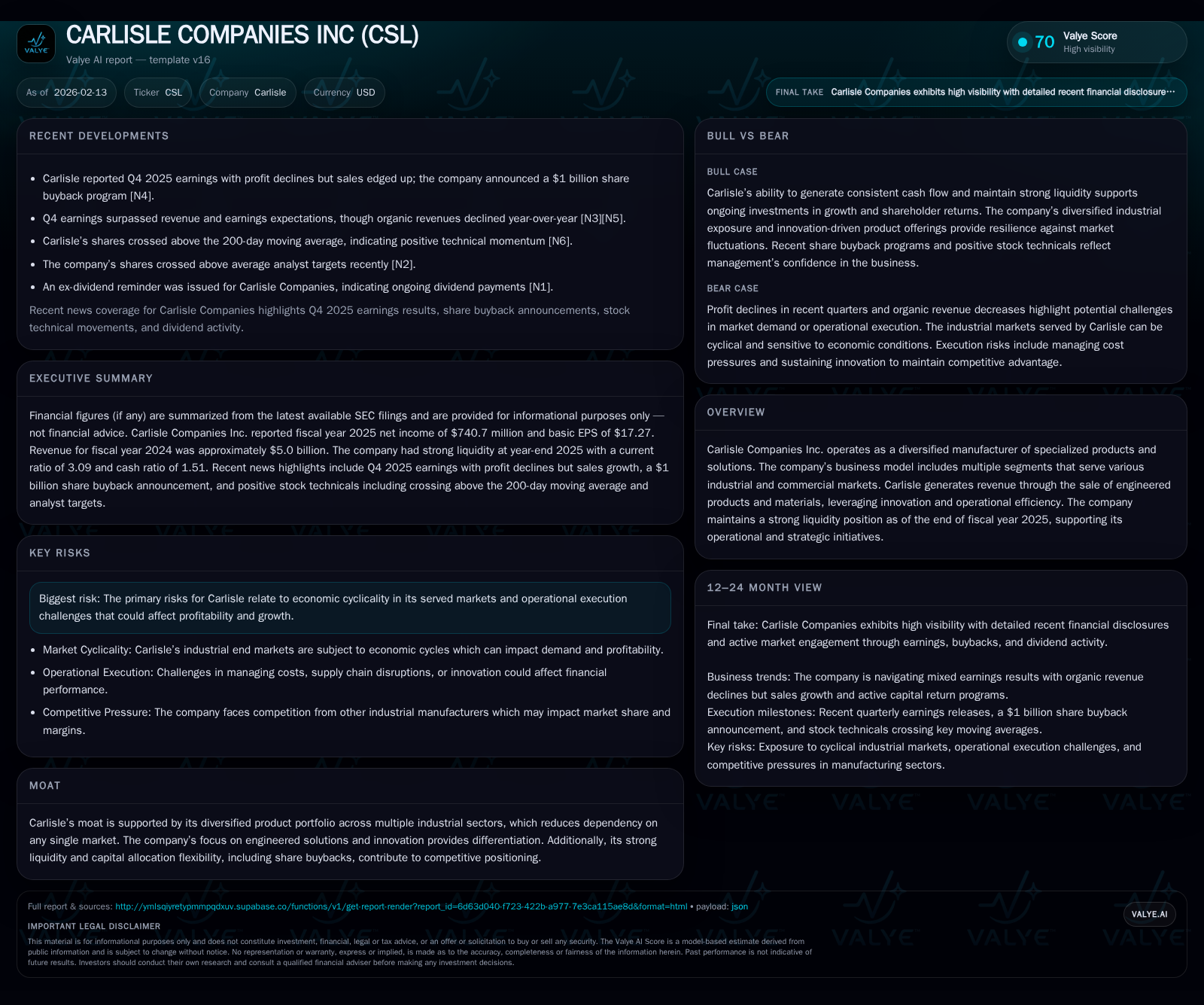
In late 2025, Carlisle Companies Inc. reported earnings that beat expectations despite declining organic revenue, underscoring its strategic adaptability. The company leverages a broad industrial product portfolio and operational innovation to sustain margins while maintaining robust liquidity and executing a sizable share buyback program. Nevertheless, economic cyclicality and execution challenges remain critical risks as Carlisle charts its course forward.
Balancing Act: Carlisle’s Strong Earnings vs. Revenue Pressure
Carlisle Companies Inc.’s Q4 2025 earnings narrative presents an intriguing paradox: net income grew despite a contraction in organic revenues. This dynamic was spotlighted in February earnings reports where adjusted EPS and overall profitability exceeded consensus expectations [N1][N4]. While headline revenue trends painted a challenging top-line environment marked by year-over-year declines in organic sales volumes, underlying cost management efforts and pricing adjustments cushioned gross margins.
Specifically, effective operational rigor—such as judicious overhead control—and targeted price increases appear to have mitigated the impact of softer demand in certain industrial verticals [N9]. The financial articulation of these outcomes manifested in an increased net income figure for the fiscal year ended December 31, 2025, reaching approximately $741 million [F1]. This juxtaposition between revenue softness and earnings strength underscores Carlisle's ability to adapt tactically, optimizing profit engines even when organic growth stalls.
Decoding Carlisle’s Diversified Portfolio: The Moat in Action
Central to Carlisle’s resilience is its diversified product footprint spanning multiple sectors within specialized manufacturing. The company’s business architecture hinges on engineered products and materials tailored for distinct industrial and commercial needs—a mosaic that dilutes reliance on any single market segment [valye_report_excerpt][S1].
This breadth confers a meaningful moat by insulating Carlisle against localized downturns. For instance, while one segment might face cyclical weakness (reflected in organic sales declines), others may provide offsetting stability or pockets of growth. The SEC filings elucidate this multi-pronged approach through segment disclosures illustrating varied end markets served with complementary risk profiles [S1].
Moreover, this diversity facilitates cross-pollination of innovation initiatives and operational best practices across units, reinforcing competitive differentiation through superior engineered solutions.
Operational Efficiency and Innovation: Engines of Competitiveness
Innovation remains a cornerstone of Carlisle's strategic agenda. During the Q4 earnings call, management emphasized ongoing investments in research & development targeting high-value engineered solutions which drive returns beyond commoditized offerings [N3]. This focus on innovation is pivotal not only for market differentiation but also for underpinning margin resilience amid cost inflation pressures.
Operational efficiency programs complement innovation efforts—streamlining production workflows, reinforcing supplier partnerships, and deploying technologies that enhance product quality while controlling costs [valye_report_excerpt]. Such initiatives collectively bolster Carlisle’s ability to deliver customized solutions at competitive price points without sacrificing profitability.
The interplay between innovation-led product evolution and disciplined operations fuels the company’s capacity to navigate fluctuating market demands effectively.
Liquidity and Capital Allocation: Funding Growth and Shareholder Returns
Financial strength is more than an abstract concept at Carlisle—it is a tangible pillar supporting both growth investments and shareholder return strategies. End-of-year balance sheet snapshots reveal current assets totaling roughly $2.28 billion versus current liabilities near $736 million, yielding a robust current ratio around 3.09 [F1]. In cash terms alone, the company held approximately $1.11 billion at year-end 2025.
Such liquidity cushions operational needs amidst economic uncertainty while providing ammunition for strategic capital deployments. Notably, Carlisle announced a substantial $1 billion share buyback program shortly after Q4 results release [N8]. This move signals confidence from management regarding valuation attractiveness and reflects disciplined capital stewardship aimed at optimizing shareholder value.
Maintaining ample liquidity also enables agile responses to acquisition opportunities or incremental R&D funding without jeopardizing financial stability.
Risks on the Horizon: Navigating Economic Cyclicality and Execution Challenges
Despite these strengths, Carlisle faces nontrivial headwinds rooted largely in external macroeconomic factors intrinsic to its end markets. The company explicitly acknowledges the cyclicality endemic to many industrial sectors it serves—fluctuations in construction activity, transportation demand, or manufacturing output can materially sway order flows [valye_report_excerpt][S2].
Operational execution risks compound these external uncertainties; given the complexity of delivering diverse engineered solutions worldwide, missteps in supply chain management or manufacturing scalability could erode margins or stall growth trajectories [S2].
Moreover, intensifying input cost inflation or geopolitical trade tensions could exacerbate pressures on procurement or sales channels.
Mitigating these risks requires vigilant forecasting paired with nimble operational adjustments—a balancing act demanding sustained management focus.
Market Sentiment and Stock Momentum: Analyst Targets and Technical Signals
Market perception has responded favorably to Carlisle’s demonstrated adaptability. Recent trading patterns show shares crossing above the average analyst target prices—a notable milestone reflecting growing corporate confidence among research firms [N6]. Complementing this ascent is a bullish technical indicator where the stock price moved decisively above its 200-day moving average [N7][N14], often interpreted as a signal of constructive medium-term momentum.
Dividend announcements have further sweetened shareholder appeal; ex-dividend dates underscore reliable income streams attractive to income-oriented investors [N5][N12]. Collectively, these elements paint a picture where fundamental resilience melds with positive investor sentiment shifts.
Looking Forward: Strategic Implications for Carlisle’s Next Chapter
As Carlisle Companies strides into the coming years, it must artfully reconcile prevailing market turbulence with ambition for growth. The firm’s entrenched diversification strategy provides foundational defense against isolated shocks while enabling strategic experimentation with innovative engineered offerings [valye_report_excerpt][S1].
Management guidance suggests continued focus on operational excellence balanced against selective capital deployment—whether in R&D ventures or opportunistic buybacks—to sustain momentum [N13]. Industry observers note potential catalysts such as increased infrastructure spending or adoption of advanced materials that could buoy demand segments aligned with Carlisle's capabilities [N10][N11].
Nevertheless, vigilance remains imperative amidst economic cyclicality risks highlighted earlier. Successfully navigating this complex environment will differentiate leaders from laggards within industrial manufacturing landscapes.
Disclaimer: This analysis is intended for informational purposes only and does not constitute investment advice or recommendations to buy or sell any securities. Readers should conduct their own due diligence before making investment decisions.
Disclaimer: This is research-only, informational analysis and not investment advice. It may include AI-generated interpretation and general industry context. Always verify important details using primary sources.

Comments