
Terex Corp’s Strategic Resilience Amid Trade Tensions and Cyclical Market Dynamics
Terex Corp navigates increasing tariff pressures and economic cyclicality with strategic innovation and liquidity strength.
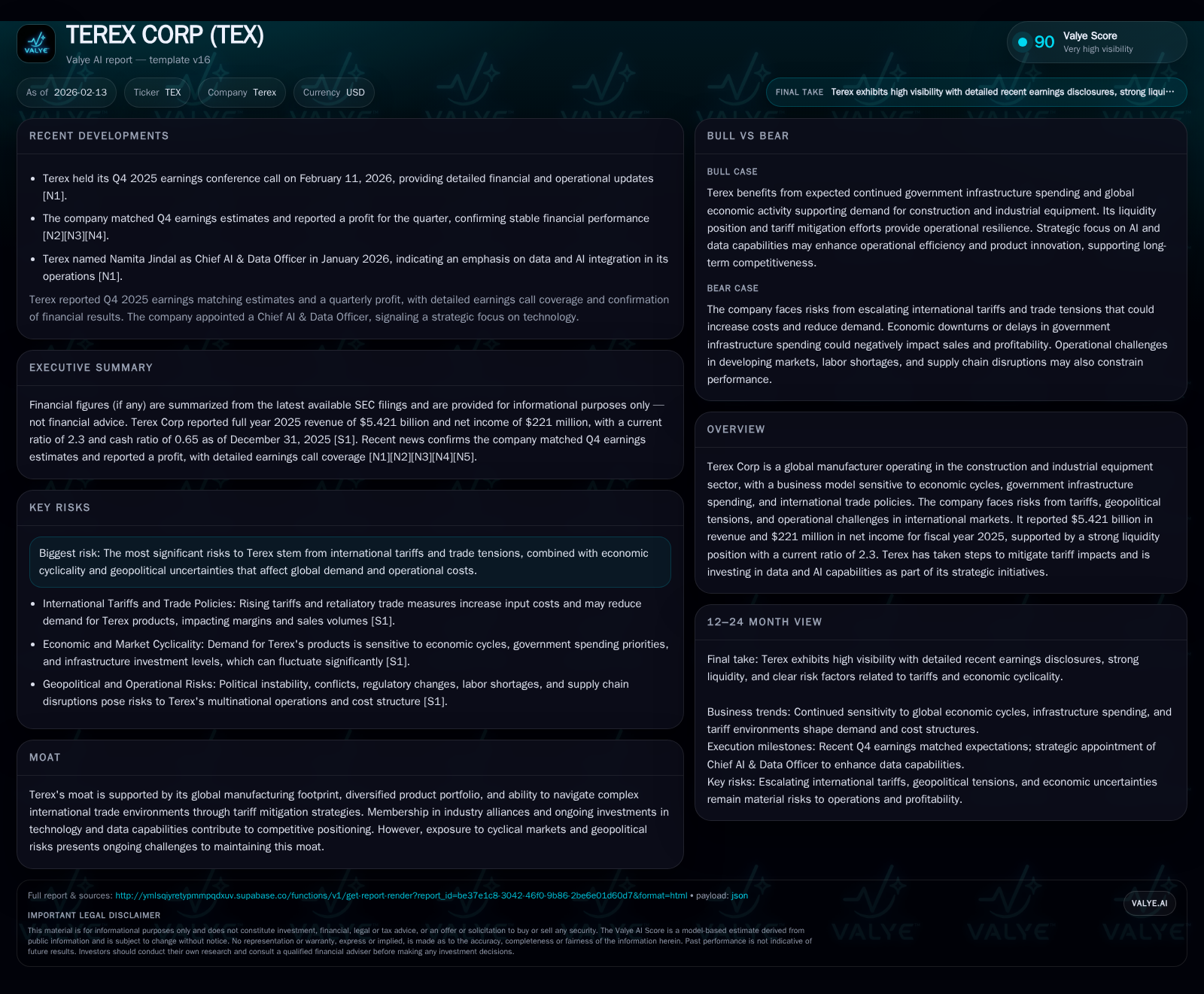
Terex Corp demonstrated operational resilience in Q4 2025 by delivering earnings in line with expectations despite persistent international tariff challenges that pressure margins. The company’s robust liquidity position, underscored by a current ratio of 2.3, provides financial flexibility to weather cyclical downturns. Its recent pivot toward AI and data integration signals an evolving competitive moat within the traditionally capital-intensive construction equipment industry. Ongoing geopolitical risks and tariff volatility remain key challenges, shaping the near-term outlook.
Navigating Tariffs: Terex’s Trade War Playbook
Terex Corp operates at the crossroads of global trade frictions that have intensified over recent years. The imposition of tariffs by the U.S. on Chinese-origin goods and reciprocal measures by China impact Terex both through direct material costs and supply chain inflation. According to the company’s latest 10-Q filing, tariffs on materials and imported machines from China elevate input costs, squeezing margins on certain product lines [S2]. This complexity is exacerbated by new tariffs imposed or proposed by additional countries, creating a fluid environment requiring agile responses.
Terex has actively pursued multiple mitigation tactics including utilization of the U.S. government's duty drawback mechanisms which allow recovery of certain tariff expenses, successful tariff exclusion applications, strategic sourcing adaptations, and partial cost pass-through via pricing adjustments [S2]. Despite these measures providing some relief, expiration of tariff exclusions coupled with potential new levies threaten to destabilize cost structures further. Shifting production footprints to non-tariff jurisdictions also forms part of the tactical response but introduces operational overheads.
The company emphasizes that continuously adapting to evolving tariffs entails significant time and cost burdens which could materially impact profitability if cost recovery proves inadequate [S2]. Thus, while tariff mitigation strategies currently absorb part of the adverse effects, ongoing vigilance in supply chain management remains critical.
Q4 2025: Earnings Performance through the Lens of Expectations
In its February 11 earnings release and conference call, Terex reported Q4 revenues and net income precisely matching consensus estimates at $5.42 billion for fiscal 2025 revenue and $221 million net income [N1][N2][N3][F1]. Market response was notably positive; shares rallied sharply following the report amid reassurances about operational resilience amid external headwinds [N12].
Margin dynamics reflected the interplay between elevated input costs due to tariffs and inflationary pressure versus disciplined pricing strategies. Management highlighted sustained order book strength supported by selective government infrastructure investments despite macroeconomic uncertainties [N1]. The diplomatic balancing act between managing cost pressures and maintaining competitive pricing helped stabilize earnings outcomes.
While the steady results fell short of a breakout surprise, consistency amidst a turbulent trade environment underscores disciplined execution. The Q4 figures affirm Terex's ability to deliver through cycles with measured optimism about growth prospects grounded in enhanced technological capabilities.
Liquidity and Balance Sheet Strength: Safety in a Cyclical Storm
A cornerstone of Terex's operational resilience lies in its strong liquidity position. At fiscal year-end 2025, Terex held $772 million in cash and equivalents alongside total current assets of approximately $2.73 billion against current liabilities near $1.19 billion — yielding a healthy current ratio of about 2.3 [F1].
This ratio significantly exceeds typical industrial equipment sector benchmarks where cyclical revenue swings often create working capital volatility [S1]. Such liquidity flexibility affords Terex capacity to absorb short-term shocks from tariff-related margin compression or delayed customer spending without immediate reliance on external financing.
Given its sensitivity to economic cycles including infrastructure spending rhythms, this balance sheet strength mitigates financial stress risk during downturns or periods of geopolitical turbulence. Maintaining prudent leverage levels while safeguarding cash reserves aligns with the company's strategic emphasis on risk management.
Technology as a Catalyst: Leadership in AI & Data Integration
Terex's appointment of Namita Jindal as Chief AI & Data Officer marks a pivotal evolution in its strategy — emphasizing intelligent data integration as a key differentiator within industrial manufacturing [N11][S1]. This leadership addition signals recognition that traditional equipment makers must innovate beyond hardware by embedding advanced analytics, predictive maintenance capabilities, and digital services into their offerings.
Investments in AI-driven platforms aim to enhance operational efficiency internally while delivering more value-added solutions externally — potentially accelerating order velocity through improved customer insights and lifecycle management tools. This strategic pivot reflects industry-wide acknowledgment that technology leadership can forge more sustainable moats even amid cyclicality.
However, challenges remain in integrating legacy manufacturing processes with cutting-edge data architectures without disrupting core operations. Execution success here will likely shape Terex’s medium-term competitive positioning relative to peers emphasizing solely traditional equipment.
Competitive Positioning: Decoding Terex’s Moat and Market Footprint
Terex's economic moat is multifaceted — anchored by an extensive global manufacturing footprint that facilitates market access despite trade disruptions; a diversified product portfolio spanning construction cranes, aerial work platforms, material processing machinery; coupled with membership in key industry alliances enhancing collaborative innovation [valye_report_excerpt].
This diversification diffuses geographic risks but does not eliminate exposure to economic cycles endemic to construction sectors worldwide. Tariff mitigation tactics supplement geographic breadth but require constant operational fine-tuning.
Moreover, ongoing investments in tech-driven capabilities align well with maintaining relevance versus larger competitors who increasingly incorporate digital tools into equipment sales models. However, cyclical demand volatility paired with geopolitical tensions ensures that maintaining this moat demands continual adaptation rather than complacency.
Macro Cycles and Sector Tides: Sensitivity to Economic Swings
Terex's business is fundamentally intertwined with macroeconomic cycles including government infrastructure allocation decisions, non-residential construction trends, oil & gas activity levels, interest rate environments, and regulatory shifts [S1][valye_report_excerpt]. These factors collectively determine capital spending patterns from contractors — directly influencing order inflows.
Recent years’ geopolitical instability has injected additional uncertainty into forecasting demand patterns. Supply chain disruptions linked to freight constraints further compound timing risks around deliveries and project execution.
As such, earnings inherently exhibit cyclicality linked tightly to spending priorities of public sectors and commodity markets — requiring agile strategy shifts responsive to evolving macro tides.
Risks on the Horizon: Geopolitical Uncertainties and Tariff Volatility
Terex explicitly identifies rising tariffs as a material risk factor affecting business outcomes [S2]. Escalation or extension of tariffs beyond current thresholds could increase input costs materially beyond mitigation capacities.
Additionally, retaliatory tariffs imposed by foreign governments may reduce export competitiveness impacting international revenue streams directly [S2]. Political uncertainties including sanctions regimes or conflict zones introduce supply chain fragilities given Terex’s multinational operations.
Economic cyclicality further compounds risk by exposing earnings sensitivity during downswings when reduced capital expenditures impair demand.
Operational risks linked to rapid compliance requirements imposed by changing trade policies involve management distraction and increased expenses. Hence risk management around these factors remains paramount.
What Investors Should Watch: Key Catalysts and Potential Pitfalls
Looking ahead, investors should track several critical themes influencing Terex’s trajectory:
- Progress executing AI/data strategy under newly appointed leadership as signal for longer-term differentiation [N11]
- Evolution in international tariff policies post recent escalation episodes weighing on margins [S2]
- Order book developments reflecting governmental infrastructure budget allotments amidst shifting macroeconomic indicators [N6]
- Cost control discipline offsetting inflationary pressures linked to raw materials and logistics [valye_report_excerpt]
- Equity market perceptions calibrated against broader industrial equipment sector performance following major competitor earnings [N14]
- Geopolitical developments influencing global trade flows particularly involving China-U.S. relations [S2]
- Ability to sustain robust liquidity buffers amid funding needs for innovation investments or capital expenditures [F1]
Balancing these variables requires nuanced assessment given intertwined external risks against internal innovation momentum.
Disclaimer: This analysis is intended for informational purposes only based on publicly available information as of February 2026. It does not constitute investment advice or recommendations.
Disclaimer: This is research-only, informational analysis and not investment advice. It may include AI-generated interpretation and general industry context. Always verify important details using primary sources.

Comments