
Acadia Realty Trust’s Resilience and Strategy in Urban Retail Real Estate Amid Sector Challenges
An in-depth assessment of Acadia Realty Trust’s niche retail property focus, financial positioning, and risk navigation within constrained urban markets.
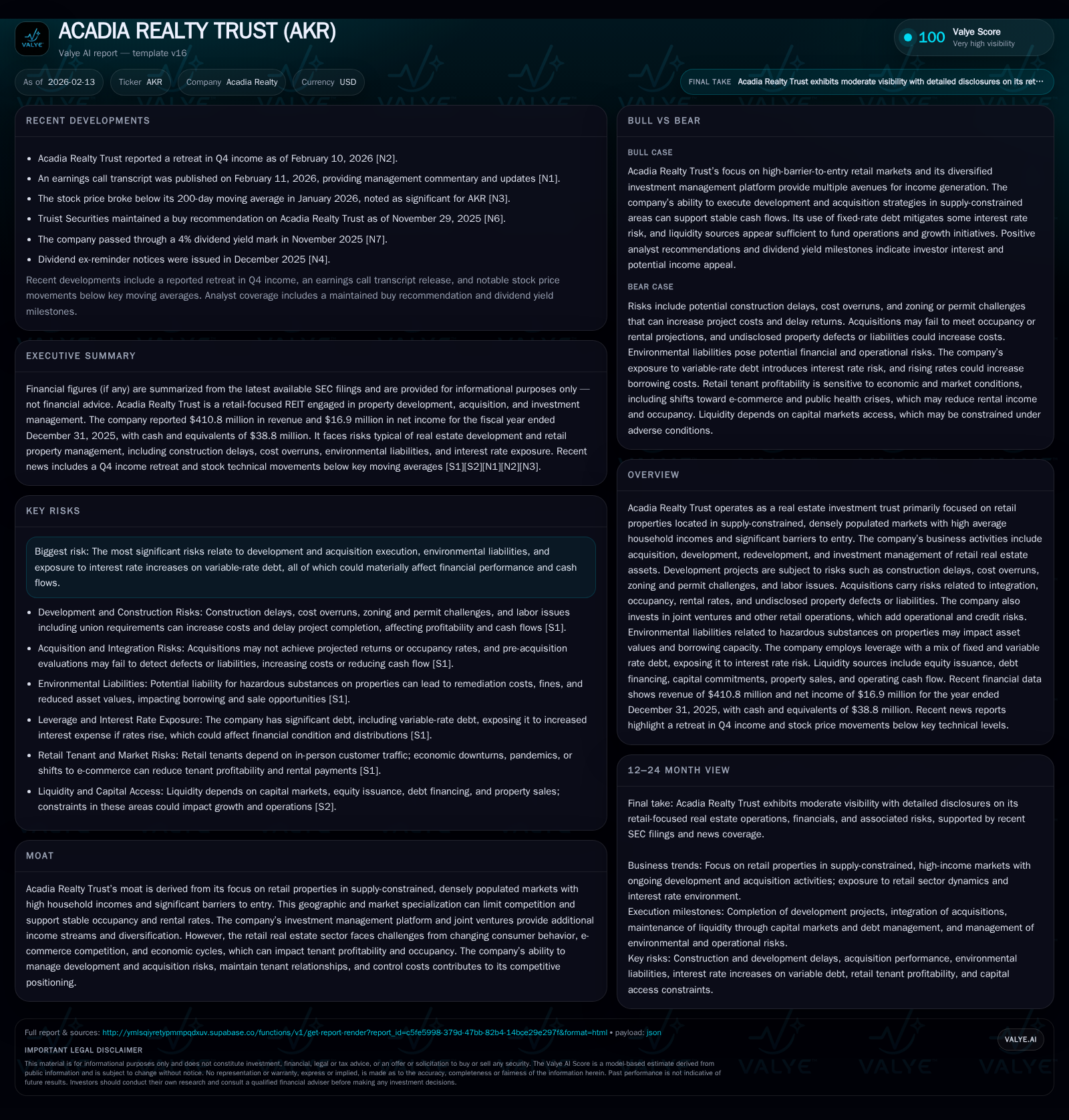
Acadia Realty Trust (AKR) anchors its business in retail properties located in densely populated, supply-constrained urban areas characterized by high household incomes and significant barriers to entry. This strategic specialization supports occupancy stability and rental premiums but remains exposed to evolving retail trends and sector headwinds. Development and acquisition ventures carry operational risks including construction delays, zoning challenges, and rising labor costs. Financially, AKR confronts earnings volatility amid a retreat in Q4 income but maintains liquidity through multiple capital channels including an active ATM equity program and substantial cash reserves. Its sustainability initiatives and joint venture activities introduce both diversification benefits and additional risk layers. Recent stock performance signals market caution, emphasizing the importance of closely monitoring execution risks against broader economic uncertainties.
Decoding AKR’s Market Focus: The Retail Real Estate Moat
Acadia Realty Trust (AKR) has carved out a distinct niche within the retail real estate sector by focusing on properties situated in supply-constrained, densely populated metropolitan markets featuring high average household incomes. This geographic concentration is not accidental; it is central to AKR's competitive advantage. By targeting locales with pronounced barriers to entry—including regulatory complexities, limited land availability, and entrenched local competition—AKR creates a defensive moat that supports relatively stable occupancy rates and rental income.
The company’s strategy leverages demographic targeting alongside geographic selectivity to prioritize assets that are more resilient to market volatility. High-income areas typically sustain stronger tenant purchasing power, which can mitigate some effects of economic cycles on retail sales. Moreover, constrained supply limits direct competition from new developments that could otherwise erode rental pricing.
However, this moat is not impervious. E-commerce growth continues reshaping consumer behavior at a pace that challenges traditional brick-and-mortar retail models despite geographic advantages. Additionally, economic downturns or shifts in consumer preferences can impact tenant profitability and occupancy even within premium neighborhoods. Consequently, while AKR’s specialization provides competitive insulation relative to broader market participants [valye_report_excerpt], it simultaneously obliges ongoing adaptability to sector trends.
Navigating Development Risks in High-Barrier Urban Environments
AKR’s growth ambitions involve both new development and redevelopment efforts targeted at its high-value urban portfolio segments. These capital-intensive projects inherently carry multifaceted risks that can derail timelines or inflate costs.[S1] Construction schedules may be disrupted by labor shortages or union wage requirements prevalent in certain jurisdictions. Cost overruns may stem from volatile material prices or protracted permitting processes.
Regulatory hurdles stand out as significant constraints—obtaining necessary zoning changes, land use approvals, environmental permits, and occupancy certifications often entails bureaucratic delay and uncertainty across multiple government layers. AKR mitigates some exposure by deferring construction until pre-leasing benchmarks are satisfactorily met and financing secured. Nevertheless, these safeguards do not eliminate the potential for project abandonment after provisional investments have been made.
Such operational execution risks directly affect not only profitability but also the timing of cash flow generation—generally delaying meaningful returns for several years post-initiation—potentially pressuring broader financial results.[S1]
Financial Snapshot: Earnings Dynamics and Liquidity Profile
The company’s recent quarterly results spotlight some stress under current economic conditions. Fourth quarter earnings exhibited a retreat with net income declining to $16.9 million on revenues approximating $410.8 million for the full year ended December 31, 2025.[F1][N2] This compression can be partly attributed to increased operating expenses tied to development activities or leasing absorption.
Liquidity stands on firmer footing; AKR reported cash and equivalents of $38.8 million as of year-end 2025.[F1] Supplementary sources include proceeds from an active at-the-market (ATM) equity issuance program along with anticipated capital contributions from investment management funds—tools that provide flexibility for acquisitions or refinancing needs.[S2]
While the cash position offers a buffer for short-term obligations, continued vigilance is essential given the variation in income streams driven by project-phase timing differences and macroeconomic variables impacting tenants.
Leverage and Capital Strategy: Financing Growth Amid Volatility
AKR manages a capital structure blending secured term loans—with the latest tranche fully drawn as of September 30, 2025 (a $250 million facility)—against remaining capacity under other REIT portfolio debt facilities totaling approximately $460 million.[S2] This layering affords moderate borrowing flexibility that can be deployed opportunistically for portfolio expansion or redevelopment work.
On the equity side, the ongoing utilization of the 2025 ATM program enables incremental capital raising aligned with market windows rather than large lump sums that might dilute shareholder value abruptly.[S2] As of late 2025, over 12.7 million forward shares remained outstanding with net forward sale pricing suggesting effective average proceeds exceeding $20 per share if settled physically.
Capital stewardship hinges on synchronized timing between equity issuances and acquisition spending—particularly considering construction delays or lease-up uncertainties that could strain liquidity if not managed prudently.[valye_report_excerpt]
Sustainability at the Forefront: AKR’s Environmental and Social Commitments
Increasingly salient within real estate investment is the integration of ESG principles—a domain where AKR has established itself as an early adopter with tangible initiatives.[S1] The company’s energy efficiency campaign includes LED lighting installations coupled with smart controls to optimize usage in parking areas as well as vacant tenant spaces.
Water conservation plays a significant role too: smart irrigation systems deployed across landscaping minimize utility consumption via sensors adapting watering schedules dynamically; additionally tenants receive submeters paired with incentives encouraging reduced consumption—linking environmental impact directly to operational savings.[S1]
Green leasing agreements formalize cooperation between landlord and tenant on sustainability goals—an innovative approach recognized through Gold status certification within industry programs focused on energy performance.
Beyond environmental considerations is a commitment to occupant health & safety grounded in responsible property management practices aimed at securing vibrant shopping center environments conducive to long-term value retention.[S1]
Investment Management & Joint Ventures: Diversification Benefits and Risks
AKR expands its footprint via investment management platforms overseeing Funds III-V which operate through noncontrolling interests sharing capital commitments alongside external partners.[valye_report_excerpt][S2] This structure diversifies revenue beyond core leasing income yet imports additional layers of complexity encompassing capital calls governance as well as operational oversight over jointly held assets.
Unfunded commitments remain notable—with tens of millions outstanding across funds—introducing conditional capital requirements sensitive to both market cycles and management execution efficacy.[S2] Operationally these arrangements expose AKR to credit risk stemming from tenant defaults or partner funding disruptions potentially amplifying downside scenarios during challenging economic periods.
Balancing these dynamics requires vigilant monitoring; while joint ventures enlarge scale without proportionally increasing leverage on AKR’s balance sheet directly, they nonetheless embed contingent liabilities that must be managed proactively.
Unpacking Recent Market Signals: Stock Movement and Investor Sentiment
Market behavior since late January 2026 underscores investor concerns rooted partly in AKR’s Q4 income contraction and broader retail real estate pressures.[N2][N3] Technical indicators reveal a break below the 200-day moving average—an event often interpreted as signaling increased volatility or diminished momentum among shareholders.
Earnings call discourse captured on February 11 also reflected tempered tone regarding near-term uncertainties arising from leasing environment softness alongside rising interest expense considerations linked to variable-rate debt exposures.[N1]
These factors coalesce into heightened market scrutiny necessitating careful communication strategies from management aimed at reassuring stakeholders over both short-term liquidity sufficiency and long-term asset value preservation.
The Outlook: Balancing Opportunities Against Emerging Risks
Looking ahead, Acadia Realty Trust inhabits a duality shaped by its entrenched strengths against an evolving risk landscape.[valye_report_excerpt][S1][N2] Its geodemographic focus lends durable demand characteristics supporting occupancy yet cannot fully isolate AKR from disruptive e-commerce trends or macroeconomic swings impacting tenant solvency.
Interest rate fluctuations remain a prominent threat given partial reliance on variable-rate borrowings—with cost increases potentially compressing margins unless offset by rental escalations or operational efficiencies.[valye_report_excerpt]
Environmental liabilities tied to hazardous substances pose latent risks influencing borrowing capacity or necessitating costly remediation efforts; meanwhile development pipelines require exquisite execution discipline to avoid margin erosion through overruns or delayed lease-ups.
Collectively these factors demand meticulous governance combined with agility—both financially through calibrated capital deployment strategies and operationally via proactive tenant engagement plus sustainability leadership—to navigate an uncertain yet opportunity-laden terrain.
Disclaimer: This analysis is intended purely for informational purposes reflecting publicly available data as of early 2026. It does not constitute investment advice or recommendations.
Disclaimer: This is research-only, informational analysis and not investment advice. It may include AI-generated interpretation and general industry context. Always verify important details using primary sources.

Comments