NOV Inc.: Navigating Cyclicality with Technological Edge and Global Scale
An in-depth analysis of NOV Inc.'s strategic positioning within the volatile oilfield equipment sector reveals key strengths and risks shaping its 2025 financial and operational landscape.
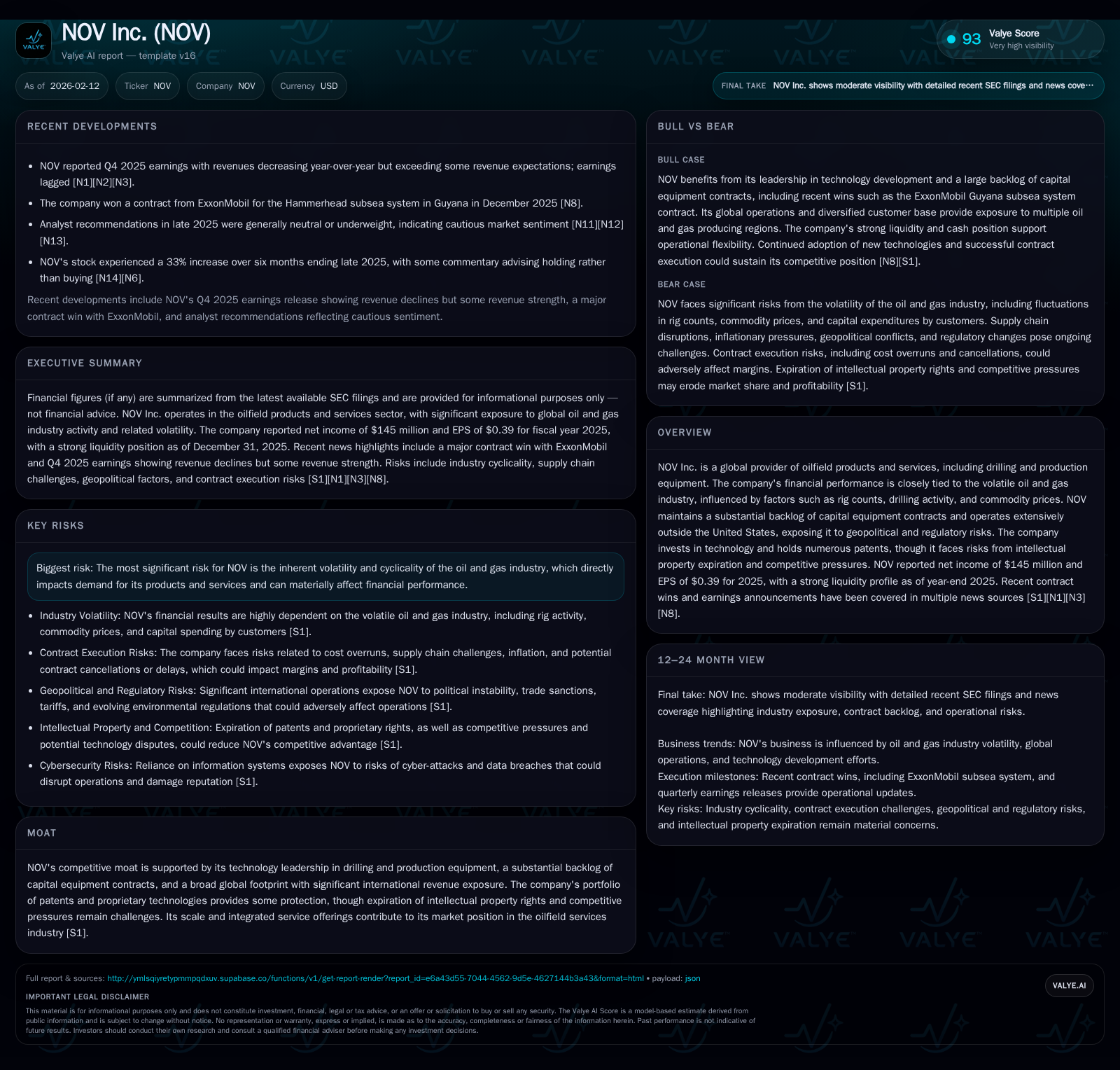
NOV Inc., a leading global provider of oilfield products and services, reported a modest net income of $145 million for 2025, contending with industry-wide headwinds marked by lower rig counts and fluctuating oil prices. Its substantial backlog of capital equipment contracts of $4.34 billion, extensive international footprint, and portfolio of proprietary technologies underpin a durable competitive moat. However, persistent cyclical volatility, supply chain complexities, and geopolitical risks continue to influence operational results and margin pressure. Recent earnings showed revenue outperformance relative to some expectations but earnings per share missed estimates, reflecting challenges in cost control and market demand dynamics.
Company Overview
NOV Inc. is a major player in the oilfield products and services arena, focusing primarily on drilling and production equipment deployed globally. Its financial health is intricately tied to fluctuations in the upstream oil and gas market, which influence drilling activity levels, rig counts, and overall exploration spending.
As of the end of 2025, NOV reported net income totaling $145 million with earnings per share at $0.39 — figures that reflect the challenging macroeconomic backdrop affecting end customer demand. While revenues slightly exceeded estimates for the fourth quarter, sales contracted year-over-year in line with broader sector contraction [N1][N3].
Industry Context
The upstream oilfield services sector is heavily cyclical; demand for NOV's offerings depends on multiple volatile factors including current and future crude prices, OPEC production decisions, geopolitical strife affecting supplier countries like Russia or Iran, US shale production dynamics, and government policy shifts internationally [S1]. Drilling rig utilization rates directly impact equipment orders and maintenance service volumes.
Additionally, global disruptions such as pandemics or wars can rapidly alter supply chain functionality or customer investment priorities. Inflationary pressures inflate raw material costs (especially steel), while newly imposed tariffs or trade restrictions further complicate cost structures.
Financial Position
NOV finished 2025 with approximately $1.55 billion in cash and cash equivalents against current liabilities of around $2.41 billion — yielding a strong current ratio near 2.42 that reflects sound short-term liquidity management [F1]. Total current assets stood at about $5.82 billion.
A notable asset underpinning NOV's financial outlook is its backlog of $4.34 billion in capital equipment contracts awaiting delivery. While this offers revenue visibility, it carries risks related to customer creditworthiness, fluctuating commodity prices potentially prompting order cancellations or deferrals, supply disruptions delaying fulfillment, inflation-driven cost overruns, and contractual penalties if technical specifications are unmet [S1].
NOV’s integrated business model combines equipment manufacturing with complementary drilling services that generate diversified revenue streams mitigating some cyclicality impacts.
Competitive Position & Moat
At the core of NOV's moat is its technology leadership manifested through an array of proprietary designs protected by patents alongside a comprehensive suite of drilling rigs, pressure control equipment, intervention tools, and production systems [S1]. This technological edge facilitates differentiation in a crowded marketplace where quality assurance is critical.
Its global footprint provides exposure to growing international markets while also introducing complexity through diverse regulatory landscapes and currency risk management requirements.
However, existing patents are approaching expiration dates on key innovations; thus sustaining R&D efforts is paramount to defending market share from aggressive competitors seeking to erode margins.
Risks & Challenges
VOLATILITY REMAINS THE DOMINANT RISK: The intrinsic cyclicality of oil exploration directly governs demand for NOV’s products. Price downturns curtail exploration budgets causing rig count declines that cascade into deferred capital orders [S1].
Supply chain vulnerabilities surfaced during the pandemic period have improved gradually but could reemerge given geopolitical uncertainties (e.g., trade sanctions) or labor market tightness affecting manufacturing timelines.
Tariffs imposed on critical raw materials such as steel elevate production costs; these are partially absorbed but ultimately pressure margins [S1].
Environmental policy shifts create dual impacts: increased compliance costs for operators may reduce equipment purchases; conversely new technologies aligned with emissions reduction could open fresh avenues if NOV adapts effectively.
Currency fluctuation risks pertain especially to sales outside the U.S., impacting translation of foreign revenue into reported results [S1].
Recent Operational Developments
In Q4 2025 releases, NOV posted results below EPS consensus but managed to beat revenue expectations driven by some recent contract awards and steady aftermarket activity [N1][N3]. Analysts note improvements in backlog replenishment signal ongoing customer interest but highlight caution given persistent margin pressure from elevated input costs and competitive pricing concessions [N6].
Market sentiment has been mixed; some see value in long-term technology leadership while others advocate patience amid uncertain near-term industry fundamentals [N7]. Institutional investors have increased exposure recently suggesting confidence in cyclical recovery prospects [N8].
Strategic Outlook & Considerations
NOV’s ability to leverage its scale across manufacturing sites worldwide provides operational flexibility essential during volatile demand cycles. Continued investment in R&D will be key for product pipeline refreshment ensuring relevance amid advancing drilling techniques.
Navigating geopolitical risks proactively through diversified geographic operations may mitigate sudden disruptions but requires continuous monitoring as global political landscapes shift rapidly.
Innovation targeting emissions reduction technology may align NOV with customer priorities adapting to climate policy constraints—a potential route towards stabilizing revenue streams beyond traditional hydrocarbon markets.
Maintaining robust liquidity enables financial resilience during downturns while allowing selective capital deployment when opportunities arise for strategic acquisitions or capacity expansions.
Conclusion
As the oilfield services environment continues to demonstrate pronounced cyclicality influenced by myriad external factors (commodity pricing volatility, geopolitical tensions, evolving regulatory regimes), NOV’s strong backlog combined with technological know-how provides advantages that should support its market standing over the medium term. Nevertheless, fundamental risks inherent to the industry mandate vigilant execution regarding operational efficiency, cost control amidst inflationary pressures, and adaptive strategies addressing both regulatory landscapes and shifting client capital investment behaviors.
This analysis is provided solely for informational purposes without providing investment advice or recommendations.
Disclaimer: This is research-only, informational analysis and not investment advice. It may include AI-generated interpretation and general industry context. Always verify important details using primary sources.

Comments