
ZoomInfo's AI-Driven GTM Platform Faces Financial and Macro Crosswinds in Early 2026
ZoomInfo’s sophisticated three-layer intelligence platform underpins solid Q4 momentum even as balance sheet constraints and macroeconomic instability complicate its growth outlook.
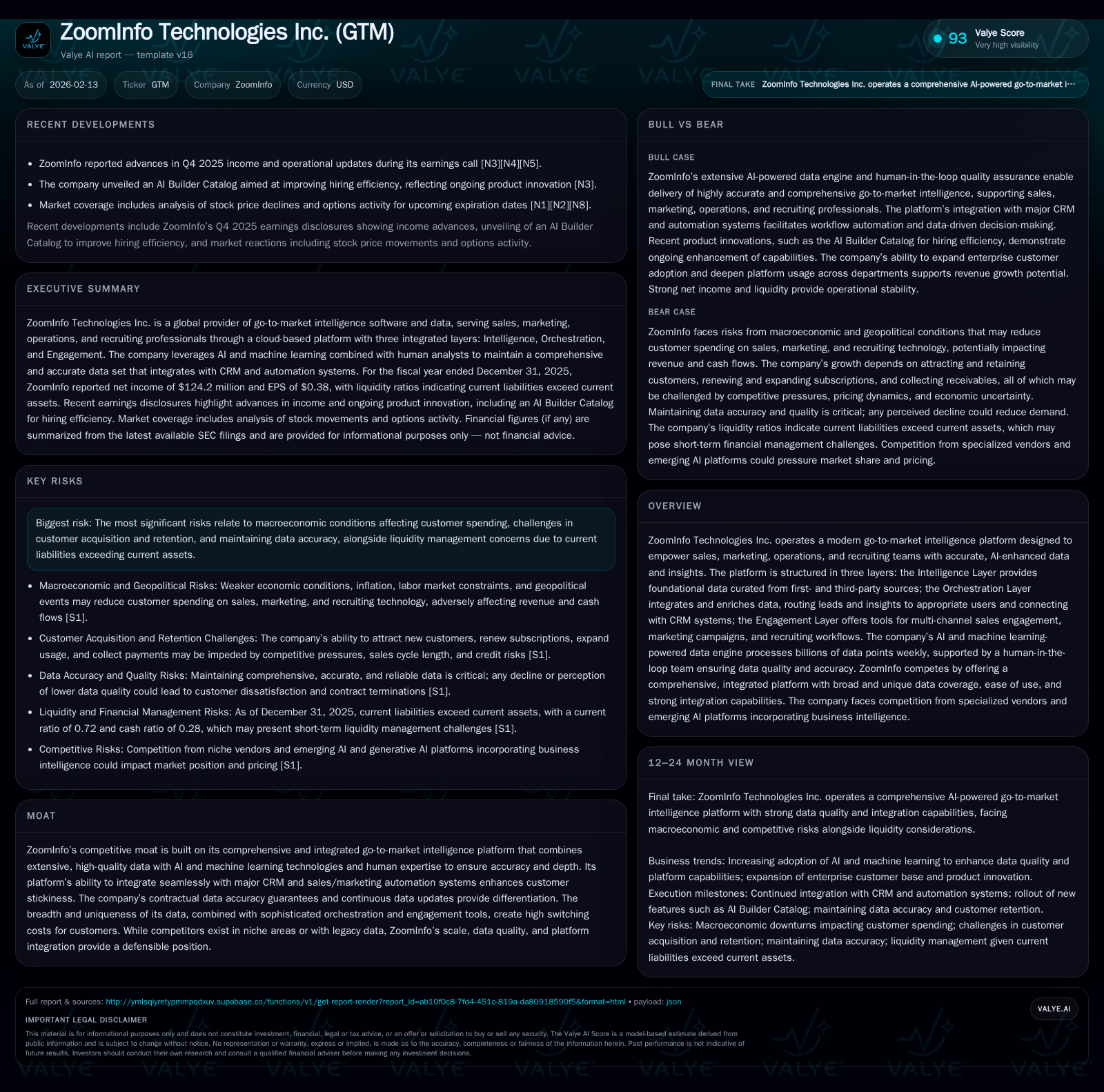
ZoomInfo Technologies Inc. has carved out a strong competitive position through its integrated AI-powered go-to-market intelligence platform that serves sales, marketing, operations, and recruiting teams globally. Despite beating Q4 2025 earnings estimates with improved net income and revenue, the company faces palpable liquidity pressures with current liabilities exceeding current assets, reflected in a sub-1 current ratio. Concurrently, ZoomInfo’s growth trajectory contends with macroeconomic headwinds—slowing IT spending cycles and cautious customer budget behavior—that may dampen near-term expansion. The company’s moat remains rooted in comprehensive data quality, human plus machine curation, and seamless CRM integration that fuels recurring customer reliance. Looking ahead, ZoomInfo’s ability to innovate AI capabilities and navigate operational risks will be pivotal amid a challenging financial and market landscape.
ZoomInfo’s Technological Core: A Three-Layer AI-Driven Platform
At the heart of ZoomInfo Technologies lies a remarkably structured go-to-market intelligence ecosystem built upon three synergistic layers: Intelligence, Orchestration, and Engagement [S1]. The Intelligence Layer forms the foundation with vast quantities of curated first- and third-party data comprising billions of data points spanning company information such as hierarchy, intent signals, technological footprints, financial metrics, and contact details. This extensive dataset is continuously refreshed to maintain freshness and reliability.
The Orchestration Layer acts as the integrative engine — dynamically enriching data while routing leads and insights to designated users based on roles or workflows. It bridges ZoomInfo’s proprietary datasets seamlessly into customers’ CRM platforms and marketing automation tools via robust integrations. This interoperability enables organizations to power complex automated business workflows without cumbersome manual data handling.
The Engagement Layer finalizes the value chain by equipping sales reps, marketers, operations specialists, and recruiters with actionable tools for outreach campaigns across multiple channels including email sequences, account-based marketing programs, recruiting pipelines automation, web meeting transcription with insight generation, and chat functionalities. Together these layers enable ZoomInfo’s clients to pinpoint prospects precisely, tailor communications effectively, and accelerate deal velocity.
A significant differentiator is ZoomInfo’s reliance on artificial intelligence (AI) and machine learning (ML) technologies operating at massive scale — the platform analyzes billions of incoming data streams weekly. Supplementing this is a dedicated human-in-the-loop team composed of research analysts who validate critical data points ensuring superior accuracy — a blend that reinforces reliable decision-making for customers [valye_report_excerpt].
The Moat That Matters: Data Quality, Integration, and Customer Stickiness
ZoomInfo’s strategic moat extends beyond mere data aggregation. The firm’s hybrid model combining robust AI-driven analytics with expert human augmentation results in unparalleled data quality distinguishing it from fragmented or legacy providers [valye_report_excerpt][S1]. Customers benefit from contractual guarantees on data accuracy which are continually upheld through ongoing updates—a service commitment rare in this industry.
Crucially, the platform’s architectural design fosters high customer stickiness through seamless integration into existing salesforce.com-like CRM ecosystems. By embedding itself into essential revenue-driving workflows across sales ops teams worldwide, ZoomInfo raises switching costs substantially. Enterprises increasingly rely on the consistent freshness of contacts, organizational changes in prospect firms captured promptly by ZoomInfo’s data engine coupled with intelligent lead routing — factors difficult to replicate swiftly by competitors.
This lock-in effect is further strengthened by extended enterprise adoption patterns where departments like marketing or recruiting expand usage once initial sales teams drive value outcomes — thereby creating internal dependencies on ZoomInfo technology that become woven into broader enterprise pipelines.
Q4 2025 Earnings Beat: Momentum Versus Market Skepticism
Delivering an encouraging headline result in early February 2026 [N1][N2], ZoomInfo surpassed consensus revenue expectations accompanied by net income soaring to $124.2 million for fiscal year ending December 31 [F1]. Yet paradoxically the share price suffered steep declines post-reporting [N5], largely driven by investor apprehension about forward guidance amidst uncertain macroeconomic conditions.
Market commentators noted that although top-line strength was intact thanks to stable subscription renewals and modest new client additions, management highlighted persistent elongation in sales cycles accompanied by pricing pressures especially within large enterprise segments [N1]. Forward commentary suggested subdued visibility over renewal rates given tightening client budgets for IT spend tied to sales/marketing intelligence technology.
The stock performance mismatch underscores growing investor wariness: operational wins beat street estimates but tectonic shifts in economic sentiment around corporate spending restrained upside valuation momentum in short term [N5]. This reflects a growing bifurcation between fundamental execution capability versus external uncertainties weighing on near-term multiple expansions.
Financial Health Under the Microscope: Liquidity Challenges and Balance Sheet Realities
Despite healthy operational profitability streams reported in FY25 [F1], a critical financial metric raises flags — the current ratio stands at a tight 0.72 (current assets $454 million vs. current liabilities $632.9 million) as of December quarter close [F1]. Put simply: ZoomInfo holds less liquid resources than its upcoming short-term obligations require.
Such imbalance means the company must carefully manage cash flows or consider financing alternatives to navigate near-term exigencies without compromising investments into growth initiatives or R&D efforts essential to sustaining innovation leadership [S1]. While cash & equivalents remain substantial at $175.9 million [F1], looming liabilities create pressure points that could constrain agility.
From an operational risk perspective this scenario demands stricter working capital optimization since liquidity shortages could hinder hiring plans for crucial talent pools like data scientists optimizing algorithms or sales hires vital for closing bigger enterprise contracts during macro slowdowns.
Hence the interplay between solid margin delivery yet constrained balance sheet flexibility portrays ZoomInfo walking a financial tightrope requiring nuanced capital stewardship complemented by prudent cost management practices [S1].
Macro Headwinds and Their Impact on Growth Trajectory
ZoomInfo operates in an environment increasingly shaped by widespread economic uncertainty and shifting IT expenditure priorities among its client base—primarily enterprises allocating budgets toward digital transformation projects but exhibiting caution amid inflationary pressures and geopolitical volatility [S1][valye_report_excerpt]. These macro headwinds materially impact customer purchasing behavior:
- Prolonged inflation erodes discretionary spend capacity within companies’ sales & marketing budgets,
- Labor market tightness inflates personnel costs across departments using ZoomInfo's services,
- Volatile credit markets tighten access to capital slowing down buying decisions,
- Geopolitical tensions contribute to supply chain unpredictability indirectly affecting corporate confidence.
Collectively these factors contribute to elongated sales cycles characterized by additional scrutiny on subscription renewals or contract upsells resulting in potential margin compression from concession negotiations or shorter contract durations requested by buyers [S1]. Slower line expansion results naturally expose near-term growth targets to downside risk requiring calibrated expectations setting from leadership.
Customer Dynamics: Acquisition, Retention, and Contract Nuances
ZoomInfo’s ability to attract new logos while retaining existing ones has been historically robust yet faces intensifying challenges reflective of longer enterprise procurement cycles weighted toward rigorous vendor evaluation processes [S1]. The company emphasizes expanding within installed bases through deeper product adoption across functional teams as a strategic lever counterbalancing acquisition slowdowns.
Renewal patterns have shown resilience but are vulnerable to economic stress forcing clients either toward smaller footprint contracts or opting for competitive alternatives offering lower pricing albeit narrower features sets. Moreover adopting multiple layers of ZoomInfo’s platform—from pure contact intelligence expanding into lead orchestration plus multi-channel engagement tools—serves as hedging against churn by embedding workflow dependencies deeply within organizations.
Effective cross-selling strategies amplifying ARPU (average revenue per user) remain paramount amidst shifting buyer behaviors evolving amid tighter budget regimes [S1].
Competitive Landscape: Navigating Niche Rivals and Legacy Data Players
While niche firms continue specializing in discrete verticals or focus areas like intent signal generation or candidate sourcing databases alone, ZoomInfo distinguishes itself through comprehensive breadth across all layers of go-to-market activity combined within a unified platform architecture [valye_report_excerpt]. Its scale advantage enables continuous ingestion from millions of sources supported by both AI validation mechanisms plus dedicated analyst verification teams—delivering superior data quality compared to smaller or legacy database providers reliant heavily on static or outdated information repositories.
This broad coverage allows ZoomInfo not merely to act as a point solution but offer end-to-end capabilities spanning multiple user personas—sales executives through recruiters—thereby expanding total addressable market reach over rivals offering fragmented capabilities.
Integration depth with dominant CRMs constitutes another moat element since disruptions would require costly workflow reengineering for customers currently embedded deeply into ZoomInfo’s ecosystem — raising barriers against competitor encroachment [valye_report_excerpt].
Nonetheless competitive dynamics remain active prompting continuous innovation cycles ensuring feature parity plus contemplating modular product mix adjustments responsive to evolving customer preferences.
Future Outlook: Innovation Roadmap and Risk Mitigation Strategies
Looking ahead to subsequent quarters following Q4 earnings season preview reports indicate tempered but steady expectations predicated on ongoing AI-powered enhancements enabling richer predictive insights atop baseline contact intelligence sets [N3][S1]. Key initiatives center around refining orchestration algorithms delivering smarter routing capabilities tied directly into customers’ CRM environments coupled with augmenting engagement tools fostering higher conversion rates in multi-touch outreach campaigns.
Simultaneously management articulates cognizance regarding potential liquidity event risks necessitating balancing aggressive growth investments against maintaining disciplined financial controls given observed current ratio shortcomings [S1]. Strategically prioritizing product lines driving immediate ROI while selectively delaying less mature experimental offerings may enable navigating macro headwinds prudently without stalling long-term innovation momentum.
In essence the path forward will likely be one blending accelerated AI-driven feature enrichment designed to deepen penetration within existing customers alongside tactical cost containment measures mitigating external economic vagaries—a duality emblematic of tech-led companies operating amid fluctuating global economic climates today.
Disclaimer: This analysis is intended solely for informational purposes reflecting publicly available filings and news reports as of early 2026. It does not constitute investment advice or recommendations.
Disclaimer: This is research-only, informational analysis and not investment advice. It may include AI-generated interpretation and general industry context. Always verify important details using primary sources.

Comments