
ASTROTECH Corp's Mass Spectrometry Innovations Forge Competitive Moats in High-Security and Industrial Markets
ASTROTECH leverages proprietary ultra-high vacuum mass spectrometry technology across security, industrial, and environmental sectors amidst financial challenges.
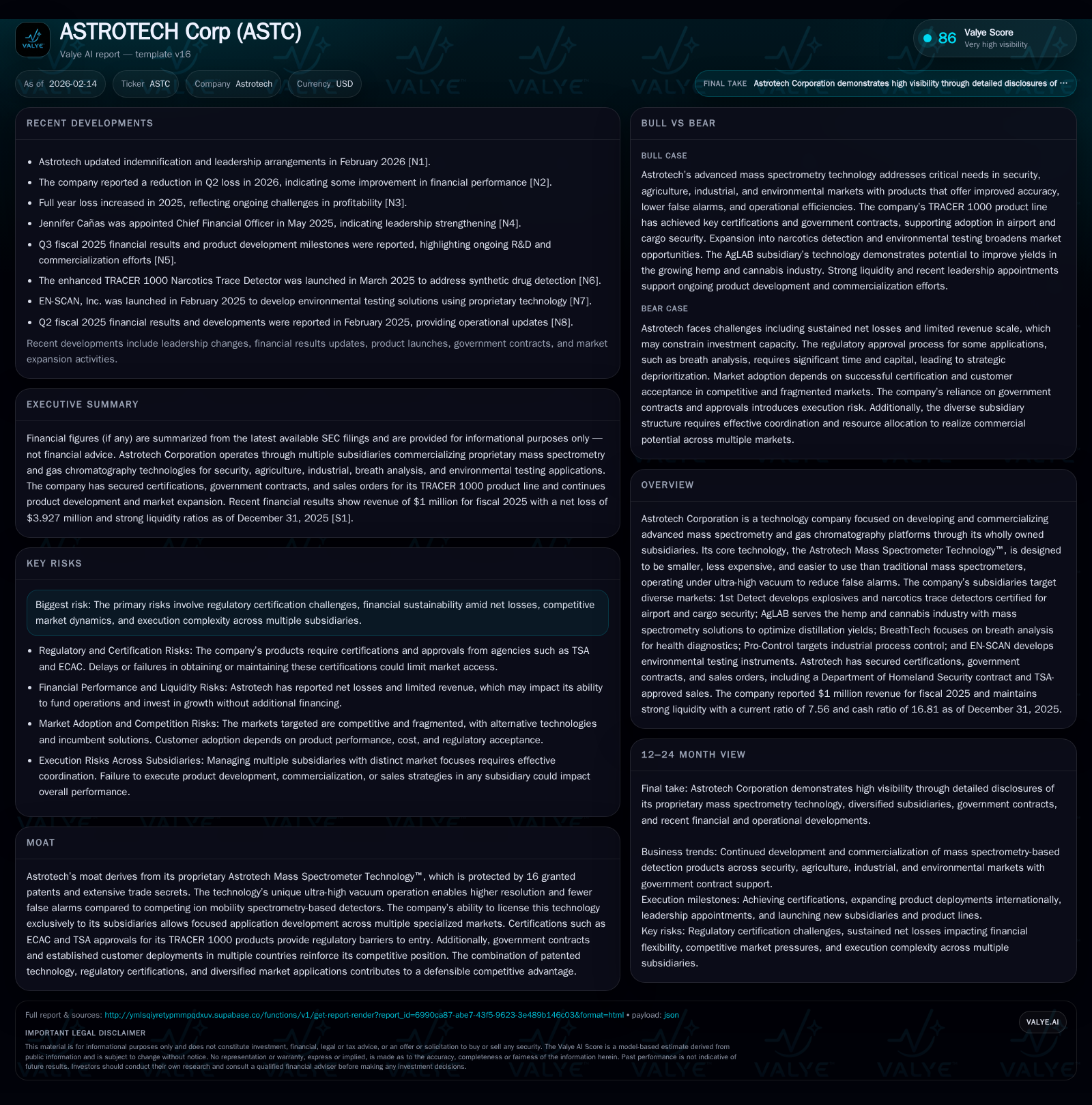
ASTROTECH Corp focuses on transforming chemical detection through its patented Astrotech Mass Spectrometer Technology™, designed for smaller size, cost-efficiency, and superior false alarm reduction. Its subsidiaries serve niche markets such as explosives detection in airports, cannabis industry analytics, breath health diagnostics, and environmental monitoring. Despite persistent net losses, the company’s diversified business model benefits from regulatory certifications and government contracts that create meaningful barriers to competition. However, the complexity of managing multiple subsidiaries and regulatory hurdles remain material risks as ASTROTECH pushes toward commercialization.
Revolutionizing Chemical Detection: The Promise of Astrotech’s Mass Spectrometry
From the frontlines of global security checkpoints to complex industrial environments, the imperative for reliable detection of chemical threats has never been greater. Traditional detection techniques often struggle with cumbersome instrumentation or yield excessive false alarms, causing operational bottlenecks and compromised safety. ASTROTECH Corporation enters this landscape with a clear mission: to democratize access to advanced mass spectrometry by delivering portable, cost-effective instruments tailored for real-time use in high-volume settings such as airports, border controls, cargo hubs, and beyond [S2].
Unlike traditional mass spectrometers hampered by size and complexity, ASTROTECH’s devices leverage the Astrotech Mass Spectrometer Technology™ (AMS Technology) which streamlines operation without sacrificing analytical precision. This is particularly vital in applications demanding rapid throughput without the noise of frequent false positives. By targeting scalable solutions optimized for rugged field conditions, ASTC attempts to bridge a long-standing gap between laboratory-grade precision and practical security deployments [F1], [N2].
From Ultra-High Vacuum to Market Edge: Decoding ASTC’s Proprietary Technology Moat
At the heart of ASTROTECH’s value proposition lies its patented AMS Technology platform sustained by sixteen granted patents plus extensive trade secrets—forming a formidable technical moat [Valye_report_excerpt]. The key differentiator is its operation within an ultra-high vacuum environment. This sophisticated approach fundamentally reduces molecular interference common in other detection techniques such as ion mobility spectrometry (IMS), which tends to trigger false alarms from benign substances.
By maintaining a virtually contaminant-free measurement chamber, ASTROTECH’s mass spectrometers achieve elevated resolution that enables precise identification across a broader threat library. Unlike IMS-based detectors whose performance diminishes when expanding detectable compounds—which ironically increases false positive rates—the AMS platform incorporates an extensible threat database without compromising accuracy [S2]. This structural advantage yields not only improved reliability but also operational efficiencies crucial in high-stakes environments.
Such proprietary innovation allows the company to exclusively license AMS Technology to its subsidiaries that focus on distinct end-markets while preserving centralized IP governance. This strategy multiplies applications yet safeguards core technology from external encroachment [Valye_report_excerpt].
Safeguarding Borders and Beyond: 1st Detect’s Role and Certification Wins
1st Detect Corporation stands as ASTROTECH's frontline subsidiary dedicated to security screening technologies. It markets the TRACER 1000™, the industry’s first mass spectrometry-based explosives trace detector (ETD) certified by the European Civil Aviation Conference (ECAC) and approved by the U.S. Transportation Security Administration (TSA) specifically for air cargo inspection [S2], [Valye_report_excerpt].
These certifications create significant regulatory hurdles for competitors and are essential endorsements that validate product efficacy in critical infrastructure settings. The TRACER 1000 addresses longstanding customer dissatisfaction with legacy IMS detectors that frequently misidentify personal care products or household chemicals as explosive threats—disrupting operations through unnecessary delays or shutdowns.
By contrast, the TRACER 1000's ultra-high vacuum mass spectrometry technology minimizes false alarms while providing an expansive threat library capable of encompassing hundreds of explosive compounds without degradation of performance. This translates into smoother operational workflows at airports and border crossings where accuracy underpins security integrity [N1].
Diversified Innovation: The Strategic Playbook of Astrotech’s Subsidiaries
ASTROTECH's ecosystem extends well beyond border security. Its wholly owned subsidiaries tailor AMS Technology applications for varied market verticals:
- AgLAB targets the rapidly growing hemp and cannabis sector with mass spectrometry solutions designed to optimize extraction yields critical for product quality.
- BreathTech develops breath analysis systems aimed at non-invasive health diagnostics that could disrupt conventional medical testing paradigms.
- Pro-Control applies gas chromatography combined with mass spectrometry toward industrial process monitoring where precise chemical analytics enhance manufacturing efficiency.
- EN-SCAN pursues environmental testing instruments capable of field deployment under rugged conditions.
This diversification strategy relies on exclusive licensing from ATI (Astrotech Technologies, Inc.) which owns AMS Technology intellectual property. By centralizing IP control while enabling focused innovation within each subsidiary’s domain, ASTC maximizes technology leverage while minimizing fragmentation risk [S2], [Valye_report_excerpt].
Financial Realities: Balancing Growth Ambitions with Operating Losses
While ASTROTECH demonstrates promising technological breadth, financials reveal an ongoing challenge translating innovation into sustainable profitability. Revenue remains limited; mid-year 2025 figures approximate $1 million—a fraction reflective of early commercialization stages rather than scale [F1]. Annual net losses persist near $3.9 million, albeit with some improvement evidenced in Q2 where losses narrowed per recent earnings disclosures [N2], [S2].
Liquidity levels afford a significant buffer with over $28 million reported cash holdings available as of early 2022, enabling continued R&D investment and market development initiatives despite current operating deficits. The company maintains a healthy current ratio near 7.56 indicating solid short-term financial solvency [F1].
However, the pressure remains acute to balance cost structures against expanding sales channels especially given multi-subsidiary management demands compounded by niche market complexities.
Navigating Regulatory Complexity and Market Competition Risks
Regulatory certification emerges as both a moat builder and notable obstacle within ASTROTECH’s operational landscape. While ECAC and TSA approvals confer competitive advantages simplifying entry into controlled markets like aviation security, these processes require rigorous validation timelines delaying time-to-market for new offerings or geographies [Valye_report_excerpt], [S2].
Simultaneously, entrenched incumbents employing IMS technologies maintain significant installed bases that benefit from scale advantages despite acknowledged technical limitations. Convincing customers to transition involves overcoming inertia entrenched by regulation protocols and cost considerations.
Moreover, executing across several subsidiaries dispersed among diverse industries imposes organizational complexity risks intertwined with execution discipline needs to prevent resource dilution or strategic misalignment.
Leadership and Governance Adjustments Reflecting Strategic Response
Recent updates indicate enhancements in ASTROTECH's leadership framework including revised indemnification protocols alongside adjustments in executive or board-level accountabilities [N1]. These moves suggest management recognition of heightened operational challenges aligned with strategic imperatives requiring robust governance.
Such procedural refinements can fortify internal cohesion vital for navigating technological milestones, regulatory landscapes, and capital allocation decisions essential during scaling phases.
What’s Next for ASTROTECH? Roadmap Indicators from Recent Developments
Looking ahead, progress will be measured against several vectors: expansion of TRACER 1000 adoption beyond early customers through leveraging ECAC/TSA certifications; broadening deployment of AgLAB analytics amid evolving cannabis regulations; maturation of BreathTech products validating clinical relevance; plus advancing EN-SCAN ruggedized instruments into environmental monitoring niches.
Financially, sustaining adequate funding runway while driving revenues beyond modest initial levels will test commercial execution capabilities amid ongoing net losses [N2], [Valye_report_excerpt]. The company’s pipeline underscores proactive R&D activity but tempered uncertainty remains regarding pace of market penetration given certification dependencies.
In summary, ASTROTECH stands at an inflection point where patented ultra-high vacuum mass spectrometry constitutes a defensible competitive moat across diversified sectors addressing pressing security and industrial needs. However, transforming technological promise into commercial traction will require adept navigation of regulatory bottlenecks coupled with disciplined resource management amid complex multi-subsidiary operations.
This analysis is based on publicly available information as of February 2026 and should not be construed as investment advice.
Disclaimer: This is research-only, informational analysis and not investment advice. It may include AI-generated interpretation and general industry context. Always verify important details using primary sources.

Comments