
Citius Pharmaceuticals on the Brink: LYMPHIR Launch Amid Financial and Commercial Hurdles
Citius Pharmaceuticals faces a pivotal moment as it prepares to commercialize LYMPHIR, balancing distributor partnerships and financial constraints.
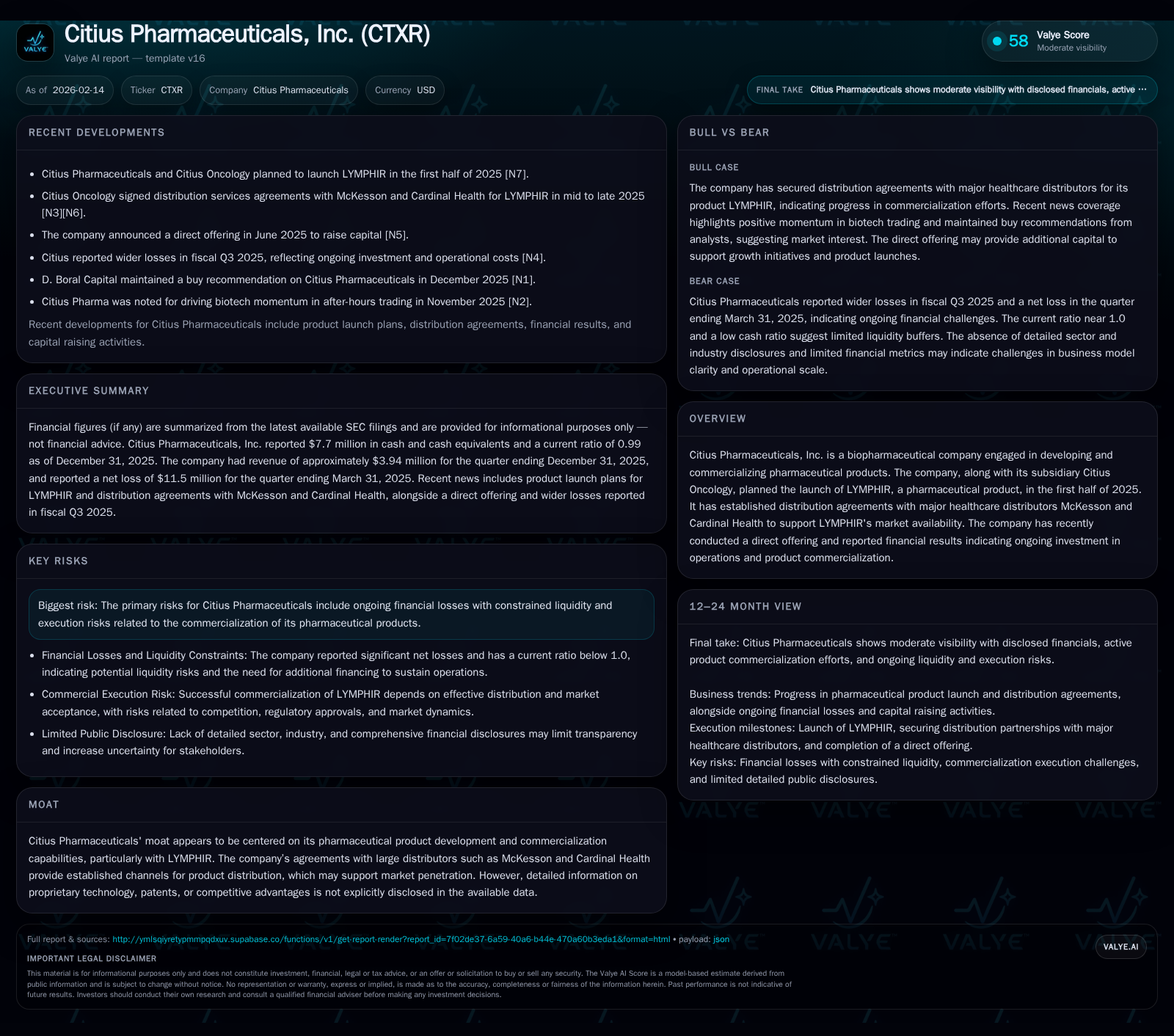
Citius Pharmaceuticals, Inc. is nearing the commercial launch of LYMPHIR, scheduled for the first half of 2025, representing a critical test of its operational readiness and strategic direction. The company has secured distribution agreements with major players McKesson and Cardinal Health to facilitate market access. However, financial reports reveal ongoing net losses and tight liquidity, underscoring execution risks inherent in transitioning from product development to full commercialization. Absent clear proprietary technology disclosures, Citius leans heavily on partnerships and product rollout success to build its competitive moat.
The LYMPHIR Launch: A Defining Milestone
As Citius Pharmaceuticals approaches the planned launch of LYMPHIR in the first half of 2025, the company stands at a crucial inflection point between clinical development accomplishments and the practical realities of commercialization [valye_report_excerpt]. LYMPHIR represents not only a potential new revenue stream but a barometer for the company's operational rigor—it tests supply chain management, marketing reach, sales force deployment, and post-launch regulatory adherence.
Though detailed clinical data are beyond this scope, commercially launching a novel pharmaceutical product requires coordinated ramp-up efforts that typically strain smaller biopharma entities like Citius. Success here would validate years of R&D investment but also expose the company to market dynamics where prescribers' preferences, payor coverage decisions, and competitive entrants influence uptake.
Building Bridges: Distribution Partnerships with McKesson and Cardinal Health
Critical to LYMPHIR's market entry are established distribution agreements the company has inked with McKesson and Cardinal Health [valye_report_excerpt]. These firms are among the largest healthcare distributors in the U.S., controlling vast retail pharmacy networks and hospital supply chains.
Such partnerships offer Citius immediate scale in accessing pharmacy outlets without the need for building proprietary logistics infrastructures—an expensive and time-consuming endeavor. Moreover, they may create de facto barriers for competitors through entrenched supply channels once these relationships deepen operationally.
However, partnership reliance also embeds risk: distributor bargaining power can affect pricing strategies and margins. The efficiency of these channel providers will be pivotal in enabling timely grade-level product availability crucial during launch phases.
Financial Foundation Under Scrutiny: Liquidity and Losses
Financial data paint a picture of constrained resources amid aggressive commercialization efforts [F1][S2]. For the quarter ending December 31, 2025, Citius reported revenues amounting to approximately $3.94 million—a modest figure relative to commercial-scale enterprises.
Net loss for Q1 2025 exceeded $11.5 million (as per the trailing quarter ended March 31, 2025), illustrating persistent operational deficit which must be bridged to sustain ongoing activities [F1]. Cash and equivalents stood at roughly $7.72 million at year-end December 2025—insufficient for extensive marketing rollouts without additional funding or rapid revenue growth.
Current assets ($37.95 million) slightly lagged current liabilities ($38.21 million), yielding a current ratio near parity at about 0.99 [F1]. In practical terms, this signals limited cushion against short-term claims on resources; any unexpected delays or cost overruns could stress solvency if not mitigated.
Commercialization Challenges: Execution Risk in Focus
Moving from clinical success to broad-based commercial traction is historically fraught for emerging biopharmaceutical companies like Citius [valye_report_excerpt][S2]. The highlighted "execution risk" reflects multiple vectors:
- Scaling a sales force competent in specialized pharmaceutical markets,
- Managing complex regulatory compliance demands that evolve pre- and post-market,
- Convincing prescribers amid competition from established therapies,
- Navigating reimbursement pathways across insurers including Medicare/Medicaid,
- Ensuring adequate manufacturing capacity meets demand without surplus inventory.
Failures or delays on any front could impact revenue realization timelines, inflating cash burn further—a looming threat given current liquidity constraints.
Unpacking the Moat: What Sets Citius Apart?
Available information offers limited visibility into any deep proprietary technology underpinning LYMPHIR or other intellectual property assets [valye_report_excerpt]. This lack restricts analysis of typical pharma moat elements such as robust patent estates or exclusive formulations that competitors cannot easily replicate.
Instead, Citius’ moat appears oriented around:
- Leveraging partnerships with large distribution entities,
- Its ability to execute commercialization logistics swiftly,
- Potential niche therapeutic positioning of LYMPHIR which might capture unmet medical needs.
While these factors can slow competitor entry somewhat, absence of strong patent protection can leave CTXR vulnerable if market uptake proves promising—attracting imitators or generic pressures sooner than peers enjoy.
Leadership and Corporate Identity: Uncovering the Backstory
Structurally, Citius Pharmaceuticals is legally incorporated in Nevada but headquartered at 11 Commerce Drive, Cranford, New Jersey [S1]. It trades under ticker CTXR on the NASDAQ Capital Market, characterizing it as a smaller reporting company [S1], indicating it operates below thresholds set for accelerated filers and large-cap biotech firms.
This status signals an organization still solidifying scale rather than commanding institutional capital markets prominence. It suggests governance structures align with growth-stage norms rather than mature corporate complexity.
Risk Realities: Interpreting Persistent Threats
There have been no material changes to disclosed risk factors as per recent quarterly filings [S2]. Notably, there are no significant pending legal proceedings reported that could impose sudden liabilities.
However, recurring themes persist:
- Limited financial runway driven by continued net losses,
- Execution uncertainty concerning commercialization plans,
- Market acceptance challenges among healthcare practitioners,
- Regulatory scrutiny possibility during post-launch phases.
These risks collectively assert caution over near-term stability absent successful top-line inflection upon LYMPHIR’s release.
Market Positioning Amid Industry Dynamics
Though direct competitor benchmarks are absent here, broader industry context places Citius within an intensely competitive biopharma space focused on precision medicine yet demanding scale efficiencies for profitability [N1][valye_report_excerpt].
Investor sentiment across similar segments often reacts sharply to clinical milestone deliveries or commercialization evidence—adding volatility around CTXR’s pending launch period. Sector-wide trends favor innovations addressing unmet patient needs but penalize prolonged developmental cycles without revenue fruition.
Hence, Citius operates at an intersection where delivering patient value quickly correlates closely with financial viability sustainability.
Looking Ahead: Strategic Implications Beyond 2025
Looking past mid-2025 when LYMPHIR enters markets strategically compresses timelines wherein CTXR must demonstrate operational competence converting developmental promise into revenue streams sufficient to offset substantial operating costs [F1][valye_report_excerpt][S2].
Should commercial uptake meet optimistic assumptions fostered by distributor collaborations, this could catalyze momentum boosting capital access possibilities while improving liquidity metrics gradually. Conversely, failure to capture meaningful market share rapidly may force another round of equity dilution or restructuring maneuvers due to stretched cash reserves below $8 million currently observed.
The pathway forward embodies both opportunity—the chance to leapfrog chronic loss through innovation delivery—and peril requiring deft management of financial resource allocation amidst inherent industry unpredictability.
Disclaimer: This analysis synthesizes publicly available documents from SEC filings and news sources up to February 2026. It is intended solely as an informative overview without specific investment recommendations.
Disclaimer: This is research-only, informational analysis and not investment advice. It may include AI-generated interpretation and general industry context. Always verify important details using primary sources.

Comments