
Nasdaq’s Dual Identity: Market Infrastructure Powerhouse and Fintech Innovator in 2025
Nasdaq, Inc. surpasses $5 billion in revenue, leveraging diverse segments amid evolving market dynamics and regulatory challenges.
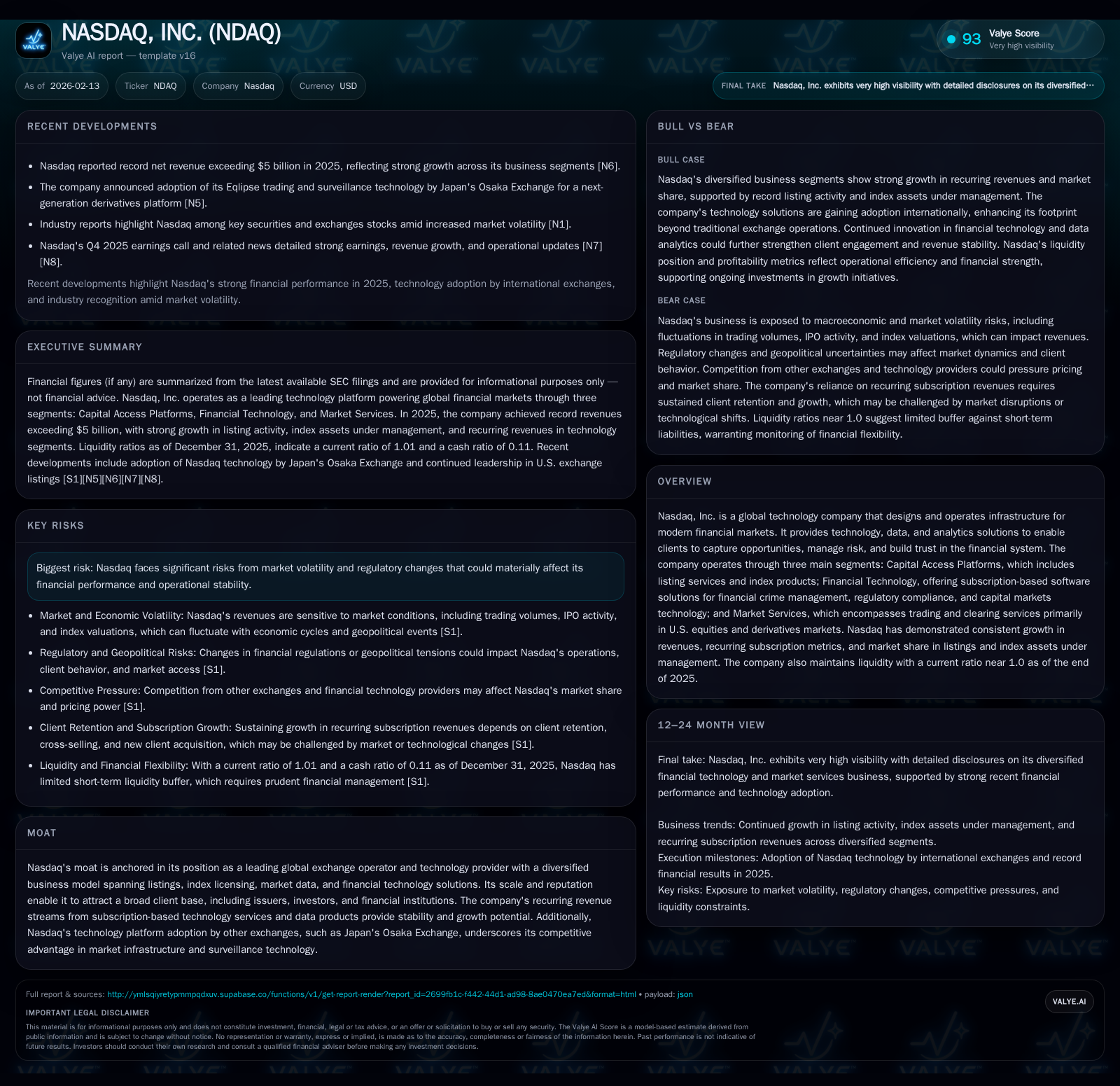
In 2025, Nasdaq marked a historic milestone by exceeding $5.2 billion in net revenues, driven by record IPO proceeds, robust subscription software growth, and elevated trading volumes. Its three-pronged business model — Capital Access Platforms, Financial Technology, and Market Services — underpins broad market influence and recurring revenue streams. Yet, looming risks such as market volatility and regulatory shifts necessitate vigilant strategic navigation as Nasdaq aims for sustained leadership within the competitive exchange ecosystem.
Nasdaq’s 2025: Scaling New Financial Heights
In a landmark performance for fiscal year 2025, Nasdaq shattered the $5 billion revenue ceiling for the first time in its history. Reporting $5.249 billion in net revenues—a robust 12.9% uplift compared to 2024—the company simultaneously drove net income to $1.788 billion, an impressive 60% increase over the prior year [S1][N4]. Operating income climbed nearly 30%, further cementing momentum fuelled by both organic growth and strategic acquisitions.
This financial leap mirrors more than just headline metrics; it reflects Nasdaq's successful orchestration of multiple business engines harmonizing to capture opportunity amid a complex macro backdrop. Elevating shareholder value through an increased dividend (up over 11%) signals management’s confidence amid rapid evolution in global capital markets [S1][N7]. Such results demand close inspection beyond pure numbers to unearth how structural innovations underpinning Nasdaq’s ecosystem drive this success.
Segment Spotlight: Capital Markets Leadership and Innovations
At the core of Nasdaq’s prowess lies its Capital Access Platforms segment—the lifeblood for its listing services and index product innovation. For the seventh consecutive year, Nasdaq sustained leadership as the premier U.S. exchange by proceeds raised [S1]. The IPO arena flourished with operating-company listings generating over $24 billion during 2025 alone.
Intriguingly, this period witnessed historic listing transfer activity totaling $1.2 trillion annually, including the largest recorded exchange transfer—a testament to fierce competitive dynamics among exchanges seeking market share [S1][N4]. Beyond volume, Nasdaq aggressively grew its index footprint launching 122 new products with notable penetration into international markets and niche institutional insurance annuities sectors that enhance its recurring revenue base.
This dual focus on capital formation facilitation and innovative index creation encapsulates Nasdaq’s strategy to cement long-term client relationships while expanding into adjacent asset classes with tailored solutions.
Financial Technology Growth: Subscription Logic in a Digital Age
Nasdaq’s Financial Technology segment emerges as a formidable engine of recurring revenue growth—reporting a remarkable 14% year-over-year increase in Annual Recurring Revenue (ARR) [S1][N6]. This growth is rooted in robust adoption of subscription-based software platforms targeting compliance automation, financial crime detection, risk management, and capital markets infrastructure.
Unlike traditional exchange revenues which are often volume-sensitive and transactional, this segment’s subscription model delivers predictable cash flow insulation against episodic market gyrations. Cross-selling among existing clients combined with wins from new customers highlight how Nasdaq leverages deep domain knowledge embedded in its technology stacks.
Such fintech capabilities distinguish Nasdaq sharply from peers focused predominantly on trading operations, positioning it as a critical enabler of regulatory resiliency and operational efficiency across the financial ecosystem.
Market Services: Trading Volume Gains Reflect Broader Market Trends
Trading volumes constitute another vital strand of Nasdaq’s narrative for 2025. The Market Services segment reported record revenues propelled by vigorous activity across U.S. cash equities and equity options markets [S1][N13]. Elevated macroeconomic volatility—spanning inflation concerns, interest rate adjustments, and geopolitical tensions—sparked heightened investor engagement translating into increased order flow.
Equity options volumes have been particularly buoyant as participants seek hedging instruments amidst uncertain environments. This dynamic underscores how external market conditions mutually reinforce Nasdaq’s core revenue drivers while heightening operational complexity requiring advanced technology solutions.
Moat and Competitive Edge: Technology, Scale, and Global Reach
Nasdaq’s competitive moat extends beyond mere scale or listing prominence—it is deeply anchored in its advanced technology infrastructure and diversified revenue streams spanning capital markets facilitation to sophisticated fintech solutions [S1][N14].
A compelling illustration is the adoption of Nasdaq's Eqlipse trading surveillance platform by Japan’s Osaka Exchange to power next-generation derivatives surveillance capabilities internationally [N14]. Such endorsements reflect market trust in Nasdaq’s technologically forward offerings enhancing market integrity globally.
Moreover, recurring subscriptions from software solutions coupled with dominant index licensing reinforce resilient earnings streams less tethered to cyclical trading fluctuations. The brand's global footprint empowers expansion into emerging markets while maintaining leadership domestically.
Risks on the Horizon: Volatility, Regulation, and Geopolitical Uncertainty
While growth trajectories remain favorable, Nasdaq operates amid multifaceted risks that could challenge future performance [S1][S2][N13]. Exposure to broad market volatility can materially impact transaction-driven revenues if overall investor activity wanes during downturns or recessions.
Regulatory landscapes continue evolving rapidly globally; tighter compliance obligations or unforeseen policy changes may increase operational costs or constrain business lines critical to Nasdaq's strategy. Additionally geopolitical tensions introduce uncertainties that could disrupt cross-border operations or dampen capital market sentiment.
Continuous vigilance over these vectors will be essential for sustaining value creation without compromising agility needed for innovation or client service excellence.
Peers in Perspective: Nasdaq Among Exchange Giants
Nasdaq operates within an intensely competitive sphere alongside formidable peers like Cboe Global Markets (CBOE), Intercontinental Exchange (ICE), and CME Group—all reporting strong recent quarterly earnings surpassing estimates [N1][N2][N3]. These exchanges collectively drive substantial market activity across equities, derivatives, commodities, and data services.
Against this backdrop, Nasdaq differentiates itself through an integrated business model blending marketplace operator advantages with scalable fintech solutions—creating layered revenue diversity versus more singularly-focused competitors [N12]. Market share shifts manifest clearly through listing transfers indicating ongoing jockeying for issuer dominance.
Comprehensive comparative analysis underscores that while peer earnings validate sector strength broadly, Nasdaq's expanded fintech footprint positions it uniquely for future disruptive opportunities amid evolving capital markets demands.
Future Forward: Strategy, Acquisitions, and Market Positioning
Looking ahead, Nasdaq is actively shaping its trajectory via strategic acquisitions such as Adenza completed in late 2023 which bolstered its financial technology capabilities focused on risk analytics and regulatory compliance platforms [S1][N6]. Conversely, divesting Solovis illustrates portfolio pruning to concentrate resources on higher-growth potential areas.
Product innovation pipelines emphasize hybrid offerings blending marketplace functions with SaaS solutions supporting end-to-end capital markets workflows. With increasing digitization accelerating systemic transformation needs—from trade surveillance to ESG data integration—Nasdaq aims to solidify leadership rooted in technological enablement rather than traditional exchange mechanics alone.
Navigating intensifying regulation while harnessing global technology adoption remain twin pillars underpinning sustained relevance across geographies amid shifting competitive contours.
Disclaimer: This analysis is provided solely for informational purposes regarding Nasdaq Inc.’s recent performance characteristics and industry context based on publicly available information as of February 2026. It does not constitute investment advice or recommendations.
Disclaimer: This is research-only, informational analysis and not investment advice. It may include AI-generated interpretation and general industry context. Always verify important details using primary sources.

Comments