
Regen BioPharma Inc: Navigating Niche Regenerative Medicine amid Financial Strains and Early Clinical Challenges
An exploration of Regen BioPharma’s innovative therapies, intellectual property fortress, and financial realities within regenerative medicine.
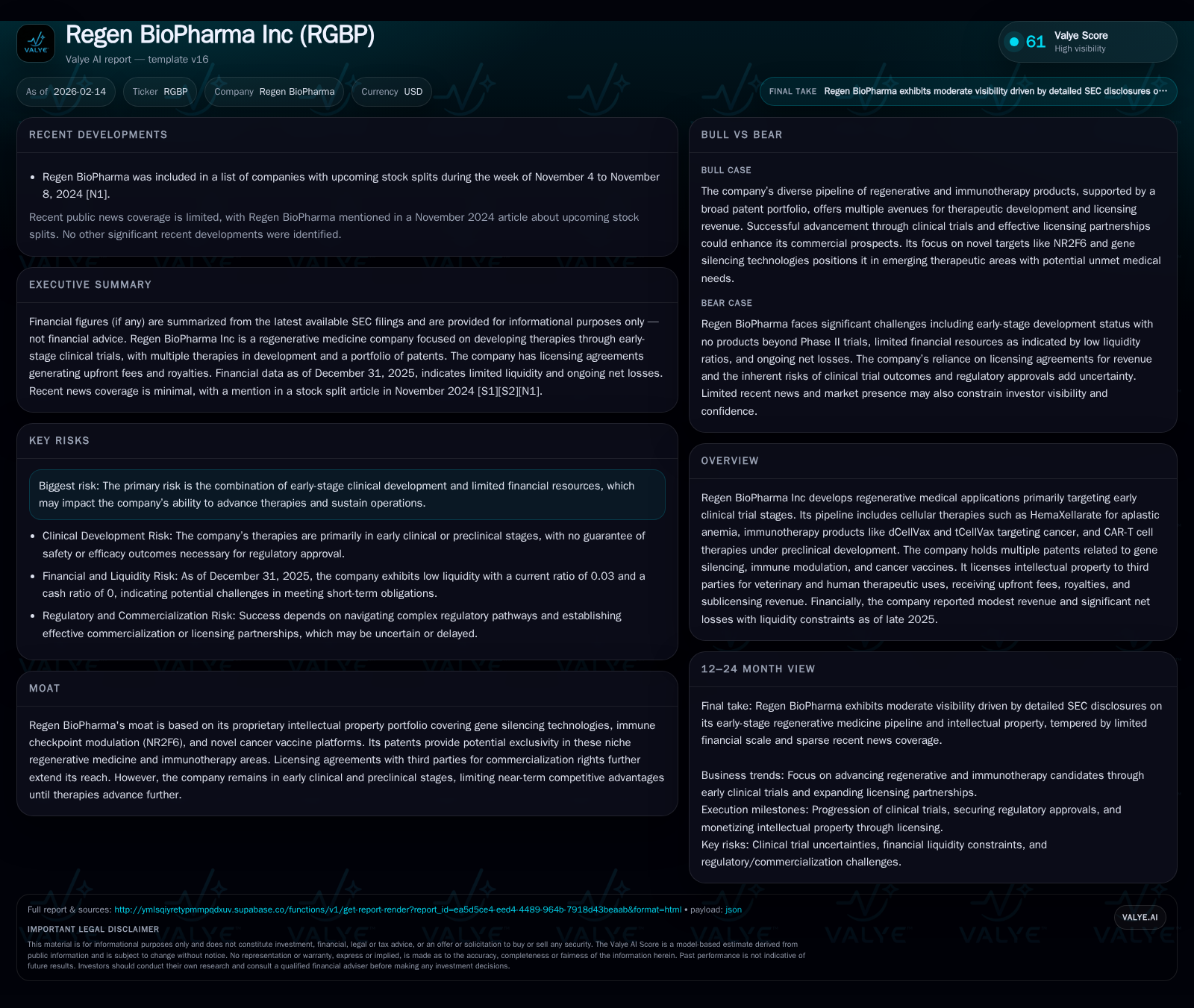
Regen BioPharma Inc operates at the cutting edge of regenerative medical science with a proprietary portfolio focused on gene silencing, immune checkpoint modulation, and cancer vaccine technologies. Its clinical pipeline, featuring therapies like HemaXellarate for aplastic anemia and siRNA-based immunotherapies dCellVax and tCellVax, remains largely in early development stages. While the company benefits from exclusive patents and licensing collaborations, its fragile financial position—with low revenues, steep losses, and scant liquidity—casts a shadow over its ability to advance clinical milestones. Navigating these tensions will define Regen's path forward in an unforgiving biotech environment.
Tracing Regen BioPharma’s Scientific Ambition: From Patents to Pipeline
What drives Regen BioPharma’s scientific mission is its concentrated focus on regenerative medical applications that blend cellular therapy with cutting-edge gene silencing approaches. Incorporated in 2012 with a Nevada base, the company navigates a challenging landscape of early clinical-stage innovation targeting diseases where few effective treatments exist [S1]. At the heart of its pipeline lies HemaXellarate—a unique cellular composition derived from autologous stromal vascular fraction (SVF) cells extracted from adipose tissue. This therapy aims to regenerate bone marrow function in patients afflicted by drug-refractory aplastic anemia through intravenous infusion of endothelial progenitor cells alongside mesenchymal stem cells.
Parallel to this cellular therapy are immunotherapy candidates leveraging short interfering RNA (siRNA) technology to silence key suppressive mechanisms within immune cells. dCellVax employs autologous dendritic cells treated with siRNA targeting indoleamine-2,3-dioxygenase (IDO), an enzyme that enables tumor immune evasion particularly noted in breast cancer contexts. tCellVax removes patient immune cells to inhibit NR2F6—a nuclear receptor functioning as an immune checkpoint—before reinfusion, theoretically unleashing T cell activity against malignant tumors [S1]. These efforts illustrate Regen's ambition to exploit molecular immunology nuances in service of regenerative medicine with an emphasis on modulating dysfunctional immune states both in hematologic and oncologic diseases.
Though innovative, these therapies remain trapped at early clinical or preclinical junctures. HemaXellarate has secured FDA IND clearance and initiated a Phase I trial focused chiefly on safety and feasibility, with secondary efficacy endpoints such as complete or partial response rates. The siRNA-based candidates have yet to reach pivotal demonstration stages but revolve around well-grounded scientific hypotheses regarding immune modulation [S1].
The Distinctive Edge: Intellectual Property as the Company’s Core Moat
In an industry beset by rapid science evolution and competitive patent races, Regen BioPharma stakes its moat on a portfolio of patents integral to its regenerative and immunotherapeutic technologies. These proprietary rights encompass gene silencing techniques harnessing siRNA mechanisms for targeted transcriptional or translational repression—an approach integral to disrupt proteins like IDO and NR2F6 known for immune suppression in cancer microenvironments [valye_report_excerpt].
Notably, patents related to NR2F6 inhibition confer potential exclusivity over manipulating this nuclear receptor—a relatively novel checkpoint target distinct from mainstream PD-1/PD-L1 pathways—and impact both immune activation and cancer stemness modulation. Meanwhile, patented innovations extend toward novel cancer vaccine platforms aiming to prime anti-tumor immunity based on dendritic cell engineering strategies.
This intellectual property foundation accomplishes several strategic objectives: it erects regulatory barriers protecting current and future therapies from direct replication; it enables licensing fee streams by granting commercialization rights for both human therapeutics and veterinary applications; and it supplies negotiating ammunition when forging external collaborations [valye_report_excerpt]. Yet despite these theoretical advantages, the infancy of the clinical programs tempers near-term competitive dominance since effective market penetration depends predominantly on demonstrating clinical efficacy beyond patent walls.
Pipeline Breakdown: HemaXellarate, dCellVax, tCellVax and Beyond
Examining the pipeline reveals a trio of mainstays reflecting Regen’s dual modalities:
HemaXellarate: Initiated under IND approval since 2013 with FDA clearance after resolving earlier holds by late 2015, this autologous cell therapy leverages stromal vascular fraction containing endothelial progenitors and mesenchymal stem cells. Designed for severe aplastic anemia patients unresponsive to standard immunosuppressants, it endeavors to restore marrow functionality directly through tissue regeneration [S1]. The ongoing Phase I trial emphasizes evaluating safety parameters as primary endpoints complemented by response assessments.
dCellVax: Represents a personalized immunotherapy utilizing dendritic cells silenced via siRNA targeting IDO—the enzyme contributing to tumor-induced immunosuppression. Target indications include breast cancer where overcoming innate immune tolerance could permit enhanced cytotoxicity by effector T cells [S1].
tCellVax: Employing a sophisticated siRNA application that inhibits NR2F6 checkpoint proteins within patient-derived immune cells before reinfusion. The blockade aims at unleashing suppressed T cell populations capable of tumor cell eradication across multiple cancers owing to NR2F6’s dual role as an immune modulator and cancer stem cell differentiator [S1].
Additional investigational agents such as DiffronC harness proprietary siRNA formulations administered in vivo though details remain sparse due to early developmental status.
Collectively these candidates reflect an integrative strategy combining regenerative cell therapies with molecular precision immunomodulation poised for initial Phase I safety trials but still distant from commercial realization.
Financial Flux: Revenue Realities and Liquidity Challenges
Turning from science to financial architecture exposes stark contrasts: Regen manifests pioneering science shadowed by precarious fiscal footing. Total reported revenues have remained minimal—approximately $59,000 reported mid-2024—reflecting licensure fees rather than product sales due to limited commercial stage presence [F1]. Conversely, net operating losses approach $968,000 for fiscal year-end 2025 highlighting the expense intensity typical of biotech R&D without scale economies [F1][valye_report_excerpt].
More concerningly is the company’s critical cash position. By December 31, 2025 currency balances dwindled perilously close to $4,578 while current liabilities ballooned above $6.8 million furnishing a dismal current ratio near 0.03 that signals acute liquidity constraints [F1]. This imbalance raises immediate concerns about operational sustainability absent near-term substantial capital infusion or debt restructuring.
Such conditions are hardly unusual in smaller development-stage biotechs but do underscore significant execution risk whereby financing options may be limited or dilutive if investor confidence dims due to delayed clinical progression.
Clinical Development Strategy: Milestones and Decision Points
How does Regen plan to convert its promising laboratory insights into demonstrable therapeutic outcomes? Its modus operandi centers on carefully staged advancement tied tightly to preliminary data findings from Phase I/II trials [S1]. Specifically:
- The company targets initial safety signals as gatekeepers before committing extensive resources toward Phase III trials.
- Decisions pivot upon observing greater-than-anticipated efficacy in early cohorts thus justifying scale-up versus licensing opportunities.
- This measured approach reflects pragmatic stewardship given resource scarcity requiring optimization of risk-reward tradeoffs at each milestone.
Such strategy aligns with industry best practices favoring de-risking steps prior to large-scale expensive studies but also imposes pressure for impactful early trial results which remain inherently variable given small sample sizes.
Licensing Model and Revenue Streams: The Role of External Collaborations
A pillar supporting Regen’s sustainability attempts lies in monetizing its extensive intellectual property through licensing arrangements encompassing both veterinary applications (often overlooked revenue niches) and human therapeutics [valye_report_excerpt]. Upfront fees upon deal closure provide episodic cash influxes while ongoing royalties tether income streams to commercialization success by sublicensees.
This model offers advantages:
- It permits leveraging third-party resources for later-stage development cost-sharing.
- It diversifies revenue generation beyond direct internal product commercialization pathways currently hampered by nascent pipeline maturation.
However these revenues remain constrained by reliance on partners’ capabilities plus unresolved commercial viability given that many licensed assets still await definitive clinical proof points [valye_report_excerpt]. In essence, licensing provides breathing room financially but cannot substitute internal progress indefinitely.
Risks in Focus: Early Clinical Stage and Funding Constraints
The intersecting challenges facing Regen are clear-cut yet formidable:
- Operating predominantly at IND or preclinical valley leaves high uncertainty around whether candidate products will clear safety or efficacy hurdles necessary for progression; failure at any point could invalidate substantial investment without return [valye_report_excerpt].
- Financial resources fall agonizingly short relative to liabilities owed raising questions about how timely funding—whether equity raises or debt restructuring—will materialize absent dilutionary terms unfavorable to existing stakeholders [F1].
- Compounding factors include general market skepticism toward small-cap biotechs without advanced pipelines during downturns alongside regulatory complexities inherent in regenerative medicine fields.
These dynamics compose a blueprint for risk requiring vigilant corporate governance alongside creative partnership cultivation if Regen hopes to continue advancing towards meaningful inflection points.
What Lies Ahead: Potential Scenarios and Strategic Options
Looking forward places emphasis on several pivotal axes:
- Clinical data yield: Positive safety plus hints of efficacy emerging from Phase I studies will be instrumental in attracting additional capital or lucrative licensing deals possibly including milestone payments incentivizing deeper commitment.
- Financing alternatives: Options might encompass private placements targeting specialized biotech investors familiar with regenerative medicine risks or collaborations blending technical contributions with funding support.[Analysis]
- Asset disposition: Should challenges persist, selective sale or spin-off of certain non-core programs might emerge as necessary maneuvers preserving value even amid financial distress.
- Long-term vision hinges on translating intellectual property into approved therapies that fulfill unmet medical needs; success here would shift narrative profoundly but remains contingent upon uncertain research trajectories coupled with complex regulatory pathways.
In sum, Regen BioPharma typifies a scientifically rich yet financially fragile biotech endeavor entrenched within niche regenerative immunotherapy spaces. Its fate will largely depend on balancing innovative breakthroughs against real-world developmental economics under intense scrutiny.
This analysis is based solely on publicly available information up to February 2026 including SEC filings and Valye News research excerpts. It reflects current data without speculative conjecture or investment recommendation.
Disclaimer: This is research-only, informational analysis and not investment advice. It may include AI-generated interpretation and general industry context. Always verify important details using primary sources.

Comments