
Flywheel Advanced Technology’s Transition: From Dormant Shell to Robotics Aspirant Amid Financial Strains
A detailed exploration of FWFW’s evolution, its robotics subsidiary’s promise, and the financial and operational hurdles on its path ahead.
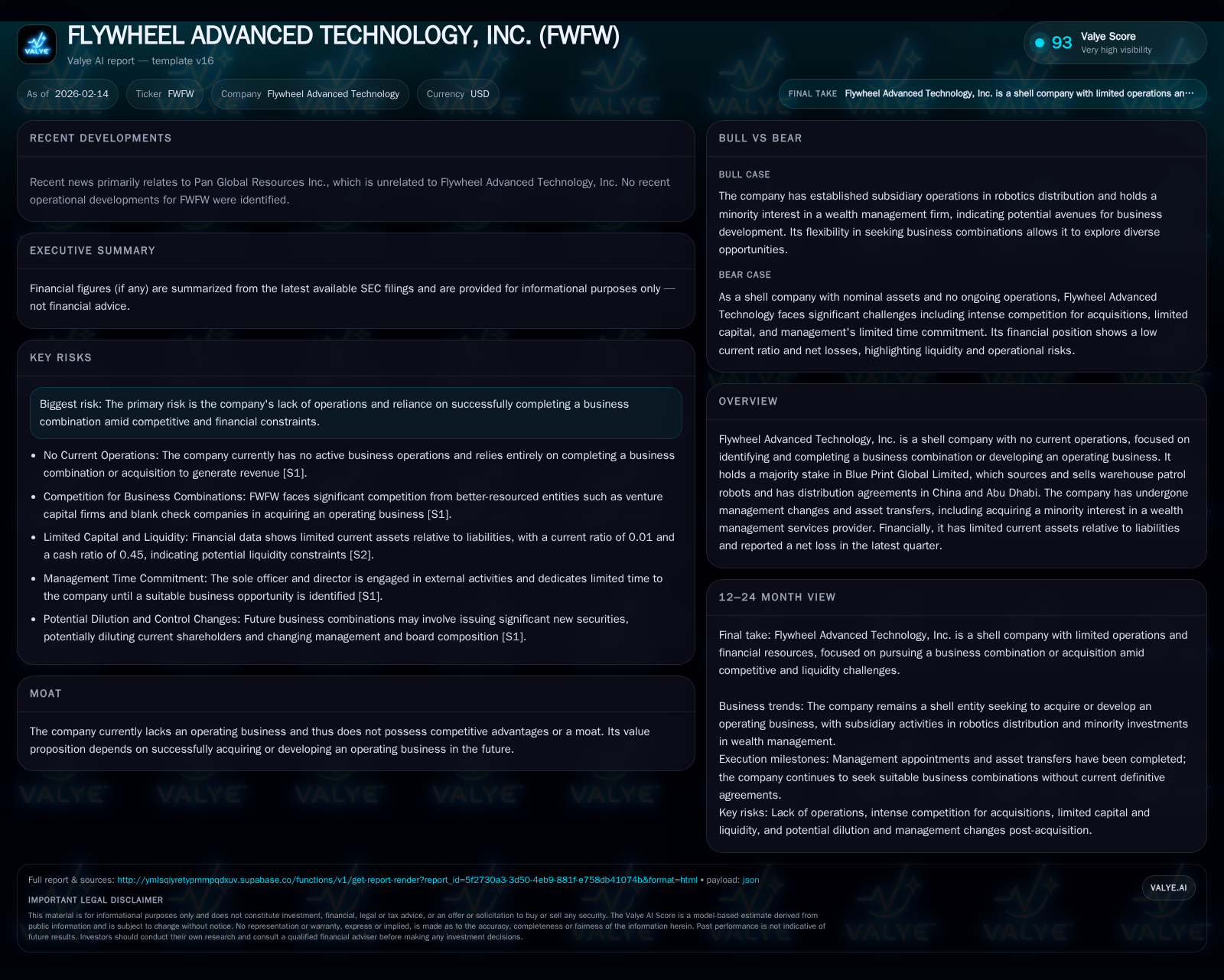
Flywheel Advanced Technology, Inc. remains a quintessential example of a speculative shell company aiming to pivot into an operating enterprise primarily through its majority stake in Blue Print Global Limited, a niche player in warehouse patrol robotics. Despite this strategic bet, FWFW faces significant financial constraints with minimal assets against substantial liabilities and reported losses. Governance shifts have consolidated control but also underscore challenges in stabilizing leadership amid uncertainty around completing a viable business combination. The company's future hinges critically on securing capital, identifying suitable acquisition targets, and effectively managing growth once operational status is achieved.
The Shell Origins and Transformation Journey
Flywheel Advanced Technology, Inc. began life as Savvy Business Support, Inc., incorporated in Nevada on April 30, 2010. Over time it underwent multiple identity shifts—most notably rebranding from Pan Global Corp. to Flywheel Advanced Technology, Inc. in November 2021 alongside ticker symbol changes (S1). A notable structural maneuver was the 1:100 reverse stock split executed in July 2022 that drastically reduced common shares outstanding to approximately 1.55 million (S1). These actions historically position the company as a quintessential shell entity: lacking meaningful operations yet maintaining public listing status to facilitate a transformative business combination.
The Company further amended its Preferred Stock terms mid-2022—converting ten million preferred shares into sixteen million common shares (S1). This shift was instrumental in consolidating ownership under Sparta, whose stake ascended above 60%, spotlighting an emerging dominant shareholder dynamic influencing corporate governance.
Despite these symbolic transformations signaling intent toward an operational business model, Flywheel remains primarily dormant without internally generated revenues or substantive operations beyond holding interests.
Blue Print Global: The Robotics Bet
In late 2022, FWFW incorporated Blue Print Global Limited — headquartered in the British Virgin Islands — marking its first substantive step toward an active business line centered on warehouse patrol robots (S1). The company commands a majority stake of 70%, with two unrelated parties sharing the remaining 30%. This positioning reflects a strategic pivot into industrial automation technologies anticipated to serve logistics sectors increasingly reliant on robotic surveillance for safety and efficiency.
Blue Print quickly established distribution reach by entering into a five-year agency agreement with International Supply Chain Alliance Co., Ltd (ISCA) based in Hong Kong. ISCA serves as Blue Print’s authorized agent specifically within China—a critical market given its expansive warehousing infrastructure—and Abu Dhabi (S1). The automatic renewal clause within this agreement suggests intended long-term collaboration potential, yet tangible revenue generation or volume shipment details remain undisclosed at this stage.
From an industry standpoint (analysis), warehouse patrol robotics is still nascent but growing rapidly due to safety compliance pressures and labor cost inflations globally. Should Blue Print succeed operationally and expand geographically, it could secure early-mover advantages. However, given the nascent phase and intense competition among robotics suppliers regionally and internationally (analysis), risks abound.
Financial Tightrope: Assets, Liabilities, and Cash Flow Realities
Financial disclosure paints a stark picture regarding FWFW’s fiscal health entering 2026. As of September 30, 2025, current assets stood at a mere $5,825 against current liabilities approaching $984,163 — yielding a precarious current ratio near 0.01 (F1). This severe liquidity mismatch raises immediate concerns about short-term solvency and ability to cover routine obligations without external funding injections.
Moreover, the company recorded a net loss of nearly $46,000 for the year ending December 31, underscoring ongoing negative cash flow dynamics (F1). Cash reserves reported earlier were modest at approximately $439,518 as of Q1 2024 but likely fluctuate due to operations external to core activities or financing rounds (F1).
Such lopsided balance sheet metrics are not unusual for development-stage or shell companies pre-acquisition; however, they crystallize the urgency of either consummating a business deal capable of generating operating cash flow or securing capital under onerous terms potentially dilutive to existing shareholders.
Governance and Control: Management Shifts and Ownership Stakes
Governance scrutiny reveals that post-conversion ownership consolidation sharply increased Sparta’s equity position to roughly 60.7% (S1). Sparta's role as the sole holder of all previously issued preferred stock before conversion underscores it as the principal power broker within FWFW’s capital structure.
While concentrated control can streamline decision-making during transformative phases such as mergers or turnarounds (analysis), it may also amplify agency risk if minority shareholders find limited voice or access to oversight mechanisms. The board has enacted key amendments approving preferred stock conversion and guiding strategic focus toward robotics ventures through Blue Print (S1).
Management expansion remains uncertain amid limited disclosure; execution risks linked to leadership capability loom large should FWFW secure an operating business requiring complex scaling initiatives.
The Daunting Road to a Business Combination
As highlighted repeatedly in SEC filings, FWFW currently has no binding agreements or understandings with any acquisition targets despite articulated intentions (S1). The process to identify viable companies suitable for merger or purchase is fraught with difficulty amidst constrained capital availability and heightened M&A competition exacerbated by residual COVID-19 economic disruptions.
This void places FWFW in an especially vulnerable position where delays risk capital depletion before generating any substantive operating revenues. Existence as an inactive shell while hunting deals amplifies risk exposure across multiple vectors including deal pricing pressures and internal resource drain.
Economically sensitive sectors relevant for acquisition pose further roadblocks given shifting post-pandemic demand patterns affecting valuations across industrial tech niches like robotics distribution (analysis).
Risk Dynamics: Investor Concerns and Market Challenges
Investors engaging with FWFW confront explicit substantial risks detailed cohesively within the Company’s disclosures (S1). Foremost is the possibility that failure to consummate an acquisition will render their entire investment worthless—an endemic hazard for public shells renewing operations via reverse mergers.
Additional threats include potential dilution resulting from necessary future equity raises which may be pivotal given depleted liquidity reserves (S1). The absence of revenues eliminates any cushion against recurring losses which will likely escalate if management must expand headcount and administrative overhead prematurely.
Market receptiveness toward microcap shells has fluctuated recently reflecting increased regulatory scrutiny alongside investor wariness toward unproven turnaround plays (analysis). These external factors constrict access to favorable financing terms critical for sustaining pursuit of acquisition opportunities.
Growth Management Prospects and Capital Needs
Should Flywheel successfully acquire or combine with an operating entity—such as advancing Blue Print Global’s scope—the ensuing challenge shifts dramatically toward rapid yet sustainable scaling. Experience-driven talent acquisition becomes essential along with bolstering internal systems supporting finance, compliance, logistics, marketing and R&D functions (S1).
Without established internal revenues at present, these scale-up costs represent significant financial burdens compounding already stretched funding needs. Effective growth management demands rigorous execution capabilities unlikely achievable without new leadership infusion and robust board oversight—a dimension not thoroughly elucidated in current reports.
Capital requirements extend beyond transactional costs encompassing working capital demands driven by product inventory cycles inherent in technology distribution businesses like Blue Print operates within (analysis).
What Lies Ahead: Critical Milestones for Flywheel’s Survival
Looking forward, Flywheel’s survival pivots on several critical junctures demanding close investor attention:
- Securing sufficient capital resources either through private placements or alternative financing structures capable of supporting transaction completion plus initial operational runs;
- Identifying strategically fit acquisition candidates that align with robotics vertical ambitions or related technology industries while balancing acceptable valuation thresholds;
- Strengthening governance frameworks perhaps via board diversification enhancing accountability aligned with increased operational complexity;
- Implementing business plans that rapidly generate identifiable revenues without compromising financial discipline;
- Navigating ongoing macroeconomic uncertainties which could impact supply chains or end-market demand relevant to robotics deployments.
Failure at any point potentially triggers value erosion culminating in total investment loss given absence of fallback revenue streams or asset liquidity cushions currently visible (S1,F1).
This analysis centers on publicly available filings through early-2026 without speculative extrapolations beyond documented facts. While Flywheel Advanced Technology carries latent upside associated with its nascent robotics subsidiary Blue Print Global Limited within growing automation markets, material operational and financial risks remain pronounced absent clear execution progress regarding business combinations or capital restructuring.
Disclaimer: This is research-only, informational analysis and not investment advice. It may include AI-generated interpretation and general industry context. Always verify important details using primary sources.

Comments