
Sun Country Airlines' Hybrid Model and Fleet Strategy Under the Lens of Allegiant Merger
Sun Country Airlines balances passenger and cargo operations with a mid-life Boeing 737 fleet, poised at a strategic inflection amid an Allegiant acquisition.
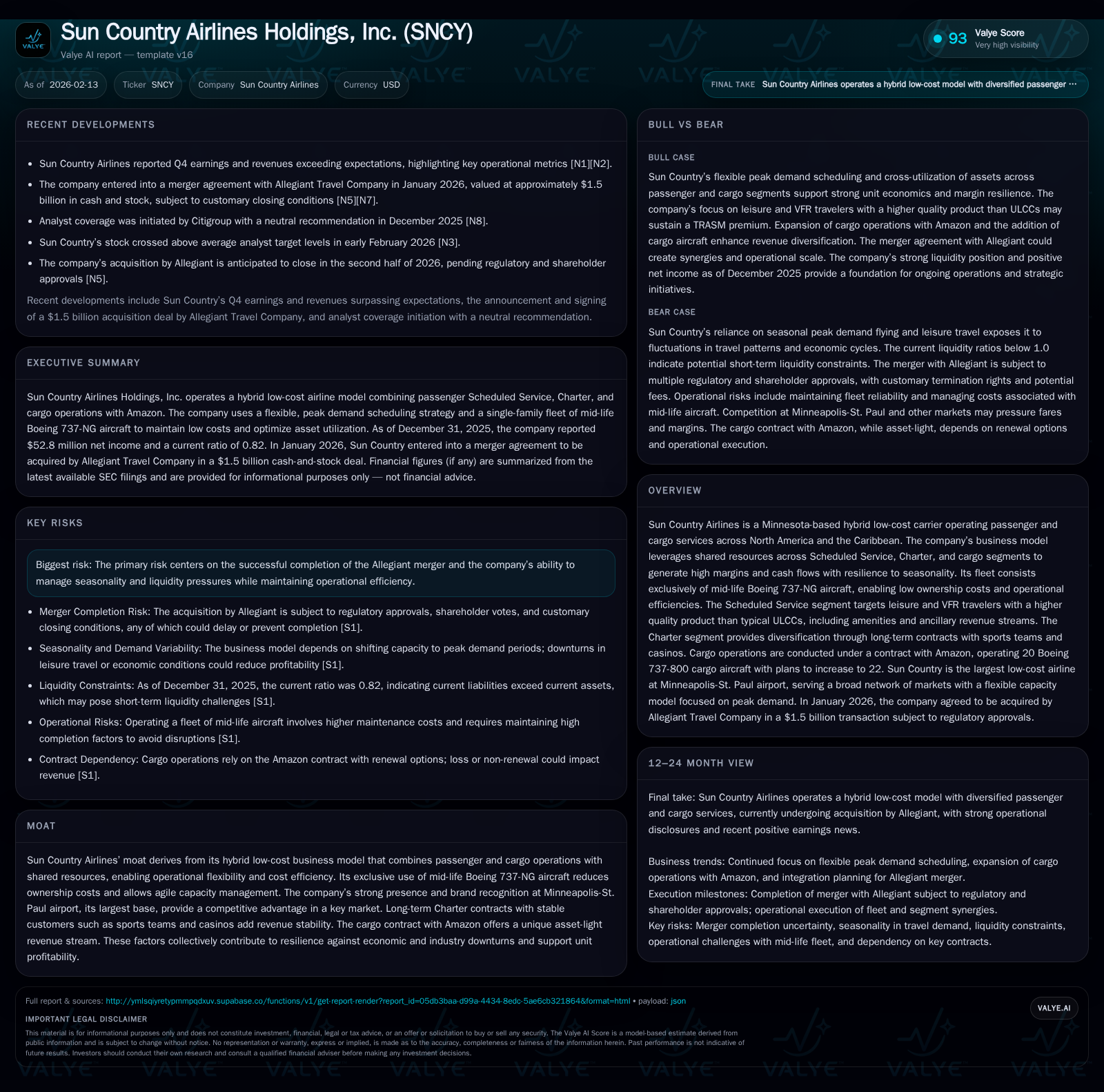
Sun Country Airlines stands out in North America’s airline landscape by deploying a hybrid low-cost model that integrates scheduled passenger service, charter flights, and Amazon-backed cargo operations. Its exclusive use of mid-life Boeing 737-NG aircraft supports cost efficiency and operational flexibility, enabling resilience against typical seasonality challenges. The pending $1.5 billion Allegiant merger introduces both growth opportunities and integration risks as Sun Country leverages its Minneapolis-St. Paul stronghold to expand. Financially, the company shows solid profitability and cash flow generation but faces liquidity tightness and sensitivity to economic downturns, fuel prices, and merger execution complexities.
Hybrid Low-Cost Innovation: Navigating Passenger and Cargo Synergies
Sun Country Airlines defies conventional ultra-low-cost carrier (ULCC) paradigms by maintaining a hybrid operational model that blends scheduled passenger service with charter flights and cargo logistics. This multi-pronged approach allows it to share critical resources—such as flight crews—across diverse business lines, which creates cost efficiencies rare among pure-plays in either segment [S1]. Unlike typical ULCCs that rely heavily on minimal service passenger models vulnerable to seasonal swings, Sun Country strategically leverages its capacity dynamically through an agile scheduling framework known internally as "Power Patterns." This scheduling technique intersperses Scheduled Service legs with higher-margin Charter segments within the same trips. By flexibly shifting aircraft between these lines of business based on demand fluctuations by day or season, the airline captures peak revenue opportunities while mitigating low-demand weaknesses inherent in leisure travel markets.
This cross-utilization ensures a smoother revenue stream amid typically pronounced seasonality in leisure flights. Additionally, the Amazon-integrated cargo operation introduces a robust asset-light revenue layer — pilots transition seamlessly between passenger flights and cargo missions under the CMI (Crew, Maintenance, Insurance) contract [valye_report_excerpt]. The interplay among these segments fosters financial resilience not generally found among peers focused solely on passenger volume maximization.
Implications of Sun Country’s approach highlight how operational flexibility rooted in diversified services can underpin higher margins compared to ULCC competitors reliant exclusively on thin ancillary revenues.
Fleet Composition: The Mid-Life Boeing Advantage
Sun Country’s entire fleet consists of mid-life Boeing 737 Next Generation (NG) aircraft — primarily 737-800s — a deliberate strategy balancing cost efficiency with operational reliability [valye_report_excerpt][S1]. These aircraft carry lower capital ownership costs compared to brand-new jets favored by legacy carriers investing in next-generation fuel-saving technologies. This choice enables Sun Country to keep its fixed costs manageable despite fuel price volatility.
While newer models can deliver superior fuel burn rates benefiting ultra-efficiency campaigns at multiple airlines, Sun Country mitigates this disadvantage through aggressive scheduling flexibility and lean operational structure that keeps unit costs competitive within the low-cost segment. However, the reliance on aging airframes does raise concerns around potential spikes in maintenance expenses as components age further — a risk amplified if fuel prices surge [S1].
This fleet strategy underscores a trade-off seen throughout the industry: balancing upfront capital expenditures against variable operating expenses shaped heavily by fluctuating commodity prices. For Sun Country’s hybrid model emphasizing quick pivoting between passenger and cargo segments, having a relatively homogenous fleet also simplifies crew training and maintenance logistics.
In essence, while not pioneering new technology adoption like some rivals pursuing narrowbody replacements for carbon savings or extended range capabilities, Sun Country’s mid-life Boeing-centric fleet is well-tailored for its niche cost structure demands.
Market Position: Minneapolis-St. Paul Stronghold and Beyond
Minneapolis-St. Paul International Airport (MSP) functions as Sun Country’s primary hub and strategic moat — an anchor point consolidating its presence in key leisure markets [valye_report_excerpt][S1]. The airline has established itself as the leading low-cost carrier at MSP offering destinations throughout North America and the Caribbean targeted mainly at leisure travelers visiting friends & relatives (VFR), alongside business customers reached via charter agreements.
Unlike pure ULCCs competing principally on price alone, Sun Country differentiates itself through enhanced product offerings — amenities beyond bare-bones seating plus diversified ancillary revenues — enhancing passenger experience without sacrificing cost discipline [valye_report_excerpt]. This market positioning appeals particularly well to price-conscious but quality-seeking travelers who dominate the leisure travel segment.
Beyond MSP, Sun Country pursues growth corridors serving emerging leisure destinations in Canada, Mexico, Central America, and select Caribbean locales. The Charter segment supplements this geographic expansion through long-term contracts with stable customers such as sports teams and casinos — relationships that embed recurring utilization variability but provide comparatively reliable revenue streams outside scheduled service volatility.
This dual market focus strengthens Sun Country’s competitive position versus both smaller regional specialists and larger network airlines that may lack low-cost agility near MSP.
Financial Profile: Solid Margins Meeting Seasonality Pressures
Fiscal year ending December 2025 reflects a financially disciplined Sun Country combining improving margins with revenue resilience amid persistent seasonality challenges. The company reported net income of approximately $52.8 million alongside $144.7 million in cash & equivalents versus $451 million in current liabilities — yielding a current ratio near 0.82 which signals liquidity constraints requiring close management [F1]. Still, recent quarterly earnings beat consensus expectations driven by better-than-anticipated revenues attributed partly to efficient cross-utilization scheduling under Power Patterns [N2][N3].
Revenue streams from scheduled passenger services remain strongest during peak leisure travel seasons; however, this cyclicality is softened meaningfully via synchronized charter deployments and robust cargo flows managed under the lucrative Amazon contract involving twenty Boeing 737-800 freighters (with plans to expand to twenty-two) [valye_report_excerpt]. This integrated approach successfully smooths cash flows across quarters when competitors may see pronounced dips.
Notably, management continues emphasizing tight operating expense controls amid inflationary cost headwinds affecting labor and maintenance budgets alongside volatile jet fuel prices which accounted for roughly 21% of operating expenses in 2025 [S1][F1]. Ancillary income strategies centered on premium seating upsells, baggage fees, and other add-ons further fortify revenue per available seat mile (RASM).
In summary, while liquidity metrics highlight areas for prudence going forward—especially given merger-related obligations—the financial profile remains one of effective margin management supporting modest profitability even under pressure.
Allegiant Acquisition: Strategic Implications and Merger Dynamics
On January 11th, 2026 Allegiant Travel Company announced a definitive $1.5 billion cash-and-stock deal to acquire Sun Country Airlines [N1][N4][S1]. Under terms of this agreement each SNCY share converts into $4.10 cash plus approximately 0.1557 shares of Allegiant common stock—a combination designed to preserve shareholder value while funding liquidity needs tied to scaling operations.
The completion hinges on multiple closing conditions including approvals from both Allegiant’s and Sun Country’s shareholders as well as clearance from regulatory bodies such as the Department of Transportation (DOT), Federal Aviation Administration (FAA), TSA oversight entities following Hart-Scott-Rodino antitrust reviews [S1]. Operationally integrating two hybrid low-cost carriers possessing overlapping yet distinct geographical footprints demands careful synchronization of schedules, crews, fleets, systems platforms as well as harmonizing contractual obligations—particularly long-term charters that form part of Sun Country’s stable revenue base.
This transaction is poised to create one of North America’s largest hybrid low-cost airline platforms by leveraging complementary route networks anchored by MSP (Sun Country) and Las Vegas/Fort Lauderdale hubs (Allegiant).
However potential realization of anticipated synergies depends heavily on seamless melding of labor agreements plus technology stack integrations without disrupting customer experience or eroding existing client relationships across charter or Amazon freight sectors.
In sum, the acquisition presents significant growth opportunity but also tangible execution risks requiring vigilant stakeholder coordination over coming quarters.
Risks Under the Microscope: Economic Sensitivities and Integration Challenges
Underpinning Sun Country’s outlook are familiar airline-industry risks accentuated by its operational specifics as detailed in official SEC disclosures [S1][S2]. Primary vulnerabilities reside in exposure to U.S. macroeconomic cycles: discretionary nature of leisure travel means recessions or inflation-driven softening reduce consumer willingness or ability to fly—which particularly impacts VFR passengers central to Sun Country’s customer base. Similarly charter clients managing discretionary event budgets may curtail demand or renegotiate contracts under economic strain.
Operationally inflation affects input costs broadly with jet fuel being especially volatile—fuel accounted for about one-fifth of operating expenses making spikes detrimental unless offset by fare increases or efficiency gains difficult with older Boeing NGs relative to competitors introducing more fuel-efficient fleets [S1]. The aging aircraft cohort also heightens maintenance risk which could pressure margins further if unplanned repairs arise frequently.
Lastly merger integration risk looms large; melding two carriers’ cultures alongside technical systems while maintaining safety standards is non-trivial at scale. Failure here risks disruption to customer service levels or loss of key contract partners particularly within Cargo or Charter divisions which drive unit profitability premiums over Scheduled Service alone.
Consequently prudent monitoring of these risk vectors is essential for stakeholders tracking SNCY post-merger outcomes.
Expert Perspectives: Analyst Upgrades and Market Reactions
Following Sun Country's Q4 outperformances announced early February 2026 several brokerage firms adjusted their views positively reflecting renewed confidence ahead of merger closure [N5][N7][N8]. Shares crossing above average analyst targets spotlight a market receptive to SNCY’s unique hybrid positioning combined with robust margin profiles resilient against peer volatility.
Notably Susquehanna's upgrade emphasized belief in sustained profitability improvements stemming from efficient capacity management practices coupled with scalable Amazon Cargo contract expansion enhancing revenue diversification [N8]. Investor communications have stressed continuity post-merger though highlighting inherent uncertainties tied to integration timelines.
Overall market tone embodies cautious optimism: participants acknowledge competitive advantages embedded within SNСY's model while closely watching execution risks intrinsic both pre- and post-transaction phases.
Future Outlook: Growth Levers Post-Merger
Looking beyond deal closure expected later in calendar year 2026 assuming regulatory consents [N1], prospects for the combined entity position it uniquely within an evolving North American airline landscape prioritizing scale-bred efficiency yet differentiated product offerings.
Expanding Amazon cargo footprint incrementally via additional Boeing freighters offers predictable revenue growth insulated somewhat from traditional passenger fee cycles [valye_report_excerpt][S1]. Operational synergies including network realignment promise optimized daily utilization rates leveraging each carrier’s route strengths—MSP anchoring Midwest-focused travel demand complemented by Allegiant’s southeast hubs constructing expansive national coverage.
Continued investments in technology platforms facilitating "Power Patterns" style scheduling will likely extend agility benefits realized pre-merger enabling sharper responses to demand swings thus preserving unit economics stability amidst seasonality nuances.
To succeed long term integration must maintain customer satisfaction metrics within Scheduled Service while preserving stable Charter client relations constituting steady cash inflows beyond episodic leisure trends.
In summation the post-merger phase offers compelling avenues for scale-enhanced returns predicated on existing asset quality but tempered by execution discipline necessary amidst complexity inherent in combining two significant carriers with distinct yet complementary value propositions.
This analysis is based purely on publicly available information including recent regulatory filings, press releases, earnings reports, and recognized industry sources without forward-looking recommendations or investment guidance. It aims solely to shed light on strategic positioning, operational characteristics, financial health metrics, transaction details, risk exposures, market perspectives, and prospective dynamics shaping Sun Country Airlines Holdings’ competitive journey amidst transformative corporate events.
Disclaimer: This is research-only, informational analysis and not investment advice. It may include AI-generated interpretation and general industry context. Always verify important details using primary sources.

Comments