
Annaly Capital Management: Navigating Earnings Strength and Regulatory Complexities in Mortgage REITs
Annaly demonstrates resilience in the mortgage REIT sector with strong earnings and yield performance set against a challenging regulatory landscape.
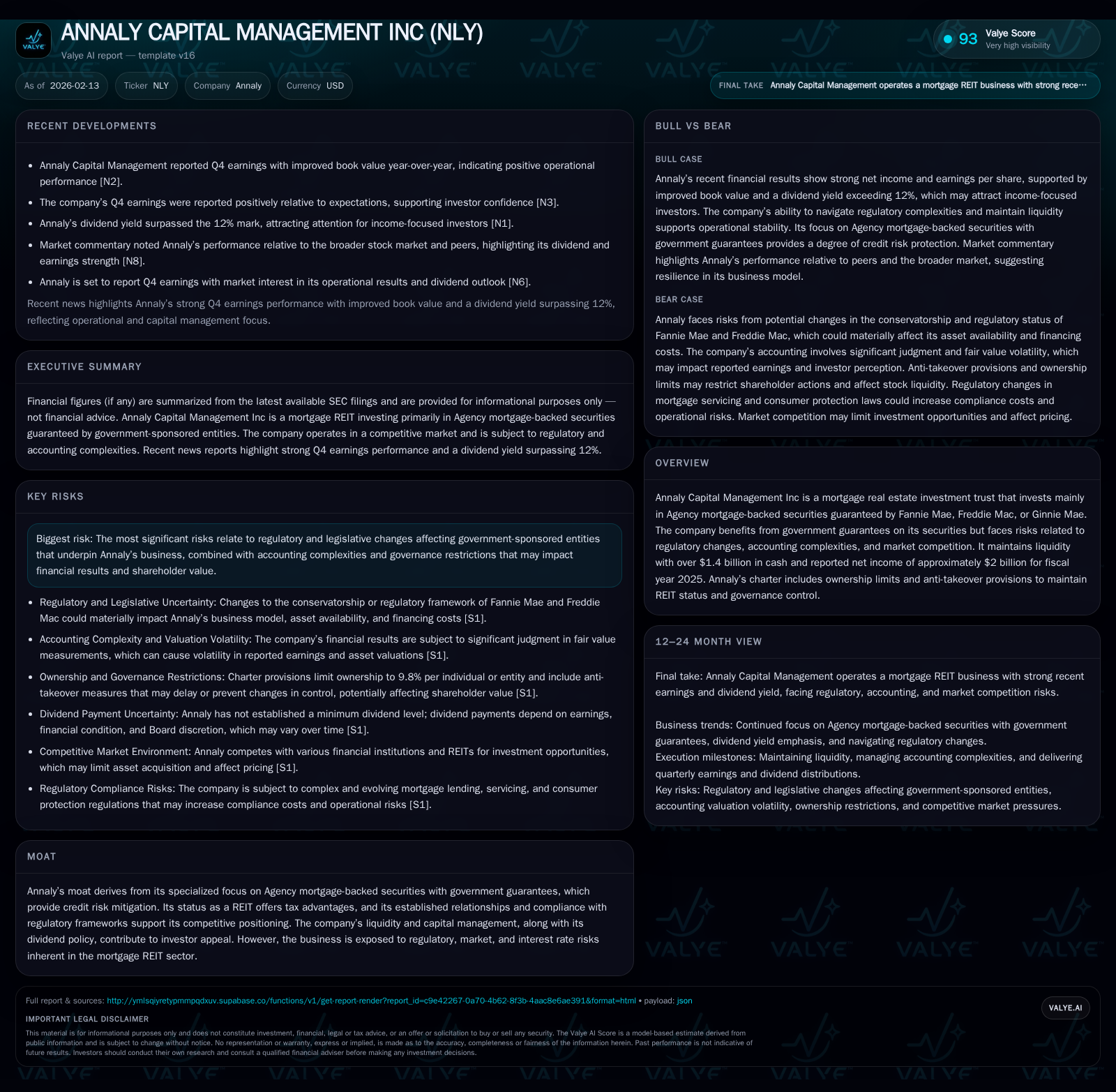
Annaly Capital Management reported a substantial net income of approximately $2 billion for fiscal 2025, surpassing market expectations and signaling solid execution within its government-backed mortgage securities portfolio. The company's competitive moat centers on agency mortgage-backed securities guaranteed by Fannie Mae, Freddie Mac, and Ginnie Mae, mitigating credit risk. While robust liquidity exceeding $1.4 billion supports dividend sustainability, stringent ownership limits and anti-takeover provisions embedded in its charter create governance challenges that may cap share price appreciation. Compared to peers like AGNC, Annaly has outperformed on earnings and yield metrics, yet regulatory uncertainties and accounting complexities remain ongoing risks.
Decoding Annaly’s Earnings Beat: What Surprised the Street?
Annaly Capital Management closed fiscal year 2025 with a net income figure near $2.03 billion [F1], substantially beating analyst estimates and supporting marked improvements in its book value per share [N1][N2]. This earnings strength largely stemmed from strategic investments primarily in Agency mortgage-backed securities (MBS), whose government guarantees helped buffer income streams from credit losses amidst volatile macroeconomic conditions. A series of Q4 disclosures highlighted continued capital gains on these holdings alongside disciplined balance sheet management.
Market participants reacted positively; notable broker BTIG upgraded Annaly soon after the release, emphasizing the durability of Annaly's dividend yield and the clean-up of legacy portfolio risks [N12]. This optimism contrasts significantly with some peers—particularly AGNC Investment—which failed to meet revenue and earnings expectations over the same period, marking a relative outperformance gap [N3][N4]. Annaly's ability to navigate a complex interest rate environment while sustaining attractive distributable cash flow drove renewed investor confidence.
Government Guarantees: The Anchor of Annaly’s Moat
At the heart of Annaly’s business model lies its concentration on Agency mortgage-backed securities guaranteed by Fannie Mae, Freddie Mac, and Ginnie Mae [valye_report_excerpt.overview]. These government-sponsored enterprises (GSEs) provide explicit credit support that substantially reduces default risk—a vital hedge given the sensitive nature of mortgage credit exposure across economic cycles [valye_report_excerpt.moat].
This structural safeguard not only stabilizes income but also enhances Annaly's competitive moat by affording the company access to high-quality assets unavailable or unattractive to broader institutional investors due to regulation or risk tolerance differences. Maintaining prudent compliance with evolving regulatory standards ensures that these guarantees remain valid, thereby protecting Annaly’s position as a premier mortgage REIT.
Liquidity and Capital Management: Navigating Uncertain Waters
Liquidity is a cornerstone of Annaly’s operational resilience. As of the last reported period, cash and cash equivalents stood at more than $1.4 billion [F1], providing ample runway to weather potential shocks such as interest rate volatility or temporary market dislocations. This robust cash position underpins management’s capacity to continue paying dividends at attractive yields, which recently edged past the 12% mark—a significant draw for yield-focused investors [N6][valye_report_excerpt.overview].
Strategic capital allocation decisions, including optimizing leverage levels and asset mix towards stable agency MBS, ensure operational flexibility. This agility remains crucial as funding costs fluctuate alongside macroeconomic policy shifts.
The Charter’s Double-Edged Sword: Protecting REIT Status but Limiting Control
Annaly’s corporate governance framework embeds several restrictive provisions designed primarily to maintain its status as a Real Estate Investment Trust for federal tax purposes while protecting current management control [S1]. The charter forbids any single stockholder or coordinated group from owning more than 9.8% of the company’s outstanding shares directly or constructively—a complex calculation that often aggregates related entity holdings into a single ownership count.
While this ownership cap helps preserve tax benefits by preventing excessive concentration among limited individuals, it simultaneously deters potential activist interventions or hostile takeovers that might otherwise unlock shareholder value through premium buyouts. Maryland state law further enforces anti-takeover protections including opting out of certain business combination statutes, effectively limiting external bids aimed at control change [S1].
Though beneficial for governance stability, these features introduce a potential ceiling on stock price appreciation related to change-of-control scenarios—a tradeoff fundamental to many top-tier mortgage REIT structures.
Competitive Set Comparisons: Outperforming Peers or Running Ahead?
When held side by side with primary competitors such as AGNC Investment Corp., Annaly's recent operating metrics reflect noteworthy superiority. While AGNC missed Q4 expectations in revenue and net income despite also improving book value year-over-year [N3][N4], Annaly posted upside surprises across key lines [N1][N2]. This translated into divergent stock performance trajectories; data evidences Annaly's shares outperforming broad market indices as well as peer REITs over comparable periods [N8].
The dividend yield premium enjoyed by Annaly—recently breaching 12%—further highlights its favorable positioning amidst changing interest rate backdrops where securing reliable pass-through income remains paramount for investors focused on steady cash flow generation [N6][N7]. These comparative advantages underscore effective capital deployment paired with tight risk controls relative to peers coping with more pronounced valuation headwinds.
Risks on the Horizon: Regulatory Dynamics and Market Complexities
Despite its strengths, Annaly remains exposed to underlying risks primarily sourced from regulatory environments linked to government-sponsored entity policies impacting its Agency MBS holdings [valye_report_excerpt.risks]. The SEC filings underline how changes in legislation governing Fannie Mae and Freddie Mac could materially disrupt asset valuations or eligibility standards [S1][S2].
Additionally, mortgage REIT accounting is inherently complex due to mark-to-market requirements on securities portfolios and varying treatment of hedging instruments. Such complexities may introduce volatility into reported results obscuring economic realities for some stakeholders.
Competitive pressure also intensifies as financial institutions and other REITs vie for similar assets amid constrained supply dynamics—potentially compressing margins over time [S1]. Sophisticated investors must weigh these layered uncertainties when appraising long-term prospects.
Investor Returns and Dividend Sustainability Amid Rate Cycles
Annaly’s recurring theme has been maintaining shareholder distributions above 12%, a rare benchmark in today’s bond-like income space for non-agency correlated assets [N6][N7]. This elevated payout aligns closely with prevailing low mortgage rates which reduce funding costs and elevate spread income opportunity when managed skillfully.
Historical total return figures reaching near 14% over recent periods demonstrate how capital appreciation complements dividends during favorable phases. However, sustainability depends critically on ongoing portfolio quality vigilance coupled with agile response to interest rate resets impacting borrowing costs—a familiar dynamic requiring continuous expertise.
Conclusion: Strategic Posture in a Regulated yet Opportunity-Rich Sector
Annaly Capital Management exemplifies a seasoned player balancing yield generation with institutional constraints characteristic of regulated mortgage real estate investment trusts. Its moat anchored by agency MBS government guarantees delivers credit risk mitigation essential for maintaining strong cash flows amidst economic uncertainty.
Robust liquidity reserves paired with disciplined capital deployment have enabled the company to sustain dividends attractive enough to outpace many peers. Meanwhile, governance protections embedded within the company's charter provide stability but also cap takeout potential—a structural facet that should inform stakeholder expectations regarding share price upside.
As regulatory frameworks evolve and competition intensifies, Annaly’s strategic focus on compliance excellence combined with proactive risk management positions it well to capitalize on prospective opportunities while guarding against inherent sector vulnerabilities.
This analysis is intended solely for informational purposes. It does not constitute investment advice or recommendations regarding any securities discussed herein.
Disclaimer: This is research-only, informational analysis and not investment advice. It may include AI-generated interpretation and general industry context. Always verify important details using primary sources.

Comments