
Iron Mountain's Strategic Transformation: Balancing Legacy Records with Digital and Sustainability Growth
Iron Mountain navigates its evolution from physical records management towards integrated digital solutions, sustainability leadership, and operational excellence amid shifting industry dynamics.
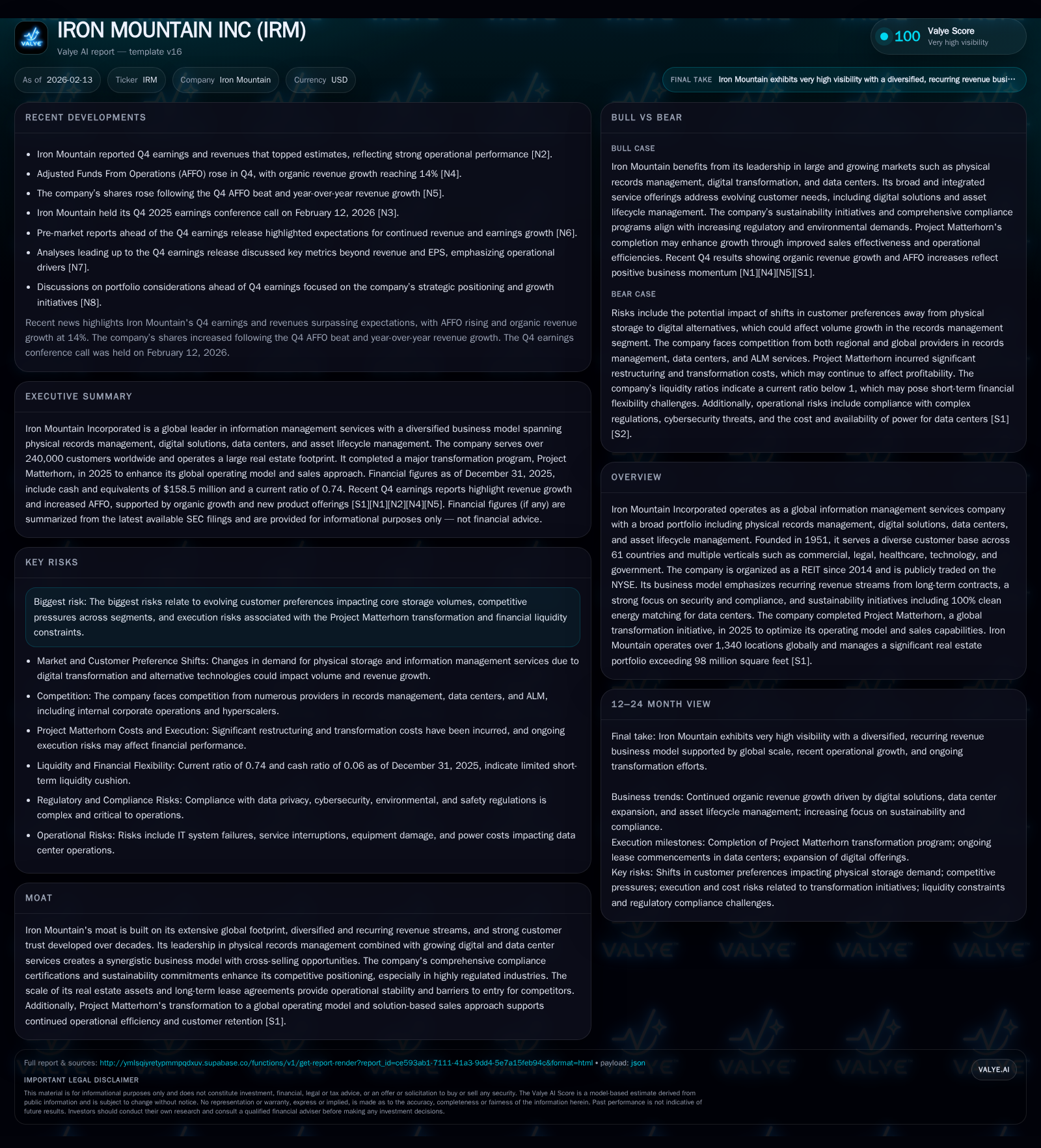
Founded in 1951, Iron Mountain (IRM) remains a dominant global information management player with a broad service portfolio across physical storage, digital solutions, data centers, and asset lifecycle management. Its transformative Project Matterhorn initiative completed in 2025 has optimized operations and sales strategies, supporting robust revenue growth of 12.2% despite net income pressures. The company leverages a vast real estate footprint intrinsic to its REIT structure as a moat while expanding data center services with a strong sustainability emphasis. Risks persist around customer migration from physical archives, competitive pressures, and execution complexity.
From Vaults to Virtual: Iron Mountain’s Core Business Evolution
Iron Mountain Incorporated originated as a physical records storage pioneer with a facility carved underground near Hudson, New York in 1951. Today, it transcends its roots by blending traditional records management with expansive digital transformation services that meet the complex regulatory demands of over 240,000 customers worldwide [S1]. The Global Records and Information Management (RIM) segment continues to generate substantial organic growth; storage rental revenue rose organically by approximately 9.6% in 2025 while service revenues surged by 11.2%, underscoring growing customer adoption of value-added offerings including Asset Lifecycle Management (ALM) [S1]. This hybrid model combines revenue stability from long-term physical storage contracts with scaling digital services aligned to customers’ moves toward information intelligence.
The firm's ability to nurture decades-long relationships while innovating digitally reflects a vital synergy—notwithstanding the inevitable secular decline in paper-based archival demand—as organizations modernize their data infrastructures yet maintain compliance and security requirements.
Decoding Project Matterhorn: The Engine for Global Operational Excellence
Completed in 2025 after thorough multi-year execution, Project Matterhorn represents IRM’s ambitious overhaul of its operating architecture to enable solution-based sales globally alongside concrete efficiency improvements [S1][N3]. This transformation reinforced commercial agility across geographies and verticals; it was instrumental in driving reported revenues up by 12.2%, with adjusted EBITDA margin expanding to a solid 37.3% despite inflationary headwinds on costs [S1][N4].
The project highlights the company’s focus on cross-selling its integrated suite—linking physical records with digital information ecosystems and ALM—thereby increasing wallet share per client. However, this strategic overhaul carries inherent execution risks ranging from change management complexities to sustaining performance momentum amidst competitive pressures.
Financial Pulse: Revenue Growth, Margin Trends, and Capital Health
In fiscal year 2025, IRM reported revenues of nearly $6.9 billion, marking an increase of $751.8 million or 12.2% year-over-year driven principally by organic growth in both storage rental (+9.6%) and service lines (+11.2%) [S1]. This top-line strength coincided with rising operating expenses totaling $5.74 billion up about 11.6%, fueled primarily by increased labor costs (+11.8%), higher facility-related expenses including real estate taxes (+7.1%), utilities, rents, and escalated product costs in ALM (+52.9%) amid expanding sales activities [S1].
Net income attributable to IRM decreased nearly 20% year-on-year to $144.6 million reflecting elevated depreciation/amortization charges along with other expenses inflating overall cost structure [S1]. Nonetheless, adjusted EBITDA rose robustly by over 15%, reflected in an improved margin profile signaling operational leverage despite rising costs [S1]. The company maintains disciplined capital allocation fueling strategic acquisitions particularly within ALM while managing cash reserves at $158 million as of year-end [F1][N1].
Liquidity remains adequate but warrants close monitoring due to sizable ongoing investments tied to digital expansion and infrastructure upgrades.
Navigating Risks: Customer Shifts, Competitive Landscape, and Execution Challenges
A critical challenge for IRM lies in evolving customer preferences—specifically the ongoing shift from physical document reliance toward digitized recordkeeping which threatens core archival volume trends [S1][S2]. This secular trend pressures legacy RIM revenues even as digital solutions scale. Concurrently, competition intensifies in adjacent sectors such as data centers and cloud services where nimble tech-focused entrants compete on innovation pace.
Execution risks related to Project Matterhorn’s complex transformation remain salient; failure to seamlessly integrate acquired businesses or sustain cultural alignment could impair expected synergies or slow growth [S2]. Further cost inflation notably labor and facilities increase operational leverage vulnerability should revenue momentum falter.
Financial liquidity constraints could emerge if capital expenditures or acquisition financing outpace free cash flow generation amidst macroeconomic uncertainties.
Sustainability as Strategic Advantage in Today’s Information Economy
Environmental stewardship is deeply embedded in IRM’s business ethos—not merely as corporate responsibility but as a competitive differentiator [S1]. The company boasts renewable energy coverage reaching approximately 91% of total electricity consumption as of 2024 complemented by science-based targets aligned with limiting global warming to under 1.5 degrees Celsius validated by the Science Based Targets initiative (SBTi) [S1][N11].
Initiatives like the Green Power Pass facilitate customers’ own carbon footprint transparency within data center operations bolstering appeal among ESG-conscious enterprises [S1][N11]. Waste diversion efforts achieving an impressive landfill diversion rate of over 82% further position IRM as an industry leader marrying sustainability with operational excellence—themes that resonate strongly within highly regulated customer verticals.
Data Centers and Digital Solutions: Pivots into Future Growth Arenas
IRM’s strategic thrust into data center expansion leverages secular tailwinds underpinning “power as the new real estate” — reflecting growing institutional emphasis on sustainable high-density compute hosting [N11][S1]. The Global Data Center Business segment benefits from lease commencements alongside improved pricing fueling organic revenue growth.
Digital Solutions including ALM represent key accelerants; organic service revenue grew over 15%, partly reflecting targeted acquisitions thus broadening scale and specialized capabilities [S1][N11]. These efforts synergize well with Iron Mountain’s reputation for secure chain-of-custody preserving trust critical for clients’ sensitive assets transitioning into hybrid physical-digital environments.
Real Estate Backbone: How Physical Assets Cement the Moat
A substantial component differentiating Iron Mountain is its extensive real estate asset base comprising more than 1,340 facilities globally which underpin stability across cyclical fluctuations [S1]. Structured legally as a REIT since 2014 keeps IRM anchored firmly within real estate investment frameworks facilitating smooth capital access while enforcing disciplined asset utilization.
Long-term leases provide predictable rental income that cushions shifts happening within business lines affected by digitization trends—it also erects formidable barriers limiting competitor entry especially given requirements for secure specialized environments meeting compliance standards.
This hybrid model enables Iron Mountain to harness both real estate value appreciation alongside service-driven growth metrics.
Investment Perspective: Valuing Stability Amid Transformation
While providing no investment advice here, it is observable that Iron Mountain offers an intriguing blend of stability conferred by recurring revenues against an active transformation narrative stressing innovation-led growth [N7][N13][N14]. The dividend yield crossing over the psychologically relevant threshold of four percent reflects confidence supported by growing Adjusted Funds From Operations (AFFO) despite net income volatility stemming from investment phases [N14][N8].
Nonetheless, valuation considerations must incorporate evolving technological risks impacting legacy storage demand plus competitive intensity within burgeoning digital spaces requiring careful execution oversight.
Looking Ahead: Strategic Priorities for 2026 and Beyond
IRM signals intent to deepen AI utilization across digital solution sets enhancing automation efficiencies while maintaining robust controls on capital expenditures essential for balancing profitably scaling initiatives [S2]. Geographic growth focuses include penetrating higher-growth emerging markets such as Latin America and Asia where appetite for integrated information management is expanding rapidly.
ESG commitments remain front-and-center featuring continuous enhancement of sustainability programs aligning long-term enterprise value creation alongside stakeholder expectations.
Successful navigation through these interconnected priorities will define IRM’s ability to reconcile its venerable legacy with agile digital future-readiness ensuring relevance across diverse evolving sectors.
Disclaimer: This analysis is intended solely for informational purposes based on publicly available data and does not constitute investment advice or recommendations.
Disclaimer: This is research-only, informational analysis and not investment advice. It may include AI-generated interpretation and general industry context. Always verify important details using primary sources.

Comments