
Curtiss-Wright Corporation: Heritage and Engineering Powering Aerospace and Defense Resilience
Exploring how Curtiss-Wright’s century-spanning lineage and technological prowess underpin its competitive edge in complex aerospace and defense sectors.
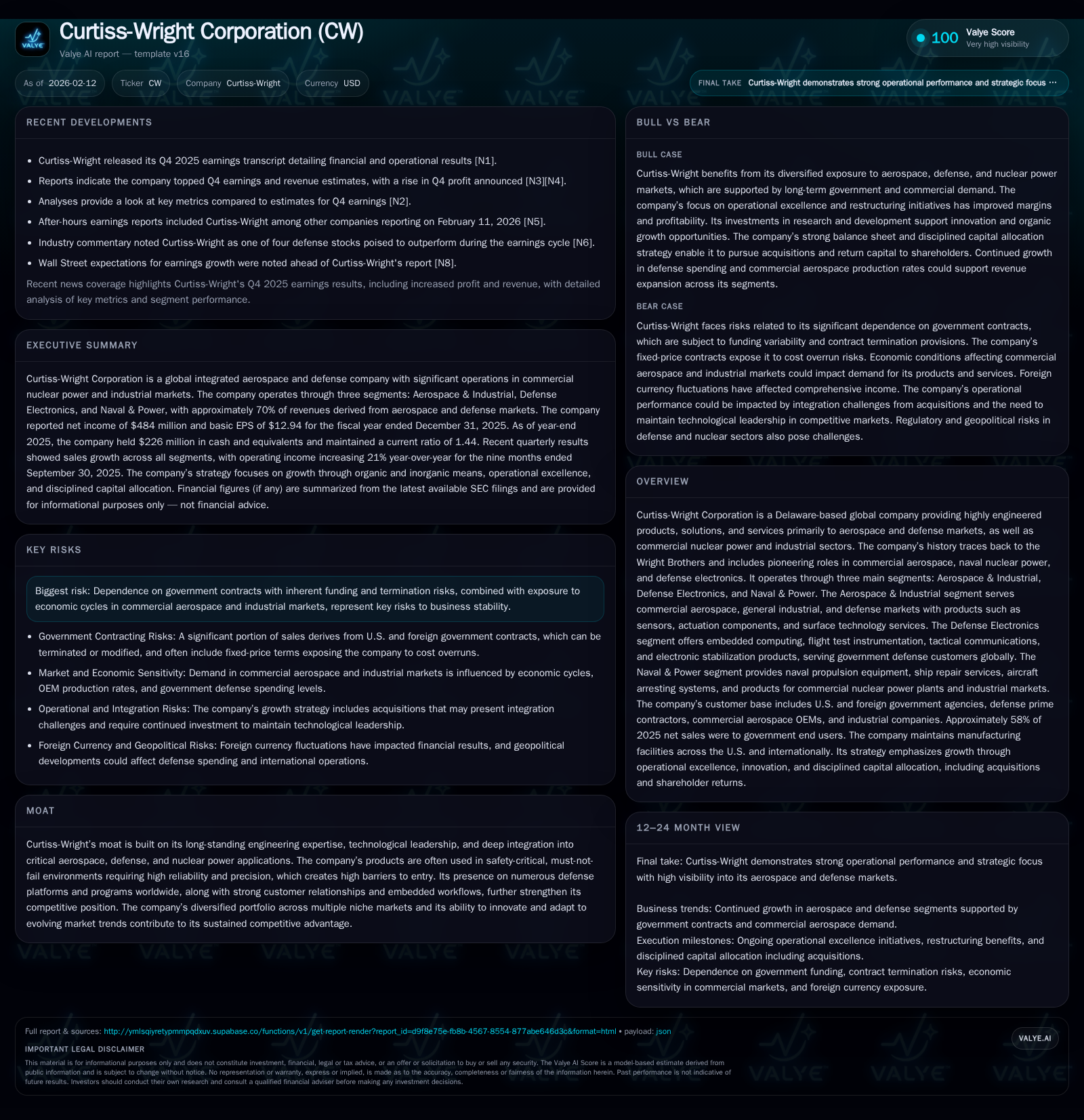
Curtiss-Wright Corporation, rooted in the pioneering history of the Wright Brothers, has evolved into a globally integrated enterprise delivering high-precision engineered products across aerospace, defense electronics, and naval power markets. Its diversified segment portfolio and embedded customer relationships fortify it against commercial cyclical pressures while leveraging innovation to fuel growth. Despite reliance on government contracts and cybersecurity vulnerabilities, the company’s strong operational performance and strategic emphasis on emerging technologies provide a robust foundation for continued value creation.
From Flight Origins to Modern Engineering: Curtiss-Wright’s Enduring Legacy
Curtiss-Wright Corporation traces its corporate lineage directly back to the Wright Brothers—the very pioneers of powered flight—laying a foundational narrative few aerospace firms can parallel. Established over a century ago, this historic imprint does more than serve as a heritage emblem; it underpins an enduring culture of engineering excellence that has evolved alongside the aerospace industry itself. From powering early commercial aircraft to contributing critical technology in naval nuclear propulsion and defense electronics, Curtiss-Wright demonstrates a continuity of innovation bridging pioneering aviation milestones with today’s advanced platform solutions [valye_report_excerpt][S1]. This blend of legacy craftsmanship and modern engineering has positioned Curtiss-Wright as a stalwart supplier within the aerospace and defense ecosystems.
Segment Spotlight: Driving Growth Through Aerospace, Defense Electronics, and Naval Power
Curtiss-Wright’s operations are compartmentalized into three distinct yet synergistic segments: Aerospace & Industrial, Defense Electronics, and Naval & Power. Each segment capitalizes on niche technological competencies addressing specialized market demands.
Aerospace & Industrial: This segment caters to commercial aerospace OEMs, general industrial processes, and defense markets with offerings such as precision sensors, actuation components, and surface technology services. It supports increased safety and efficiency in demanding applications [valye_report_excerpt][S2].
Defense Electronics: Provides embedded computing solutions, flight test instrumentation, tactical communication systems, and electronic stabilization products primarily serving global government defense customers. These products emphasize reliability under mission-critical conditions [valye_report_excerpt][N3].
Naval & Power: Focused on naval nuclear power systems alongside commercial nuclear power and industrial sectors. Its technology portfolio includes products integral to naval reactors—themselves reflective of Curtiss-Wright’s historical firsts in nuclear propulsion—and industrial applications demanding exceptional operational safety [valye_report_excerpt][S2].
Segment performance metrics reveal steady expansion; for instance, Q3 2025 sales grew organically by 6–8% across segments with total sales increasing 9% year-over-year to $869 million. Operating income also marked double-digit gains led by Defense Electronics (16%) and Aerospace & Industrial (21%), highlighting operational leverage amid increased volumes [S2].
Financial Performance Deep Dive: Navigating Growth in a Cyclic Market
Curtiss-Wright confronts a nuanced market landscape characterized by the cyclicality of commercial aerospace juxtaposed with relative stability in defense-related deliveries. Financial disclosures from recent quarters outline the company’s adept navigation through this environment.
In Q3 2025 alone, revenues rose approximately 9% year-over-year driven mainly by organic growth (6%), supplemented modestly by acquisitions. Operating margins improved concurrently—operating income surged 15%, reflecting cost efficiencies alongside volume gains [S2][N1]. Net earnings for the nine months ending September 2025 were up 21% versus prior-year levels at $347 million. Capital discipline is underscored by reduced interest expenses despite incremental debt usage supporting acquisitions.
This financial trajectory evidences Curtiss-Wright's ability to maintain profitability expansions even when commercial aerospace cycles tend toward softness; defense contracts appear instrumental in cushioning volatility through their longer lead times and more predictable funding profiles [S2][N3].
Moat Mechanics: Why Reliability and Embedded Workflows Secure Competitive Advantage
Curtiss-Wright’s competitive moat extends beyond mere product differentiation—it is deeply anchored in technological leadership within must-not-fail applications. The precision manufacturing processes produce components integral to flight safety, defense mission success, or nuclear reactor operability all demanding faultless performance under rigorous conditions [valye_report_excerpt].
These products are extensively embedded within complex platforms; thus, switching costs are considerably high for customers who rely on sustained technical support and system integration expertise. Long-standing relationships with government contractors, OEMs, and energy firms embed Curtiss-Wright deeply into customer workflows reducing churn risk. The company’s extensive engineering knowledge accumulated over decades furthers barriers to entry against potential competitors lacking equivalent domain expertise or certification credentials [valye_report_excerpt][S1].
Risks on the Horizon: Government Dependency and Cybersecurity Challenges
As is typical for companies heavily tied to defense contracts, Curtiss-Wright faces risks emerging from inherent government budget fluctuations that could impact contract awards or funding levels unpredictably. Dependency on a limited group of prime contractors concentrates risk should major programs be delayed or canceled [S1]. Thus fiscal prudence involves balancing exposure while leveraging stable defense demand against volatile commercial aerospace markets.
Simultaneously, cybersecurity represents an escalating concern given the sensitivity of intellectual property hosted within their IT systems. Despite ongoing safeguards such as firewalls and employee training aimed at mitigating threats including phishing attacks or malware intrusions, breaches cannot be entirely ruled out due to sophisticated adversaries possibly exploiting vulnerabilities enhanced by increasing adoption of AI-driven cyberattacks [S1]. Potential data compromises or operational disruptions pose material risks both financially—via remediation costs—and reputationally affecting customer confidence.
Innovation Trajectory: Balancing Tradition with Strategic Expansion
Curtiss-Wright pursues a "Pivot to Growth" strategy blending organic innovation with selective acquisitions designed to accelerate revenue streams aligned with secular aerospace-defence trends. The company invests significantly in R&D targeting next-generation embedded computing platforms, advanced sensor technologies, and improved actuation systems tailored for emerging military and commercial vehicle architectures [valye_report_excerpt].
While honoring its core competencies steeped in precision manufacturing for legacy platforms, strategic expansion prioritizes scalable technologies advantageous over multi-decade horizons where secular tailwinds such as increased unmanned system deployment or naval modernization persist.
Navigating Market Cycles: Commercial Aerospace vs Defense Stability
With approximately 70% of revenue derived from aerospace and defense markets combined according to recent filings [S2], Curtiss-Wright enjoys some insulation against severe downturns facing purely commercial aerospace suppliers. The defense portion typically exhibits steadier funding pathways through multi-year government budgets contrasting sharply with cyclical airline capital spending influenced by macroeconomic oscillations.
This portfolio composition represents a deliberate risk mitigation measure permitting investment continuity during periods when commercial aviation orders soften—a prudent stance confirmed among peer analyses highlighting similar dual-exposure industry players appreciated for their balanced risk profiles [N5][valye_report_excerpt].
Investor Sentiment and Market Reaction: Earnings Beat vs ETF Outflows
Despite consistently surpassing earnings estimates as documented in recent quarterly releases [N1][N3], market reactions have included notable ETF outflows concurrent with these positive results [N14], suggesting investor caution potentially tied to broader macroeconomic uncertainties or sector rotation dynamics.
Option market activity around CW signals hedging plays or positioning adjustments reflecting anticipation of continued volatility despite operational strength [N12]. Such dichotomy between fundamentals and sentiment is illustrative of today's complex investment environment where defensive growth stories can be simultaneously rewarded yet discounted amid geopolitical or economic concerns.
Looking Ahead: Strategic Priorities in Emerging Technologies and Markets
Forward-looking guidance underscores sustained commitment toward deepening capabilities in emerging areas such as electronic warfare systems integration, unmanned naval platforms support, and digital transformation enhancing product lifecycle management [S1][valye_report_excerpt][N7].
Management appears focused on harmonizing historic engineering depth with agile innovation practices fostering faster commercialization cycles tailored to evolving client requirements amid increasingly sophisticated threat environments. Adapting successfully will rest on sustaining technological relevance while exploiting long-term customer trust anchoring Curtiss-Wright’s niche market advantages.
This analysis reflects information available as of early 2026 derived from official SEC filings alongside contemporaneous news coverage. It is intended solely for informational purposes without any recommendation regarding investment decisions.
Disclaimer: This is research-only, informational analysis and not investment advice. It may include AI-generated interpretation and general industry context. Always verify important details using primary sources.

Comments