
ARTS WAY Manufacturing: Niche Strategies Driving Durability in Ag Equipment and Modular Buildings
An exploration of how ARTS WAY’s specialized focus across two distinct segments supports its competitive strength amid industry challenges.
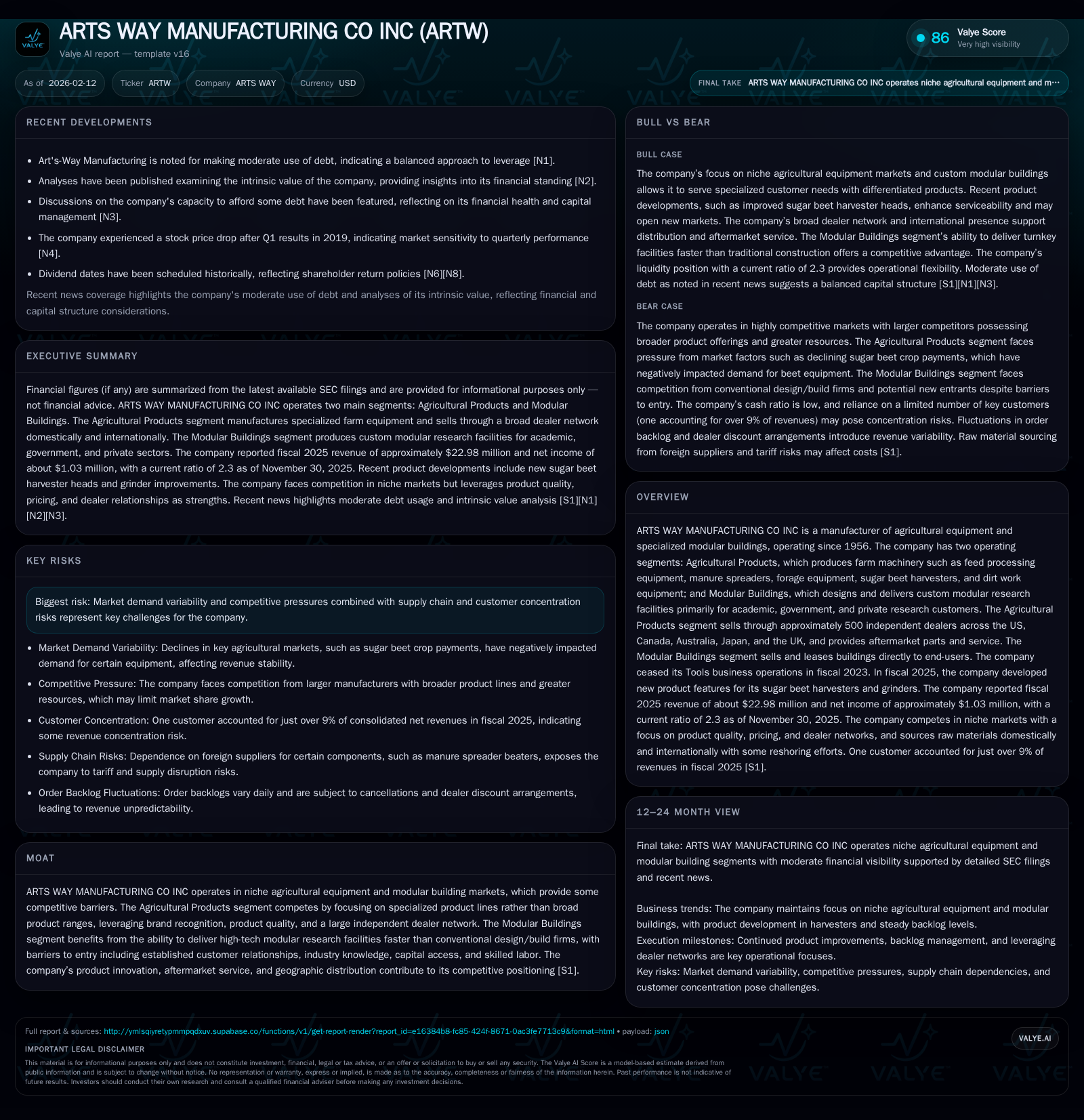
ARTS WAY Manufacturing Co Inc, with roots tracing back to 1956, operates through two focused segments: Agricultural Products and Modular Buildings, enabling it to sustain a unique market position. Its agricultural machinery caters exclusively to select farm equipment needs distributed globally via a broad independent dealer network, while the modular buildings segment delivers custom research facilities directly to specialized end users. The company’s strategic exit from tools manufacturing and ongoing product refinements underscore an adaptive approach balancing tradition with innovation. Despite exposure to market demand variability and supply chain risks, ARTS WAY’s niche orientation fosters competitive moats grounded in distribution networks, product quality, and technical expertise.
From Farm Fields to Research Labs: Tracing ARTS WAY’s Evolution
Since its inception in 1956 as a manufacturer of farm equipment, ARTS WAY Manufacturing Co Inc has evolved into a dual-segment industrial entity combining traditional agricultural machinery production with high-tech modular building solutions. Headquartered in Armstrong, Iowa, this transformation reflects a deliberate diversification strategy marrying heritage craftmanship with specialized modern infrastructure needs. The company's origin story frames its core competencies deeply rooted in manufacturing durable agricultural tools while responding strategically to emerging demands from academic and governmental research institutions that require nimble facility solutions [S1].
Segment Spotlight: Agricultural Products — Specialized Equipment in a Global Patchwork
The Agricultural Products segment remains cornerstone, accounting for 55.5% of ARTS WAY’s fiscal 2025 revenue. This division manufactures a narrow but comprehensive suite of farm machinery including portable and stationary feed processing systems vital for custom animal feed formulations; manure spreaders; forage handling equipment such as bale processors; sugar beet harvesters meeting specific crop requirements; and dirt work implements designed for terrain modification. Unlike broader industry players offering extensive catalogues, ARTS WAY focuses on highly specialized products integral to certain agricultural niches.
Sales span multiple continents—United States, Canada, Australia, Japan, and the United Kingdom—facilitated by roughly 500 independent dealers who not only retail finished goods but provide aftermarket parts and service support crucial for operational longevity of identified equipment lines [S1][F1]. This geographically dispersed dealer network underpins accessibility despite the company’s mid-size scale and reinforces brand presence internationally.
Beyond Machinery: ARTS WAY’s Foray into Modular Science Facilities
Complementing its heritage product base is the distinctly different Modular Buildings segment. Operating through its wholly owned subsidiary Art’s-Way Scientific Inc., this unit designs and delivers specialized modular buildings chiefly catering to research laboratories and animal containment units utilized by academic researchers, government agencies, and private sector laboratories. This business model hinges on direct engagement with end-users rather than intermediated distribution channels.
Barriers intrinsic to this sector include not only capital intensity related to design and manufacturing but also staffing skilled labor versed in complex architectural standards required for laboratory-grade facilities. Moreover, established customer relationships infused with knowledge of regulatory compliance constitute formidable entry obstacles for competitors attempting similar market penetration [S1].
Distribution Dynamics: Leveraging Independent Dealers and Direct Sales
ARTS WAY deploys differentiated distribution strategies aligned closely with each segment’s market realities. Agricultural Products depend heavily on their extensive independent dealer network which serves as both sales conduit and frontline service provider across diverse geographies. These dealers represent an outsourced channel maintaining end-user satisfaction through parts availability and servicing expertise—a critical factor given the technical maintenance needs of niche farm equipment.
In contrast, the Modular Buildings segment eschews intermediaries favoring direct sales or leasing agreements. This approach caters better to the often bespoke nature of scientific laboratories where customization extends beyond product features to integration within client research ecosystems. Such direct interaction enables tailored project management yet demands sustained investment into customer relationship management [S1].
Unpacking Financial Fundamentals: Revenues, Margins, and Current Position
As of fiscal year-end November 30, 2025, ARTS WAY reported total revenues near $22.97 million complemented by net income approximating $1.03 million—signaling profitable operations despite competitive pressures. The company exhibits liquidity strength illustrated by a current ratio of approximately 2.3 (current assets of $14.78 million against current liabilities near $6.44 million), indicative of manageable short-term obligations without compromising operational fluidity [F1].
These financial metrics reflect modest yet stable profitability consistent with mid-tier manufacturing firms operating in niche markets where scale limitations coexist with specialized value propositions.
Moat Mechanics: Niche Focus as a Competitive Bulwark
ARTS WAY’s protective economic moat derives from several concrete factors directly tied to its product portfolio and go-to-market infrastructure. Its Agricultural Products segment’s brand recognition within specialized farm equipment categories foster loyalty nurtured through quality manufacturing combined with robust aftermarket support facilitated by an established dealer ecosystem.
Meanwhile, the Modular Buildings business leverages speed-to-delivery advantages against conventional design/build firms coupled with accumulated industry expertise that creates switching costs for customers requiring high-compliance research environments. Capital access for customized manufacturing setups alongside skilled labor pools further buttress entry barriers [S1].
This bifurcated but complementary moat structure enables resilience against broad-based commodity agricultural equipment competition or generic construction firms entering modular building spaces.
Navigating Risks in Market Demand and Supply Chains
Despite solid positioning, ARTS WAY faces identifiable operational risks spotlighted in SEC disclosures emphasizing market demand variability intertwined with competitive pressures inherent to both segments. Fluctuating ordering cycles influenced by agricultural commodity prices or governmental research funding can precipitate revenue volatility.
Supply chain constraints constitute another vulnerability given reliance on component availability for machinery production as well as materials necessary for modular building fabrication. Additionally, customer concentration within narrower niche markets can amplify impacts from contract losses or delayed procurement decisions [S1].
Compounding this risk landscape is the company's status as a smaller reporting entity which limits comprehensive public disclosure around mitigating strategies or risk outlooks reducing external transparency.
Strategic Divestment: The Tools Business Exit and Its Ramifications
Highlighting ongoing portfolio recalibration efforts is ARTS WAY’s decision to cease operations within its Tools segment during fiscal 2023—a move reflected in discontinued operations reporting culminating all activities cessation by fiscal 2025 [S1]. This divestment signals executive intent to sharpen corporate focus away from lower-margin or peripheral businesses towards core competencies embodied by Agricultural Products and Modular Buildings.
Beyond resource reallocation benefits such streamlining reduces operational complexity potentially improving capital deployment effectiveness; however it may also temporarily reduce top-line diversification breadth until residual margins are replaced organically within continuing segments.
Innovation Trajectory: Product Enhancements and Market Responsiveness
In line with sustaining competitive differentiation through product relevance enhancement initiatives remain evident especially within the Agricultural Products domain where fiscal 2025 saw new features introduced specifically targeting the sugar beet harvester line—a key example given crop-specific harvesting challenges.
Such targeted innovations suggest management prioritizes incremental engineering advances aimed at optimization rather than wholesale platform reinventions reflecting pragmatic adaptation calibrated towards existing customer bases [S1].
These enhancements arguably reinforce after-sales service offerings enhancing usability and operator experience critical factors incentivizing brand allegiance amidst cyclical ag markets.
Outlook & Growth Vistas: Balancing Tradition with Adaptive Strategy
Looking ahead presents a complex balancing act between preserving traditional expertise rooted in decades-old farm machinery craftsmanship against embracing progressive trends embodied within modular building technologies responsive to evolving research community demands.
ARTS WAY's entrenched dealer network provides a strong foundation facilitating sustained Agricultural Products sales throughput enhanced further by service parts availability ensuring lifecycle extension of physical assets deployed globally. Concurrently leveraging technological merits afforded by modular science facilities positions the company advantageously amongst specialized construction providers capable of faster time-to-use delivery appealing amid constrained institutional capital allocation environments.
However executing this dual strategy requires continuous risk vigilance relating to market fluxes alongside efficient operational execution especially given limitations typical among smaller scale public companies concerning disclosure scope and resource bandwidth [S1][F1].
This analysis is based exclusively on publicly available information up to early 2026 without inclusion of any non-public data or forward-looking projections beyond documented facts contained within official securities filings.
Disclaimer: This is research-only, informational analysis and not investment advice. It may include AI-generated interpretation and general industry context. Always verify important details using primary sources.

Comments