
Central Plains Bancshares: Navigating Tradition and Modern Challenges in Nebraska’s Banking Landscape
Central Plains Bancshares, Inc. leverages deep local market insight and a conservative lending approach to build resilience amid evolving regional banking dynamics.
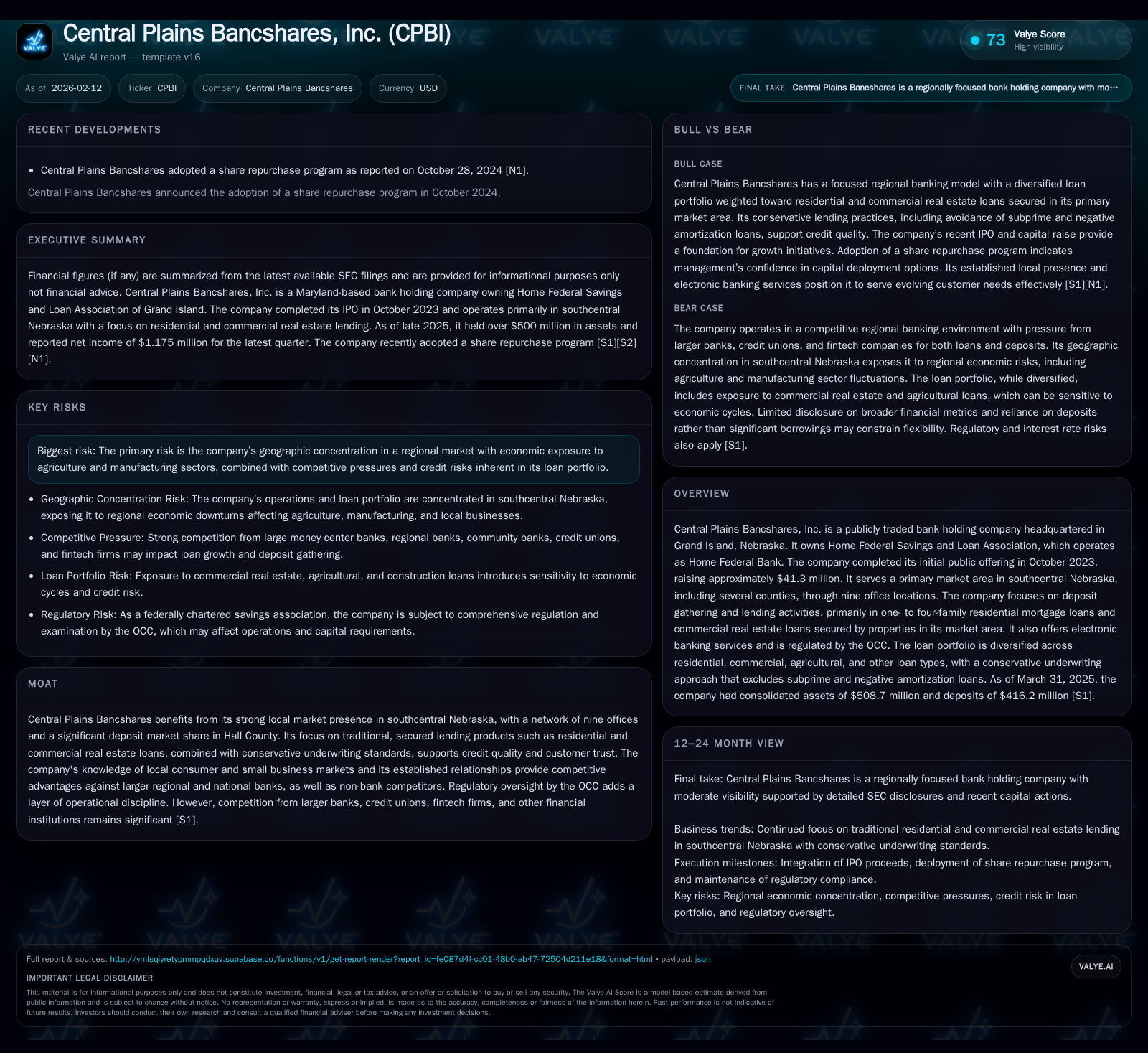
Central Plains Bancshares, through its subsidiary Home Federal Bank, completed a seminal IPO in October 2023, marking its transition from mutual roots to a public company with enhanced capital flexibility. Anchored in southcentral Nebraska’s diverse economy, the bank maintains a solid footprint across six counties with nine offices, drawing strength from long-standing community relationships. Its conservative underwriting and loan portfolio composition underpin credit quality even as it contends with competition from larger institutions and fintech innovators. Regulatory oversight by the OCC offers operational discipline supporting stability, although geographic and sector concentrations remain notable risks.
From Mutual Roots to Public Markets: Mapping CPBI's IPO Journey
The story of Central Plains Bancshares is one that embodies transformation rooted in tradition. Established through its wholly-owned subsidiary Home Federal Savings—originally chartered in 1935—the institution recently redefined its trajectory by completing an initial public offering (IPO) in October 2023. This event was not merely a capital raise but a milestone signifying its shift from a mutual savings association to a publicly traded entity. The offering raised approximately $41.3 million through the issuance of over four million shares at $10 each [S1].
This mutual-to-stock conversion allowed the bank to solidify its financial foundation with fresh equity capital, expanding its strategic runway without disrupting the core operations built around community banking values. Since the IPO, the company has maintained a steady operational pace focused on supporting Home Federal Savings' banking activities rather than diversifying into new lines immediately [S1]. The infusion of capital bolsters regulatory capital ratios and positions CPBI to selectively pursue growth opportunities while weathering competitive pressures.
Anchored in Nebraska: Unpacking the Local Market Footprint
Geographically, Central Plains Bancshares is deeply embedded within southcentral Nebraska—a region marked by a blend of traditional and modern economic drivers. Its network of nine branch locations spans six counties: Adams, Dawson, Hall, Lancaster, Nuckolls, and Phelps [S1]. This diversified footprint encompasses urban centers like Grand Island and Lincoln alongside rural communities where agriculture holds substantial economic weight.
The bank’s intimate knowledge of local markets has been a cornerstone competitive advantage. Demographic segments served include farmers managing crop cycles; manufacturers contributing to regional employment; healthcare providers; educators; and small businesses underpinning vibrant community economies. This mosaic ensures that deposits come from a broad base while loans address diverse credit needs within familiar territories.
Relationship banking thrives here—decision-makers often possess nuanced understandings unavailable to larger, impersonal institutions. Moreover, community ties facilitate cross-selling opportunities without sacrificing credit prudence.
A Conservative Lending Philosophy: Navigating Credit Quality and Portfolio Mix
A defining feature of Central Plains Bancshares is its disciplined approach to credit risk management. The company's loan portfolio is concentrated primarily on secured one- to four-family residential mortgage loans coupled with commercial real estate exposures within its primary market area [S1]. Additional lending categories include agricultural real estate/non-real estate loans, multi-family housing loans, construction/land development financing, as well as limited consumer lending.
Notably absent are subprime or negative amortization loans—a deliberate exclusion reflecting conservative underwriting policies designed to minimize credit losses in fluctuating economic cycles [S1]. This approach seeks to enhance portfolio stability by favoring quality collateral and well-understood borrower profiles native to the region.
Credit risk mitigation is further supported by careful loan-to-value ratios consistent with traditional savings association standards; this reduces volatility relative to more aggressive commercial bank peers or non-bank lenders pursuing higher-risk borrower segments.
Competitive Dynamics in Southcentral Nebraska: Community Bank vs Giants and Fintechs
Central Plains Bancshares operates within an ecosystem where competition is multifaceted. Its rivals span large money center banks offering breadth of services and pricing advantages; regional banks leveraging scale; credit unions focusing on member trust incentives; as well as fintech firms disrupting payment systems and lending channels [S1].
Against this backdrop, CPBI’s strength lies in localized consumer insights born of longstanding presence. Custom-tailored credit decisions grounded in personal knowledge contrast favorably against algorithm-driven lenders lacking regional context.
However, challenges persist—digital-native competitors attract younger customer cohorts accustomed to seamless mobile experiences; meanwhile large banks can undercut pricing or bundle products economically unfeasible for smaller players. Maintaining deposit share thus demands balancing traditional relationship banking with enhancing digital engagement.
Stability Behind the Scenes: Regulatory Oversight and Operational Discipline
Central Plains Bancshares is subject to comprehensive federal oversight from the Office of the Comptroller of the Currency (OCC), which serves as both regulator and examiner for Home Federal Savings [S1]. This relationship imposes stringent requirements for capital adequacy, asset quality monitoring, internal controls, compliance programs, and transparency reporting.
Such regulatory discipline acts as a stabilizing force behind operational decision-making—ensuring prudent growth aligned with risk tolerance benchmarks accepted by stakeholders. It also reassures investors about governance standards particularly important given CPBI’s recent public listing.
Adherence to OCC guidelines mandates regular stress testing scenarios, reviews of liquidity profiles, and compliance audits that collectively underpin sound banking practices. While adding some administrative burden typical of federally-regulated institutions, this oversight mitigates systemic risks common among smaller banks.
Risks on the Horizon: Geographic Concentration and Sectoral Dependencies
Despite strategic strengths, Central Plains Bancshares faces notable headwinds inherited from its concentrated regional footprint [S1][S2]. The primary market's economic health depends significantly on agriculture—which remains vulnerable to commodity price swings, weather events, government policy changes—and manufacturing sectors sensitive to broader industrial cycles.
This sectoral dependence introduces volatility risks that could impair borrowers’ repayment capacities during downturns. Furthermore, concentrated geographic exposure limits diversification benefits that larger multi-state institutions enjoy.
Competitive pressures amplify these challenges: deposit attrition or loan migration toward digitally sophisticated rivals could constrain growth prospects if not countered effectively. The company’s risk disclosures acknowledge these factors without raising immediate alarm but underscore ongoing vigilance necessity [S1].
Financial Snapshot: Profitability, Liquidity, and Capital Strength
Landing squarely in a post-IPO operating steady-state as of December 31, 2025 data reveals foundational financial metrics worth noting [F1][S2]. Net income registered at approximately $1.175 million for the period ending year-end 2025 signals modest profitability anchored by stable interest income streams from traditional loan portfolios.
Cash & cash equivalents stood robustly at roughly $28.1 million—reflecting healthy liquidity buffers enabling overnight funding flexibility alongside operational resilience [F1]. Consolidated assets reached about $508.7 million with deposits totaling $416.2 million accompanied by stockholders’ equity near $83.3 million highlighting solid capitalization post-equity raise [S1].
These figures imply prudent balance sheet management oriented towards sustainable growth rather than aggressive expansion — consistent with management focus articulated elsewhere.
Digital Strategy: Modern Services Meet Traditional Banking
Recognizing shifting consumer expectations amidst digital disruption trends affecting all corners of financial services space, Central Plains Bancshares supplements its branch network with electronic banking capabilities including mobile apps, online bill pay functionalities, and Zelle-powered electronic funds transfers [S1].
This digital layer caters especially to convenience-seeking customers without undermining personalized service hallmarking community banks. By integrating technology pragmatically rather than positioning it as wholesale replacement for human interaction, CPBI maintains relevance while safeguarding relational equity.
Such blended service delivery models are increasingly critical as younger demographics prioritize seamless access but still value trust-based relationships cultivated locally—a duality reflecting evolving yet persistent customer preferences.
Balancing Growth Ambitions with Local Market Sensibilities
Looking ahead, CPBI appears poised for cautious yet deliberate progress—leveraging newfound public company status for incremental product enhancements paired with deepening existing client relationships rather than broad risk-taking maneuvers [S1]. Strategic intent emphasizes reinforcing core competencies tied tightly to regional identity while gradually adapting innovations aligned with marketplace demands.
This balancing act involves juggling capital deployment priorities inclusive of maintaining conservative underwriting thresholds against pressures for digital investments necessary for future competitiveness—a nuanced evolution emblematic of many mid-sized community banks facing similar crossroads.
Ultimately the key challenge may reside less in exploitable opportunities than in discerning how best to sequence change initiatives that honor heritage without impeding forward momentum.
This analysis is intended solely for informational purposes regarding Central Plains Bancshares' operational landscape based on publicly available filings as of February 2026. It does not constitute investment advice or recommendations.
Disclaimer: This is research-only, informational analysis and not investment advice. It may include AI-generated interpretation and general industry context. Always verify important details using primary sources.

Comments