L3Harris Technologies Inc: Comprehensive Analysis of Strategic Position and Industry Dynamics in Aerospace & Defense
L3Harris Technologies stands as a diversified aerospace and defense player with a strong U.S. government customer base, navigating geopolitical risks through operational transformation and innovation.
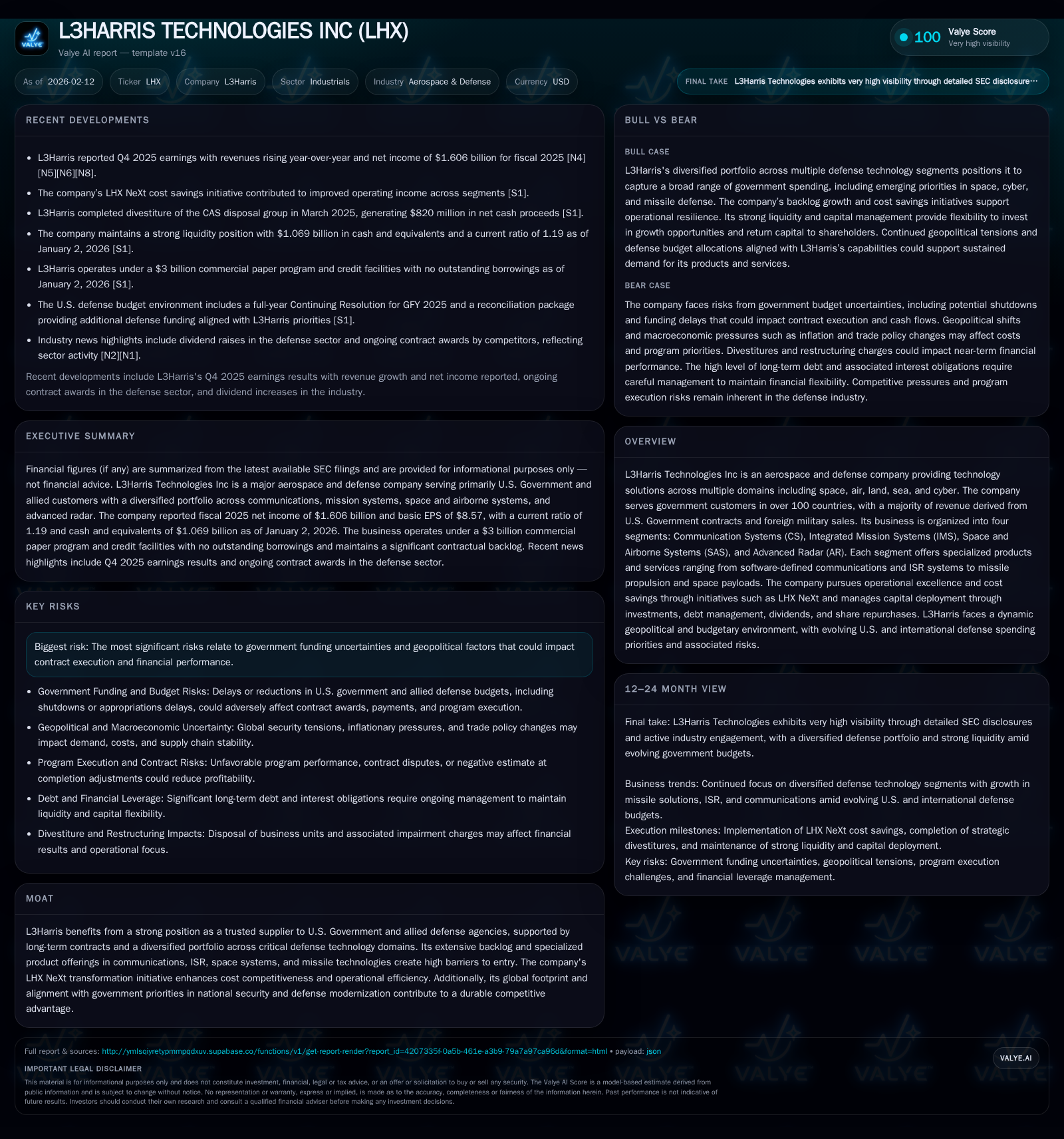
L3Harris Technologies Inc (ticker: LHX) is a key player in the aerospace and defense industry, serving governments worldwide with a portfolio encompassing communications, ISR, space systems, and missile technologies. The company’s revenue is heavily weighted toward the U.S. Government, representing roughly three-quarters of sales. Its four segments—Communication Systems (CS), Integrated Mission Systems (IMS), Space and Airborne Systems (SAS), and Advanced Radar (AR)—deliver specialized solutions that leverage technology innovation while confronting budgetary and geopolitical uncertainties. L3Harris pursues margin expansion through its LHX NeXt initiative. While the firm faces risks from government funding volatility, a robust backlog, strong operational discipline, and favorable strategic positioning underpin its moat.
Company Overview
L3Harris Technologies Inc positions itself as the "Trusted Disruptor" within the aerospace and defense landscape. It delivers end-to-end technology solutions that integrate multiple operational domains — space, air, land, sea, and cyber — supporting national security objectives primarily for the U.S. Government and allied nations across more than 100 countries [S1]. The firm's workforce is considerable with around 45,000 employees including approximately 18,000 engineers and scientists dedicated to advancing defense innovation.
The company's business model is designed to be flexible; it operates variously as prime contractor, merchant supplier, or subcontractor depending on specific program demands. Its platform-agnostic approach allows adaptability in an industry characterized by evolving threats and increasing technological complexity.
Business Segments Breakdown
Communication Systems (CS): This segment focuses on software-defined communications products including tactical radios for resilience on the battlefield, broadband communications capability enhancements such as the Next Generation Jammer Electronic Warfare program, integrated vision solutions, and public safety communications equipment. Fiscal 2025 revenue grew by 4% to about $5.67 billion owing largely to expanded international deliveries in tactical communications and ramp-up in broadband programs [S1]. Operating margin improved slightly to 25.2%, supported by cost savings initiatives under LHX NeXt.
Integrated Mission Systems (IMS): Encompassing intelligence, surveillance and reconnaissance (ISR) systems, passive sensing technologies, electronic warfare platforms, autonomy development, power/communications units, networks integration—and until early 2025 the CAS disposal group focused on aviation products—the IMS segment reported stable top-line performance year-over-year with approximately $6.63 billion in revenue for FY25. Adjusting for CAS divestiture headwinds which reduced revenues by $459 million post-disposal, organic growth was recorded in ISR (+$359 million), maritime programs (+$61 million), and targeting/sensor systems (+$41 million). Operating margins compressed marginally to around 12.2%, partially reflecting divestiture impacts as well as some unfavorable program performance [S1].
Space & Airborne Systems (SAS): Although less detailed disclosures exist here in the excerpts provided, SAS represents critical capabilities including payloads for space platforms, airborne platforms integration often supporting defense modernization priorities such as next-generation sensing.
Advanced Radar (AR): A high-technology segment developing radar solutions likely tied to air/sea/land domain awareness and missile defense applications.
Financial Performance Highlights
For fiscal year ended January 2, 2026 (fiscal 2025), L3Harris posted:
- Revenue: $21.87 billion (+3% YoY)
- Gross margin: Stability compared to prior year though influenced by absence of CAS disposal group impact (-$204 million adjustment)
- Operating income: $2.11 billion (+10% YoY approx.)
- Net income attributable to L3Harris: $1.61 billion with diluted EPS of $8.53
- Contractual backlog: Approximately $38.7 billion up 13% relative to prior year end indicating strong demand pipeline [S1][F1]
Despite government funding headwinds—including protracted federal shutdowns stretching over six weeks into late CY25—the firm has maintained steady growth through program ramps particularly focused on classified ISR programs internationally (e.g., Republic of Korea Air Force AEW&C aircraft) as well as maritime sensor integrations.
Capital allocation strategies include prudent debt management complemented by dividends and share repurchases; the $536 million R&D spend (~2% of total revenues) denotes continued investment in emerging technologies central to sustaining technological leadership.
Macroeconomic & Geopolitical Context
The company’s financials are heavily influenced by U.S. federal budget decisions where defense spending constitutes roughly three quarters of revenue sources either directly or via foreign military sales brokered through the U.S Government apparatus [S1]. The GFY25 full-year continuing resolution provided $893 billion defense funding inline with inflation constraints under the Fiscal Responsibility Act.
Fiscal Year 2026 anticipates flat topline from base budgets supplemented materially by an additional $119 billion from reconciliation packages aimed at priority domains closely aligned with L3Harris’ offerings including munitions modernization and shipbuilding expansions.
However,
- Extended government shutdowns created uncertainty around contract approvals
- Shifts in NASA funding impact SAS-related space systems initiatives;
- The Commerce-Justice-Science appropriations bill passed early 2026 granted additional funding for NASA ($6B increase) preserving core space launch systems like SLS-based Artemis missions aligning with L3Harris’ space payload interests.
Geopolitical tensions globally add layers of risk given dependency on international sales through foreign military sales mechanisms; these can be volatile based on diplomatic relations or trade policy.
Strategic Initiatives: LHX NeXt and Operational Excellence
A cornerstone of management's strategy lies in the LHX NeXt enterprise-wide transformation program initiated several years ago aiming at unlocking value through:
- Enhanced agility to respond rapidly to shifting threat environments
- Cross-segment collaboration leveraging scale economies
- Streamlined processes improving margins (measured via e3: excellence everywhere everyday)
Cost saving benefits were evident during FY25 results contributing meaningfully to operating income gains even amidst flat gross margins.
This continuous improvement mindset positions L3Harris favorably against peers especially within segments facing pricing pressure or elevated competitive intensity.
Competitive Advantages (Moat)
L3Harris’ moat rests on several pillars:
- Trusted status among U.S Government agencies bolstered through long-term contracts,
- Global reach servicing allied military customers enhances revenue diversification,
- Deep technology specialization spanning communication waveforms to advanced radar reducing threat of commoditization,
- Large backlog providing visibility into multi-year revenue streams,
- Innovation culture powered by a large cohort of engineers driving rapid prototyping and adaptation,
- Flexibility acting either as prime contractor or subcontractor increases market opportunity capture,
- Alignment with national security priorities ensuring relevance amid changing defense policies.
Risks & Challenges
The principal risk factors center on:
- Uncertainties in government funding levels that directly affect contract volume/timing,
- Geopolitical volatility that could delay or cancel foreign military sales,
- Supply chain interruptions exacerbated by recent tariffs requiring mitigation steps like supplier diversification,
- Program execution risks including cost overruns or delays impacting profitability,
- Macroeconomic pressures inflating labor/material costs potentially offsetting margin gains,
- Regulatory changes affecting tax codes or export controls impacting operating environment.
Management acknowledges these risks openly while emphasizing ongoing mitigation tactics such as strategic supplier negotiations and flexibility in pricing models [S1].
Liquidity & Capital Structure Insights
From latest financial snapshots:
- Cash & cash equivalents stand at approximately $1.07 billion providing healthy liquidity buffers [F1],
- Current assets exceed current liabilities resulting in a current ratio exceeding 1.19 indicative of sound short-term financial health though working capital management remains crucial,
- Interest expense declined slightly reflecting effective debt management efforts lowering net financing costs.
These financial metrics underpin capacity to invest in R&D while returning capital to shareholders responsibly.
Industry Outlook & Competitive Landscape (Analysis)
The aerospace & defense sector remains shaped by rising great power competition prompting sustained government investment especially in advanced ISR capabilities, networked communications infrastructure distortion-tolerant radars/sensors and space domain awareness systems. L3Harris competes against industry titans like Raytheon Technologies, Lockheed Martin, Northrop Grumman who similarly vie for prime contracts; however its niche focus on communications plus tactical ISR differentiates it. Demand for software-defined resilient communications equipment aligns well with modern multi-domain operations concepts emerging among western militaries. Furthermore, electronic warfare advancements integral within next-gen jammers reflect increasing importance of spectrum dominance warfare classrooms. Market uncertainty persists from potential shifts in U.S.-China strategic competition possibly impacting procurement allocations but overall demand fundamentals support continued innovation investments across L3Harris’ portfolio sectors.
Recent Earnings Trends & Market Reception[N2-N8]
Recent Q4 FY25 earnings releases indicated top-line outperformance relative to estimates driven largely by segment-specific volume expansions notably within Tactical Communications driven by international deliveries. Operational leverage gains attributed to NeXt efficiencies helped beat operating income forecasts though mixed segment results illustrate ongoing complexity balancing legacy programs versus new tech deployments. Some market participants reacted cautiously highlighting geopolitical uncertainties but acknowledged strength of backlog underpinning future growth avenues [N2][N4][N6]. Liquidity outflows detected in certain ETFs holding LHX shares suggest mixed institutional repositioning which may relate more broadly to sector rotation dynamics than company fundamentals specifically [N11]. Options activity for March '26 expiry commencing indicates trader interest potentially linked to upcoming contract awards or Congressional budget appropriations cycles [N13]. Competition announcements such as RTX’s receipt of a large Army contract underscore intense bidding environment yet reinforce growing market opportunities available simultaneously for all qualified suppliers [N14].
Conclusion Overview
L3Harris Technologies holds a strategically vital position within aerospace & defense serving critical warfighter needs linking multiple domains across communication systems through space payloads to advanced radar technologies. The company balances growth ambitions fueled by innovation investments against inherent cyclical risks associated with reliance on government budgeting processes amid complex geopolitical landscapes. Their proactive operational transformation via LHX NeXt coupled with diversified segment exposure constructs a resilient platform poised for execution success over coming years despite uncertainty vectors inherent in their industry niche.
Disclaimer: This is research-only, informational analysis and not investment advice. It may include AI-generated interpretation and general industry context. Always verify important details using primary sources.

Comments