
CareTrust REIT: Navigating Healthcare Real Estate with Strategic Focus and Financial Fortitude
Analyzing CareTrust REIT’s specialized healthcare property niche, solid 2025 financials, and regulatory navigation amid evolving market dynamics.
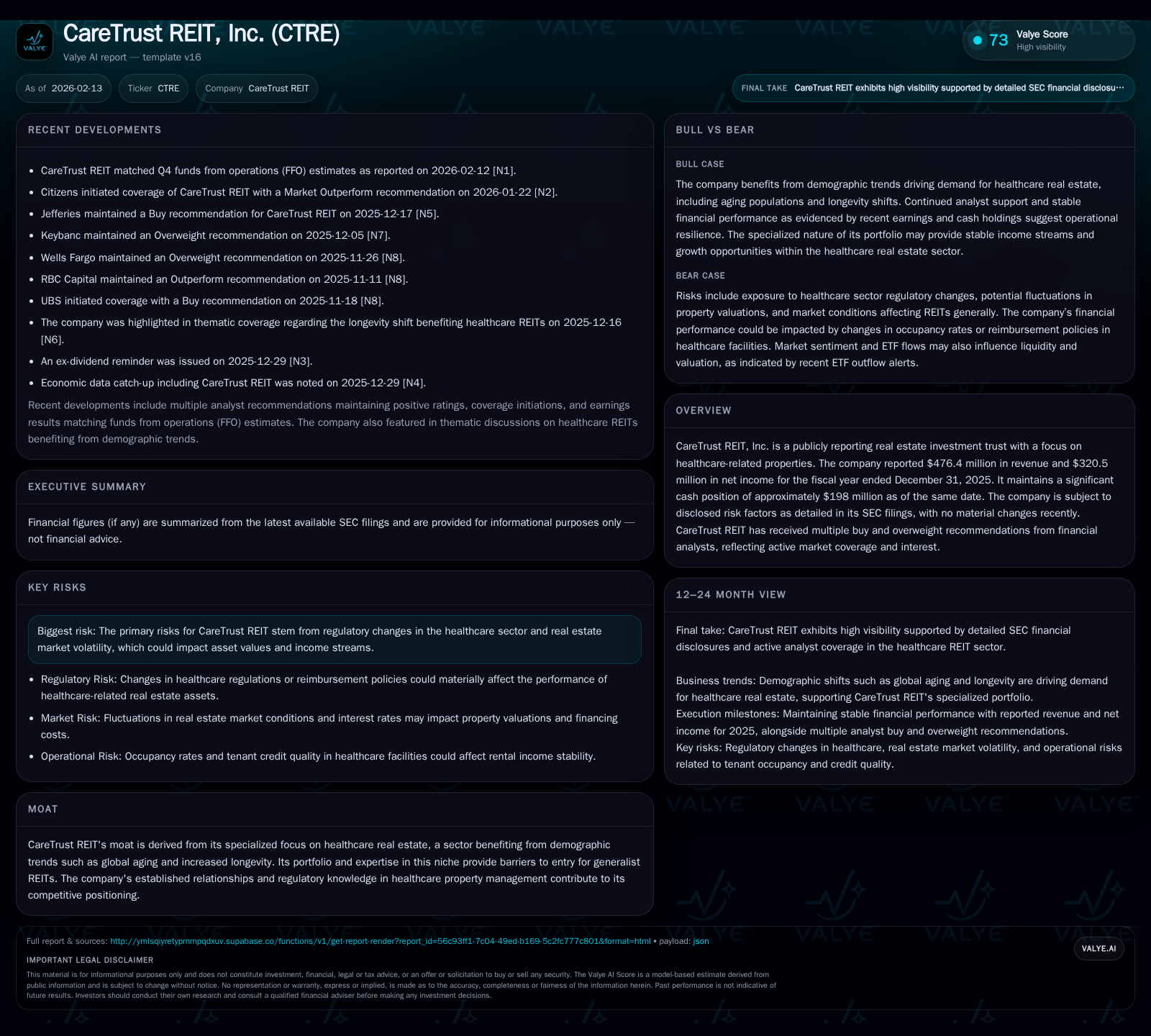
CareTrust REIT, Inc. leverages a focused healthcare real estate portfolio anchored by aging demographic trends to sustain a meaningful competitive moat. For fiscal 2025, the company posted substantial revenues of $476.4 million alongside strong net income and a robust cash position approaching $200 million, underscoring financial resilience. Recent analyst upgrades reflect positive market sentiment tied to consistent performance and sector fundamentals, while regulatory risks remain stable but warrant ongoing vigilance. Governance transparency through insider trading arrangements further signals disciplined management amid industry complexities.
Specialized Healthcare Focus: The Core of CareTrust's Moat
In an arena often marked by broad-spectrum real estate players, CareTrust REIT stakes its claim through acute specialization in healthcare-related properties. This focus confers competitive barriers rooted not just in the physical portfolio but also in deep sector knowledge and regulatory familiarity inherent to managing healthcare assets. Demographic realities—most notably the steady rise in global aging populations coupled with improved longevity—amplify demand for medical facilities, senior housing, and ancillary care properties. This confluence of macro trends fortifies CareTrust’s moat against incursions by generalist REITs less versed in navigating complex healthcare regulations or tailoring properties to evolving clinical needs [valye_report_excerpt].
By investing predominantly within healthcare niches, CareTrust has cultivated relationships and institutional experience that further entrench its market positioning. The precise calibration of property types aligns with anticipated long-term utilization patterns driven by demographic shifts—a cornerstone that withstands broader economic fluctuations impacting traditional real estate sectors.
2025 Financial Performance: Robust Revenue and Cash Strength
Financially, CareTrust demonstrated considerable operational vigor across fiscal 2025, reporting revenues totaling approximately $476.4 million accompanied by net income surpassing $320 million [F1]. These figures underscore effective asset management and occupancy stability within specialized healthcare holdings.
Importantly, near $198 million in cash and equivalents endows the company with substantial liquidity buffers to pursue growth opportunities or shield against market headwinds [F1]. This cash position reflects prudent capital stewardship aligned with maintaining flexibility amid uncertain regulatory and macroeconomic environments [S1].
Such a balance sheet—not often characteristic of niche REITs—may facilitate selective acquisitions or renovations tailored to emerging healthcare trends without excessive reliance on external financing or dilutive equity issuances.
Market Sentiment and Analyst Upgrades: Insights from the Latest Coverage
Investor sentiment toward CareTrust has strengthened significantly since late 2025, as evidenced by multiple notable analyst upgrades implemented early in 2026. Coverage initiations describing the company as ‘market outperform’ [N3] along with upgrades to 'buy' or ‘overweight’ ratings from established firms like BMO Capital Markets [N4] and other independent voices [N2] collectively signal growing confidence.
This bullish stance correlates temporally with CareTrust's delivery of Q4 FFO results meeting consensus forecasts [N1], reinforcing expectational alignment between operational execution and market outlook. Analysts appear attuned to the duality of solid near-term financial metrics married to the longer-term structural drivers inherent to healthcare property demand.
These endorsements may also reflect acknowledgment of CareTrust's earnings quality amid an industry where volatility can arise from regulatory changes or policy shifts affecting tenant operations.
Regulatory Landscape: Navigating Healthcare Sector Risks
Healthcare regulations constitute a pivotal risk vector for CareTrust given their direct influence on tenant viability and reimbursement frameworks impacting rent flows. SEC filings affirm a comprehensive disclosure approach identifying these risks as material yet stable in scope over recent reporting periods, with no new significant issues arising through late 2025 [S1][S2].
While this steadiness tempers concerns about abrupt regulatory shocks, it simultaneously mandates sustained vigilance as legislative or policy modifications at federal or state levels could alter tenant economics or necessitate costly property adaptations.
CareTrust’s embedded regulatory expertise likely serves as a mitigating factor, enabling proactive positioning ahead of potential adjustments. Nonetheless, the inherent complexity underlying healthcare reimbursement models (e.g., Medicare/Medicaid adjustments) remains a background uncertainty requiring attentive risk management.
Governance and Insider Activity: Significance of Leadership Moves
Corporate governance nuances at CareTrust received attention following the September 2025 adoption by CEO David Sedgwick of a Rule 10b5-1 trading plan permitting predetermined sales of common stock up through August 2026 [S2]. Such arrangements typically convey managerial discipline regarding share disposals while signaling confidence about ongoing business prospects under structured conditions.
From an analytical standpoint, this planned insider selling should be interpreted not as immediate concern but as indication of transparent liquidity management aligned with SEC best practices. It reflects mature governance intent on avoiding perceived opportunistic insider transactions during potentially volatile windows.
By formalizing such plans publicly via SEC disclosures, leadership projects steadiness essential to sustaining stakeholder trust amid an evolving healthcare real estate landscape.
Risks Without Surprises: Stability in Disclosure
An encouraging aspect within CareTrust’s recent filings is consistency in risk factor disclosures related to its business operations [S2]. No material changes emerged compared to prior quarters—implying either effective risk containment or stable operating conditions versus competitors confronting more dynamic exposures.
For investors analyzing long-term viability, this stability suggests a controlled risk evolution rather than emergent vulnerabilities tied to market or regulatory disruptions. Compared with peers facing fluctuating healthcare reform environments or property valuation pressures, CareTrust seems positioned with measured transparency reflecting experienced risk navigation.
Nonetheless, inherent real estate market volatility tied to interest rates or tenant creditworthiness remains relevant overlays requiring continuous monitoring alongside sector-specific challenges.
Growth Prospects within Demographic Tailwinds
Looking forward, demographic imperatives underpinning demand for specialized healthcare properties are unlikely to wane anytime soon—if anything, they intensify as populations age globally coupled with rising chronic illness prevalence and longevity gains [valye_report_excerpt].
CareTrust is uniquely situated to capture these tailwinds via its targeted portfolio calibrated toward hospitals, senior living communities, medical offices, and other critical care facilities. The convergence of increased utilization rates alongside constrained new supply due to regulatory approval hurdles enhances growth visibility relative to non-specialized property classes.
Furthermore, innovations in healthcare delivery models—such as outpatient care expansion—may create new property demand niches suited for agile landlords like CareTrust that maintain sector familiarity and flexible asset strategies.
Conclusion: Balancing Opportunity with Vigilance in Healthcare Real Estate
Synthesizing strategic concentration, steady financial health, favorable investor reception, and disciplined governance reveals a nuanced portrait of CareTrust REIT navigating the intersecting forces shaping healthcare real estate today. The company’s moat emerges not solely from ownership metrics but also through adeptness at steering regulatory intricacies paired with operational liquidity advantages.
Yet such strengths coexist alongside challenges resonant across the sector—chief among them are regulatory flux potentialities that could ripple through tenant economics and asset valuations unpredictably. The absence of recent material shifts in disclosed risks is reassuring but mandates ongoing attention rather than complacency.
Investor enthusiasm reflected by analyst upgrades captures both confidence born from concrete performance data (e.g., Q4 FFO alignment) and faith in thematic growth drivers buttressing demand for specialized care properties amid aging demographics.
Ultimately, CareTrust exemplifies how targeted expertise combined with financial prudence may yield resilience within a volatile yet opportunity-rich segment of commercial real estate—highlighting the importance of blending optimism about structural trends with vigilance toward evolving uncertainties intrinsic to the U.S. healthcare ecosystem.
Disclaimer: This analysis is for informational purposes only and does not constitute investment advice or recommendations.
Disclaimer: This is research-only, informational analysis and not investment advice. It may include AI-generated interpretation and general industry context. Always verify important details using primary sources.

Comments