
LiveOne, Inc.: Navigating AI Partnerships and Capital Strategies Amid Financial Challenges in Digital Audio Streaming
LiveOne pursues subscriber growth through AI collaborations and capital market activity while confronting persistent losses and liquidity pressures.
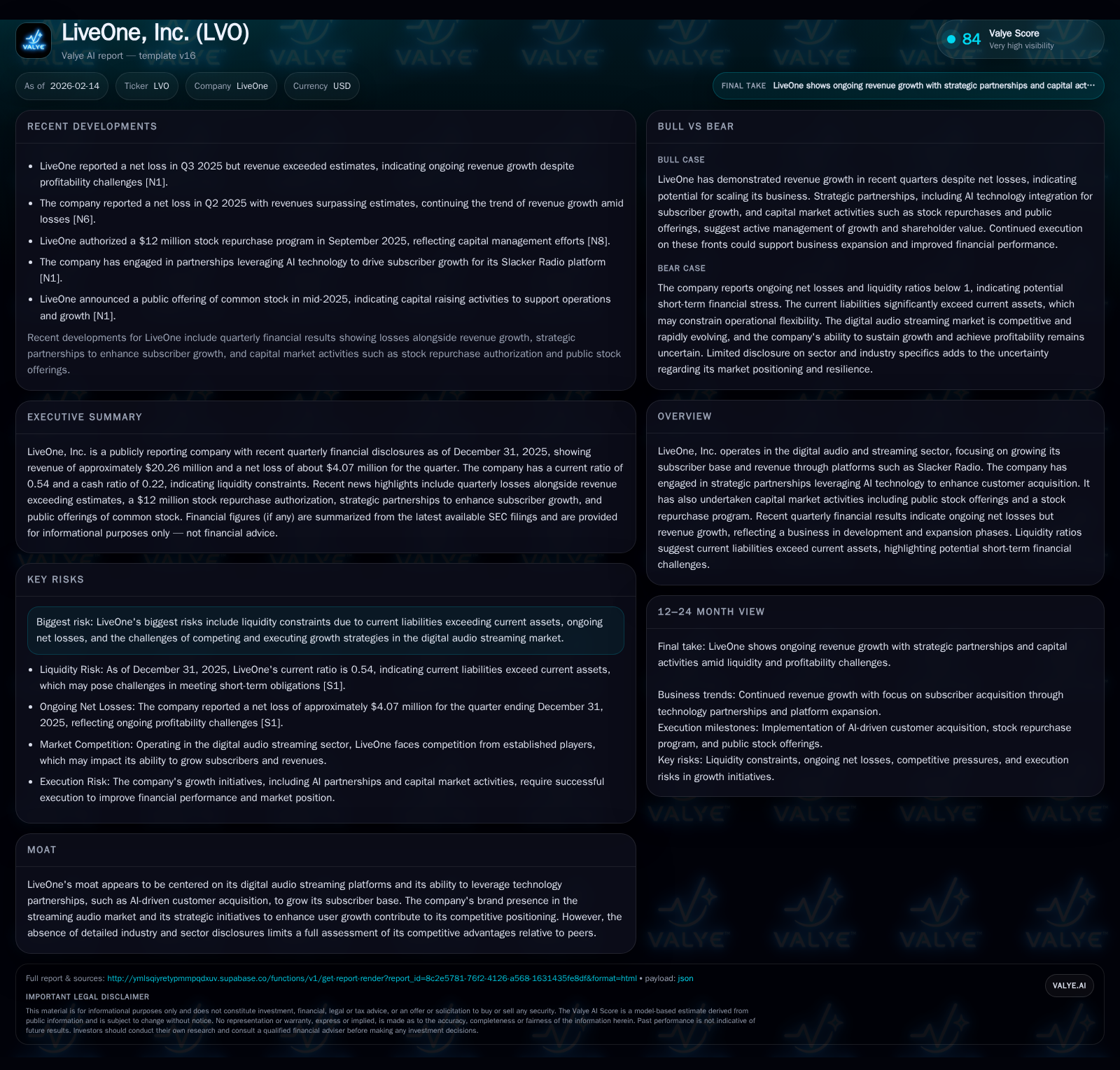
LiveOne, Inc. demonstrates encouraging revenue growth fueled by strategic AI-driven customer acquisition efforts within the competitive digital audio streaming landscape. However, the company continues to report net losses and faces liquidity constraints as current liabilities substantially exceed current assets. Management has responded with capital market initiatives including stock offerings and a repurchase plan, reflecting attempts to balance growth ambitions with financial discipline. The company’s technological differentiation and brand presence offer some moat, yet competing against industry giants amid execution risks presents ongoing challenges.
LiveOne’s Revenue Momentum vs. Enduring Net Losses
LiveOne’s recent financial disclosures portray a nuanced picture: strong revenue progression paired with persistent bottom-line deficits. For the quarter ending December 31, 2025, reported revenue reached $20.256 million, notably exceeding market expectations [N1][F1]. This top-line strength suggests successful traction in acquiring or monetizing users on its Slacker Radio platform and other digital audio services.
Nevertheless, the company recorded a net loss nearing $4.067 million over the same period [F1]. This gap underscores that LiveOne remains in a developmental phase where investments in content, marketing, technology, and operational scale weigh heavily on profitability. These numbers align with an organization prioritizing subscriber base expansion over immediate earnings.
Importantly, the juxtaposition of revenue gains amid net losses highlights a common pattern in emerging streaming firms striving to carve out market share against entrenched incumbents. LiveOne’s reported growth signals operational potential but also flags the need for prudent cost management going forward.
The Role of AI-Driven Partnerships in Customer Acquisition
At the core of LiveOne’s user growth strategy is its adoption of artificial intelligence to drive smarter customer acquisition campaigns [valye_report_excerpt]. The company has engaged strategic partners specializing in AI integration to refine targeting algorithms, optimize marketing spends, and improve subscriber conversion rates.
This technological leverage forms the backbone of LiveOne's moat by differentiating its platform capabilities in an otherwise crowded digital audio streaming market lacking detailed sector disclosures. By harnessing AI, LiveOne aims to enhance both scale and engagement metrics which are critical KPI levers for subscription businesses.
While specifics regarding these partnerships remain limited publicly, their prominence within corporate narratives indicates management considers AI not simply as a tool but as an essential axis of competitive advantage.
Capital Markets Moves: Stock Offerings and Repurchase Plans
Active participation in public equity markets characterizes LiveOne’s approach toward navigating financial needs and shareholder relations [valye_report_excerpt][S2]. The firm has conducted stock offerings to raise fresh capital aimed at fueling growth initiatives including technology development and content acquisition.
Concurrently, LiveOne initiated a stock repurchase program signaling management's intent to support valuation by reducing share count when feasible.
This dual approach reflects a balancing act: leveraging capital markets to secure operational flexibility while also attempting to reinforce investor confidence through buybacks. Such moves depict a company mindful of both growth imperatives and shareholder value creation although these must be contextualized against ongoing losses.
Liquidity Crunch: Dissecting the Balance Sheet and Current Ratio
A salient concern revealed in recent filings is LiveOne’s liquidity strain. With reported current assets amounting to approximately $21.2 million against current liabilities near $39.3 million, the resulting current ratio stands at around 0.54 [F1][valye_report_excerpt]. This metric signifies that short-term obligations exceed available liquid resources by a considerable margin.
Such working capital pressure could impede routine operations or delay planned investments absent external financing or improved cash generation. It underscores the urgency for robust cash flow management or additional funding events to alleviate near-term liquidity risks.
This aspect injects caution into analyses centered solely on revenue momentum; without addressing working capital imbalances, sustaining operational continuity might prove challenging during periods of broader market volatility or execution slips.
Competitive Landscape: Positioning Among Streaming Giants
Contextualizing LiveOne requires benchmarking against better-capitalized streaming rivals such as Sirius XM and Sonos [N2][N3]. Both these players recently reported earnings surpassing forecasts accompanied by stable or growing revenues — indicators reflective of entrenched consumer bases and deeper pockets for innovation.
Moreover, Comcast (CMCSA), with diversified media properties including Peacock streaming service, also included favorable theme park performance that buttressed overall results [N5]. These industry bellwethers benefit from extensive content libraries, brand recognition, and economies of scale unavailable to smaller entities like LiveOne.
Within this milieu, LiveOne occupies a niche position where it must aggressively leverage innovative strategies — notably AI-enabled customer acquisition — while contending with comparatively limited visibility and smaller operating scale. This dynamic emphasizes the uphill climb in gaining competitive footing amidst giants possessing broad ecosystem advantages.
Risks Lurking Below the Surface: From Blockchain Forks to Market Execution
Beyond typical streaming sector risks lies regulatory-technical complexity tied to blockchain "forks" highlighted in official SEC documents [S2]. Given LiveOne's operational reliance on crypto-related platforms or custodians handling digital assets related to bitcoin fork events, there exists possible exposure to network disruptions, security vulnerabilities such as replay attacks, valuation volatility due to fragmented crypto asset standards, and reputational damage stemming from community conflicts around contentious forks.
Although these factors may not directly pertain to core streaming functions, they introduce ancillary layers of uncertainty particularly if any significant fork event hampers asset recognition or custody workflows internally managed by or connected with LiveOne.
Furthermore, execution risk looms large: successfully scaling existing AI-enhanced acquisition frameworks demands sustained technological investments and adept market responsiveness; missteps could exacerbate financial strain already visible from losses and liquidity limits.
Future Outlook: Growth Prospects Against Financial Headwinds
Looking forward, LiveOne’s trajectory hinges upon its ability to convert promising revenue trends into positive operating leverage while managing liquidity prudently [valye_report_excerpt][N1][F1]. Preserving subscriber momentum via AI innovations offers a tangible pathway toward improved monetization metrics, but must be balanced against cost structures that have so far produced net losses.
Capital market maneuvers provide breathing room yet highlight dependence on external financing for near-term sustainability until potential break-even points arrive.
The interplay between expanding digital audio consumption globally—which remains fertile ground—and LiveOne’s tactical investment deployment will shape whether it transitions from developmental status into a durable player capable of competing at scale within this fast-evolving domain.
LiveOne’s Brand and Moat: Assessing Sustainable Advantages
At its essence, LiveOne relies on a confluence of digital streaming assets coupled with differentiated AI-driven marketing strategies as pillars of its competitive moat [valye_report_excerpt]. Its brand footprint through Slacker Radio contributes credibility within targeted listener segments; however, lack of explicit sector classification limits conclusive judgments about relative advantages versus peers.
The company's success will depend heavily on sustaining technological leadership, elevating subscriber lifetime value,and navigating operational efficiencies amidst fierce competition typified by industry stalwarts enjoying considerable resource depth. Our assessment suggests cautious optimism tempered by recognition that these moats are nascent rather than firmly entrenched presently, and require consistent execution excellence underpinned by financial discipline.
Disclaimer: This analysis is for informational purposes only based on publicly available data as of February 2026. It does not constitute investment advice or recommendations.
Disclaimer: This is research-only, informational analysis and not investment advice. It may include AI-generated interpretation and general industry context. Always verify important details using primary sources.

Comments