
Bodhi Tree Biotechnology Inc: Navigating Early Challenges in a Crowded Vegetarian Consulting Market
An emerging player in vegetarian menu and diet consulting seeks footing amid intense competition and early-stage risks.
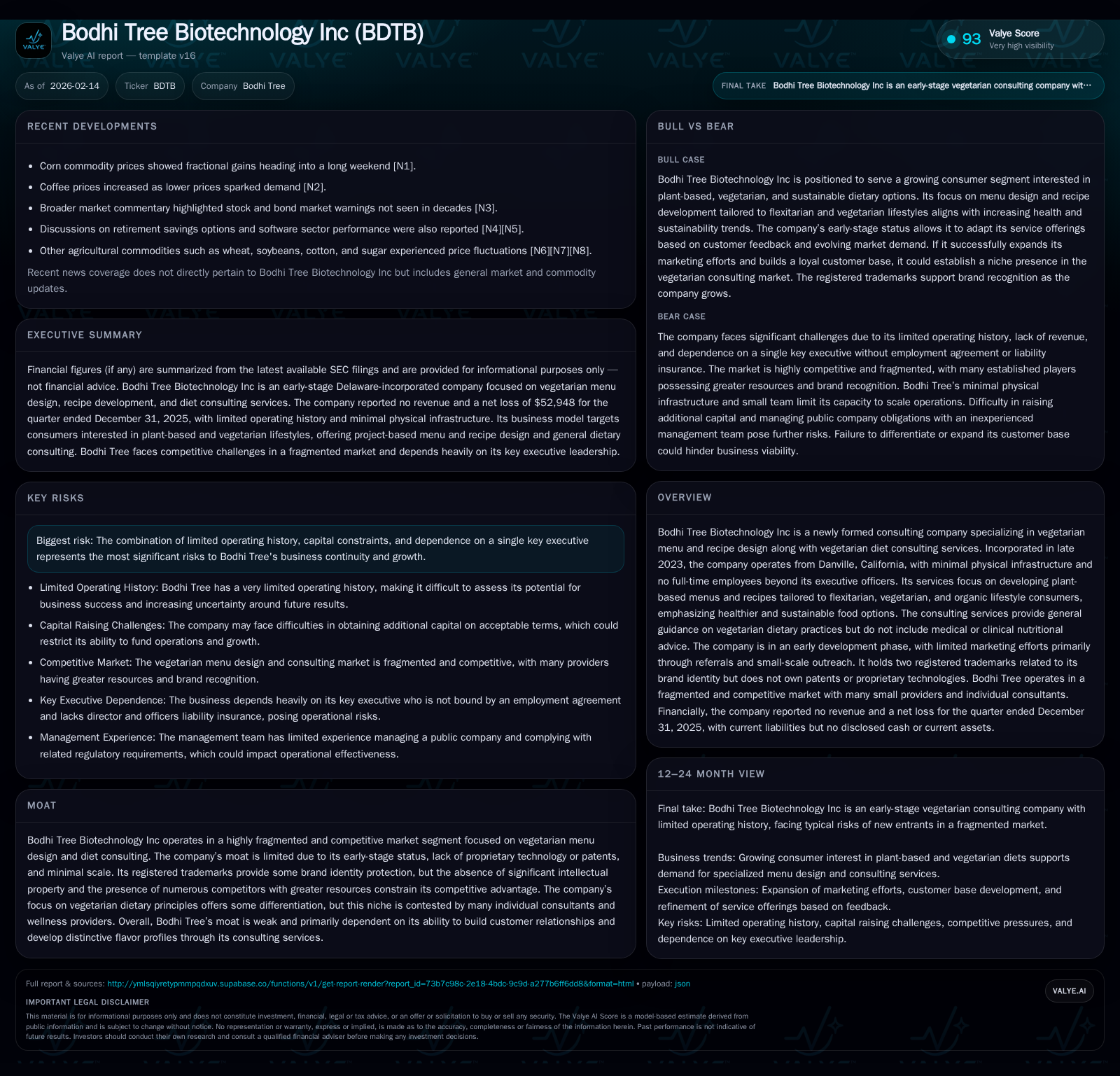
Bodhi Tree Biotechnology Inc, incorporated in late 2023, operates as an early-stage consulting firm specializing in vegetarian menu design and dietary guidance. Despite a growing global interest in plant-based lifestyles, the company faces a highly fragmented market with limited intellectual property and minimal operational scale. Leadership experience and brand trademarks provide some foundation, but Bodhi Tree must contend with capital constraints, reliance on key executives, and significant competitive pressures as it attempts to build durable client relationships and distinctive culinary offerings. The company’s future trajectory hinges on its ability to innovate flavor profiles and expand client bases within a niche crowded by many.
Plant-Based Consulting: A Fragmented Terrain
The vegetarian and plant-based dietary movement has seen remarkable growth worldwide over recent years, fueled by increasing consumer awareness of health benefits, ethical concerns for animal welfare, and environmental sustainability. This surge has spawned a sprawling ecosystem of service providers including independent diet consultants, wellness coaches, culinary innovators, and small boutique agencies focused on vegetarian menu design. In this dense field, Bodhi Tree Biotechnology Inc emerges as an entrant attempting to stake out a niche within the consulting segment focused on recipe development and dietary guidance.
Despite the expanding demand for plant-based solutions, the overall market remains highly fragmented. Numerous small operators cater to a wide variety of client needs without scale or standardized service delivery models. The low barriers to entry mean intense competition from freelance professionals to local firms with greater resources or established brand recognition. Against this backdrop, Bodhi Tree's potential moat is inherently constrained; it lacks proprietary technologies or broad distribution channels that could elevate it above peers [S1][valye_report_excerpt].
Bodhi Tree’s Business Model and Early Steps
Founded only in December 2023 and headquartered in Danville, California, Bodhi Tree pursues consulting engagements centered on vegetarian menu creation and recipe formulation tailored primarily to flexitarian, vegetarian, and organic consumers. The company's approach emphasizes crafting distinctive flavor profiles aimed at enhancing the appeal of plant-based meals beyond mere nutritional considerations.
Service delivery is project-based rather than continuous or subscription-oriented, fitting the profile of bespoke consultancy rather than scalable product lines. Currently devoid of full-time employees beyond its core executives and with minimal physical infrastructure, the firm's footprint is slim. Marketing efforts are limited mostly to referrals and modest outreach initiatives consistent with its developmental status [S1][valye_report_excerpt].
This business model prioritizes culinary creativity and trend responsiveness over technological innovation or mass-market penetration. As a result, while the focus aligns well with emerging consumer preferences for healthy eating options rooted in sustainability principles, commercial expansion faces notable challenges owing to limited scale [S1].
Leadership Profile: Experience Meets Startup Challenges
At the helm is President and CEO Xiaohang Wang who brings over thirteen years of management expertise in the health products arena. This background provides relevant insight into consumer health trends though it differs from direct experience in public company operations or large-scale organizational leadership.
Complementing Wang is CFO Juan Ye who assumed financial oversight roles at other entities since 2019 but whose public-market navigation experience is similarly unproven. The duo's leadership thus combines domain-relevant knowledge with nascent capabilities managing the increasingly complex regulatory demands incumbent upon publicly listed firms [S1][valye_report_excerpt].
Their relatively limited track record introduces execution risk—transitioning from private startup modus operandi to sustained investor relations engagement alongside rigorous compliance environments will require steep learning curves.
Trademarks Amidst Limited Intellectual Capital
Bodhi Tree maintains ownership of two registered trademarks linked to its brand identity. These trademarks provide legal recognition protecting brand name usage against immediate infringement threats within its territory.
However, the company does not hold patents or proprietary technologies that could confer defensible competitive advantages. In an industry more reliant on human creativity than patentable innovation, legal barriers often hold less weight compared to other sectors such as biotech or pharma.
Hence trademarks offer only modest protection—they support brand continuity but do not prevent competitors from replicating service concepts or culinary approaches absent more substantial intellectual property assets [valye_report_excerpt].
Financial Snapshot: Zero Revenue, Modest Expenses
The latest financial disclosures as of December 31, 2025 report no revenues generated since inception. Operating expenses have accumulated losses approximating $52,948 with current liabilities totaling about $3,500. These figures typify an enterprise still incubating its business model without meaningful commercial traction [F1].
Such early-stage financial footprints reflect necessary investment in foundational activities including research & development of recipes and menus alongside preparatory administrative costs. Persistent operating losses highlight an urgent need for capital infusion to sustain forthcoming growth endeavors.
Future performance metrics must be carefully monitored—particularly cash burn rates versus financing inflows—as they will critically influence Bodhi Tree's ability to scale services beyond pilot projects.
Risks Under the Microscope: From Capital to Key Person Dependencies
Regulatory filings enumerate multiple material risks centered primarily on Bodhi Tree’s youth as a corporate entity coupled with financial vulnerabilities [S1]. An absence of operational history leaves uncertain prospects for sustainable profitability.
Funding sufficiency poses another major risk: continued investment via equity issuance or debt financing is indispensable to support business expansion plans yet may prove challenging under current conditions given stock illiquidity and lack of proven market success.
Most notably, reliance on a narrow executive team—and particularly on CEO Wang as a pivotal figure—heightens exposure to key person risk. Any disruption impacting management continuity could materially impair execution capabilities.
Further complicating matters is the transitional challenge posed by evolving regulatory compliance burdens typical of emerging growth companies (EGCs), which while offering some reduced disclosure requirements can also mask underlying governance stresses during critical scaling phases.
Market Opportunity vs. Competitive Pressures
Consumer trends robustly favor embracing plant-based diets driven by health-consciousness and environmental advocacy. This growing influx enlarges potential addressable markets for consulting firms like Bodhi Tree aiming to capitalize on demand for specialized vegetarian culinary design services.
Nonetheless, converting these attractive macro drivers into stable revenue streams amidst myriad competitors ranging from solo consultants to larger wellness organizations remains daunting. Without distinguishing technology or expansive client networks to catalyze scale economies that reduce costs per engagement, differentiation hinges largely on qualitative factors—flavor innovation quality and client experiences [valye_report_excerpt].
This dynamic imposes continual pressure on Bodhi Tree’s strategic positioning: simply matching existing service standards insufficiently guarantees customer acquisition or retention against rival offerings better resourced or more established.
Strategic Roadmap Forward: Building Flavor Profiles and Client Bonds
Bodhi Tree’s declared growth strategy revolves around leveraging innovative recipe creation tailored finely toward evolving palates within vegetarian cohorts. By crafting distinctive menus emphasizing healthy ingredients sourced sustainably—and aligning with broader flexitarian trends—the company aims to deepen customer engagement.
Beyond product novelty itself, emphasis lies on nurturing consultative relationships grounded in educational support related to vegetarian dietary practices (while explicitly disclaiming clinical nutrition advice). Such partnerships could foster repeat business through trust-building yet require sustained outreach intensification absent today’s referral-dependent marketing model [S1][valye_report_excerpt].
Innovation primarily manifests at the intersection of culinary art and consumer lifestyle alignment rather than through disruptive technological advancements—a double-edged sword that cultivates niche appeal but limits scalability potential unless complemented by operational improvements.
Regulatory and Reporting Considerations as an Emerging Growth Company
Bodhi Tree qualifies as an "emerging growth company" under current U.S. securities laws which affords various eased regulatory burdens including simplified executive compensation disclosures and auditor attestation exemptions under Sarbanes-Oxley provisions [S1].
While these accommodations assist young companies navigating public markets’ complexities initially by reducing compliance costs and procedural rigidity, they also impose transparency trade-offs potentially influencing investor confidence.
Importantly, Bodhi Tree's election to forgo extended transition periods for new accounting standards suggests management prioritizes alignment with mainstream reporting frameworks—a prudent step towards building credible financial reporting integrity despite incipient operational strides.
The journey ahead for Bodhi Tree Biotechnology Inc encapsulates significant hurdles inherent in pioneering within a nascent yet competitive vegetarian consulting landscape. Success hinges less on breakthrough inventions than on cultivating authentic culinary expertise paired with client trust while managing scarce resources prudently amid evolving public company demands. The firm’s progress will warrant close observation given its current embryonic scale contrasted against promising market tailwinds favoring plant-based lifestyles.
Disclaimer: This analysis is intended solely for informational purposes based on available data as of February 2026; it does not constitute investment advice or recommendations.
Disclaimer: This is research-only, informational analysis and not investment advice. It may include AI-generated interpretation and general industry context. Always verify important details using primary sources.

Comments