
Live Ventures Inc: Navigating Growth Amid Opacity and Operational Shifts
An in-depth look at how Live Ventures Inc manages revenue gains against persistent losses and limited transparency.
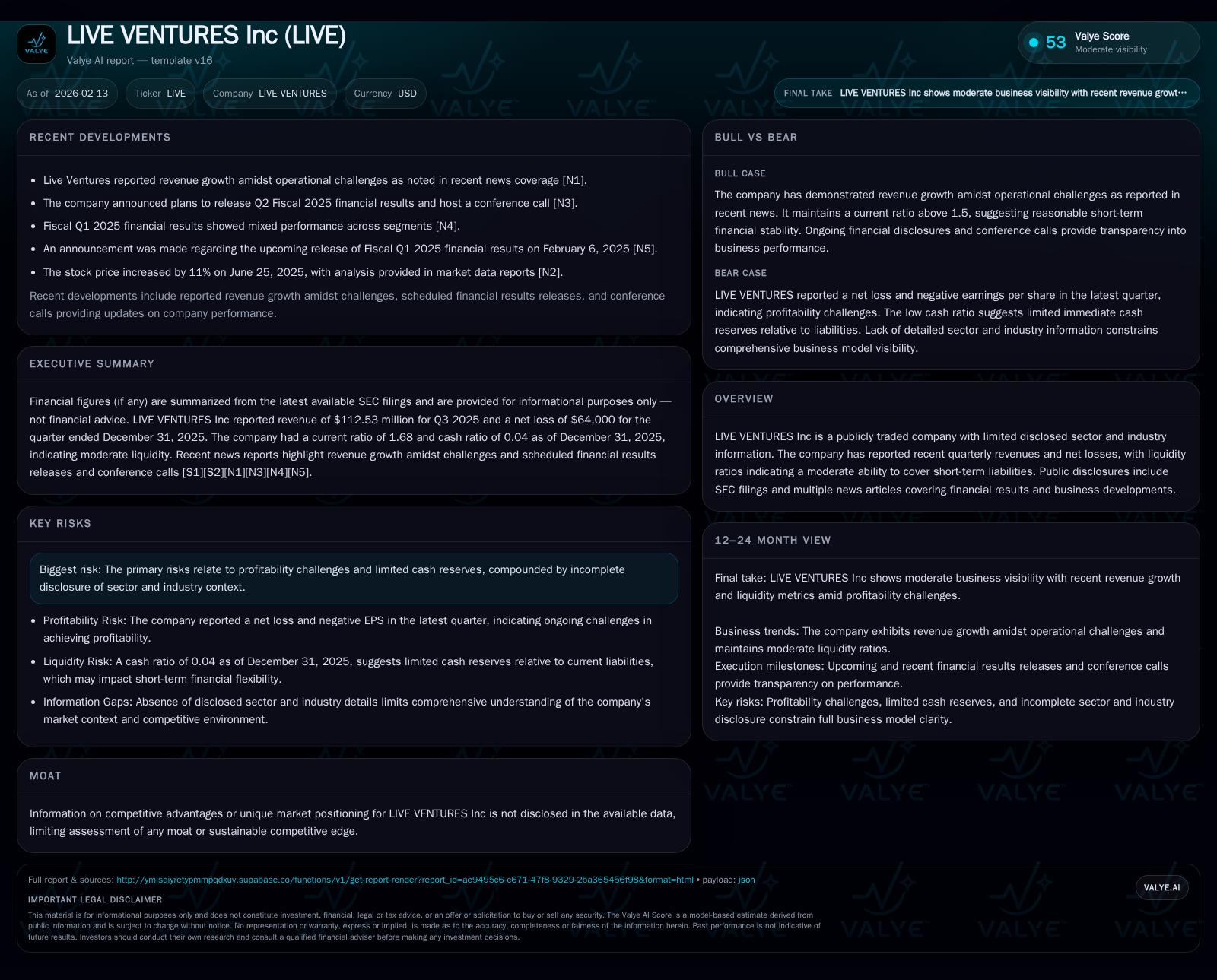
Live Ventures Inc has reported encouraging revenue growth recently, yet its financial health remains fragile with ongoing net losses and liquidity concerns. The company’s strategic adoption of AI technology is being touted as a potential margin enhancer, though this innovation is weighed against a backdrop of opaque sector positioning and limited disclosure. A notable removal of risk factors in the latest SEC filings signals evolving disclosure approaches, complicating investor assessment amid profitability pressures.
Revenue Growth in a Fog of Uncertainty
Live Ventures Inc’s most recent quarterly reports highlight an intriguing paradox: revenue growth persists even while the company cloaks its core business lines in ambiguity. According to public disclosures and recent news coverage [N1][F1], revenue reached approximately $112.5 million for the six months ending June 2025. Yet, what exactly fuels these top-line gains remains unclear — the company has not provided segment-level breakdowns or detailed industry classification. This opacity leaves analysts piecing together possibilities from indirect cues rather than concrete data.
The allure of increasing revenues often signals momentum; however, without insight into revenue composition or market drivers, it is difficult to contextualize whether this is sustainable organic growth, contract expansion, or temporary boosts from discrete projects. Such obscurity is uncommon for publicly traded firms aiming to build investor trust through transparency, suggesting Live Ventures might be navigating complex commercial terrain or pivoting business models without full disclosure.
Decoding the Financial Health: Liquidity and Losses
A second layer to this narrative involves the company’s financial resilience amid continued operating losses. The latest filings report a net loss of approximately $64,000 USD as of December 31, 2025 [F1]. While this loss is relatively modest in absolute dollars considering the revenue scale, it underscores that profitability remains elusive.
More revealing is Live Ventures’ liquidity position. With current assets standing at roughly $170.9 million against current liabilities of about $101.7 million at year-end 2025 [F1], the company posts a current ratio near 1.68 — indicating a moderate cushion to cover short-term obligations. However, cash and cash equivalents measured around $4.3 million as of September 2023 [F1] signal limited immediate liquid reserves relative to overall liabilities.
This juxtaposition paints a complex picture: while operational cash flows may not be sufficient to erase losses outright, asset management ensures short-term solvency. The pressing question centers on whether Live Ventures can transition from this cautious equilibrium toward consistent profitability without destabilizing its liquidity.
The Leverage on AI: Innovation as a Double-Edged Sword
Adding a technological dimension to this financial landscape is Live Ventures’ recent deployment of an AI-driven engine designed to forecast demand more accurately, reduce operational costs, and accelerate retail margin expansion [N2]. The announcement held promise for enhancing efficiency across supply chain management and inventory control — areas traditionally fraught with expense volatility.
Yet innovation here cuts both ways. While AI could potentially streamline operations and bolster margins, such technologies entail upfront investment risks and uncertain integration timelines. The actual impact depends heavily on execution quality and adoption speed within existing systems.
Moreover, given the company’s limited disclosure of precise business lines or sector focus, understanding how AI fits into its overall operational model proves challenging. Is AI being applied broadly or selectively? Does it signal a pivot toward tech-enabled retailing or merely incremental improvements? Without clarity on these fronts, the AI narrative remains an intriguing yet unquantifiable factor.
Opaque Sector Positioning: Navigating Without a Clear Moat
One fundamental complication for Live Ventures is its failure to disclose sector or industry classifications publicly [valye_report_excerpt]. Such gaps dramatically obscure assessments of competitive positioning or moat — key metrics for valuation and investor confidence.
Strategic moats typically hinge on product differentiation, customer loyalty, scale advantages, or proprietary technologies. In Live Ventures’ case, no evident claims or disclosures delineate these characteristics, leaving stakeholders guessing about the durability of any competitive edge.
This opacity raises important questions about market dynamics the firm confronts: Are revenues driven by durable contracts or volatile spot sales? Does the firm operate in fragmented niches or concentrated industries? Without answers here, any assessment rests on speculative ground.
Risk Landscape: Transparency Gaps and Profitability Pressures
Examining documented risks reveals an instructive shift. LIVE's annual report filed December 17, 2025 (10-K) included traditional risk factors related to profitability challenges and operational uncertainties [S1]. However, the subsequent quarterly report filed February 12, 2026 (10-Q) notably omits any stated risk factors entirely [S2].
This removal deviates from customary practice where companies update rather than expunge risk disclosures quarter-over-quarter unless material risks are resolved or deemed irrelevant.
Such omission could suggest strategic reframing by management aiming to project confidence amid market skepticism. Conversely, it risks raising red flags among investors sensitive to diminishing transparency — potentially masking unresolved vulnerabilities tied to profitability constraints or liquidity risk.
SEC Filings Tell the Tale: What’s Disclosed and What’s Omitted
Tracking pairs of filings over time reveals an evolving approach to disclosure. The comprehensive annual filing contained expected sections on business operations and risk factors [S1], whereas the latest quarterly filing streamlined these disclosures substantially [S2].
Crucially absent are detailed explanations about core segments or granular financial drivers — details critical for investor analytic rigor. While summarization can be defensible for interim filings due to timing constraints, this degree of omission reduces visibility into operational shifts occurring since year-end.
Such evolving transparency may reflect either purposeful discretion as Live Ventures refines strategy or constrained capacity to provide fuller narratives promptly given ongoing restructuring efforts.
Investor Perspectives: Balancing Hype with Hard Data
Investor commentary sourced from recent public articles illustrates a delicate balance between optimism over reported topline momentum [N1] and healthy skepticism regarding profitability challenges verified by filings [F1]. Public excitement around AI deployment peppered news narratives with forward-looking expectations for cost savings and margin lifts [N2].
Yet beneath such enthusiasm lies enduring uncertainty over sustainability free cash flow generation given narrow earnings deficits persisting through late 2025. This tension drives cautious market sentiment rather than exuberance, reflecting broader investment community norms demanding hard evidence beyond headline growth statistics before signaling conviction.
Trajectory Ahead: Possible Outcomes and Strategic Paths
Synthesizing available evidence suggests several plausible paths forward for Live Ventures without veering into pure speculation:
- Successfully leveraging AI initiatives could incrementally boost operational efficiency enough to push into consistent profitability.
- Enhanced disclosure practices might follow as management seeks deeper investor trust amid competitive pressures.
- Conversely, failure to clarify business segmentation combined with ongoing net losses could strain liquidity further posing existential risks beyond current margins.
While substantial unknowns persist—particularly due to sector opacity—documented financial trends hint at cautious optimism contingent on operational execution and improved transparency frameworks going forward.
This analysis presents factual observations based on publicly available data up to February 2026 and does not constitute investment advice.
Disclaimer: This is research-only, informational analysis and not investment advice. It may include AI-generated interpretation and general industry context. Always verify important details using primary sources.

Comments