Navigating Complexity and Competition: Zebra Technologies' Quest to Sustain Its AIDC Leadership
Zebra Technologies confronts operational challenges and a competitive landscape while advancing innovation in automatic identification and data capture.
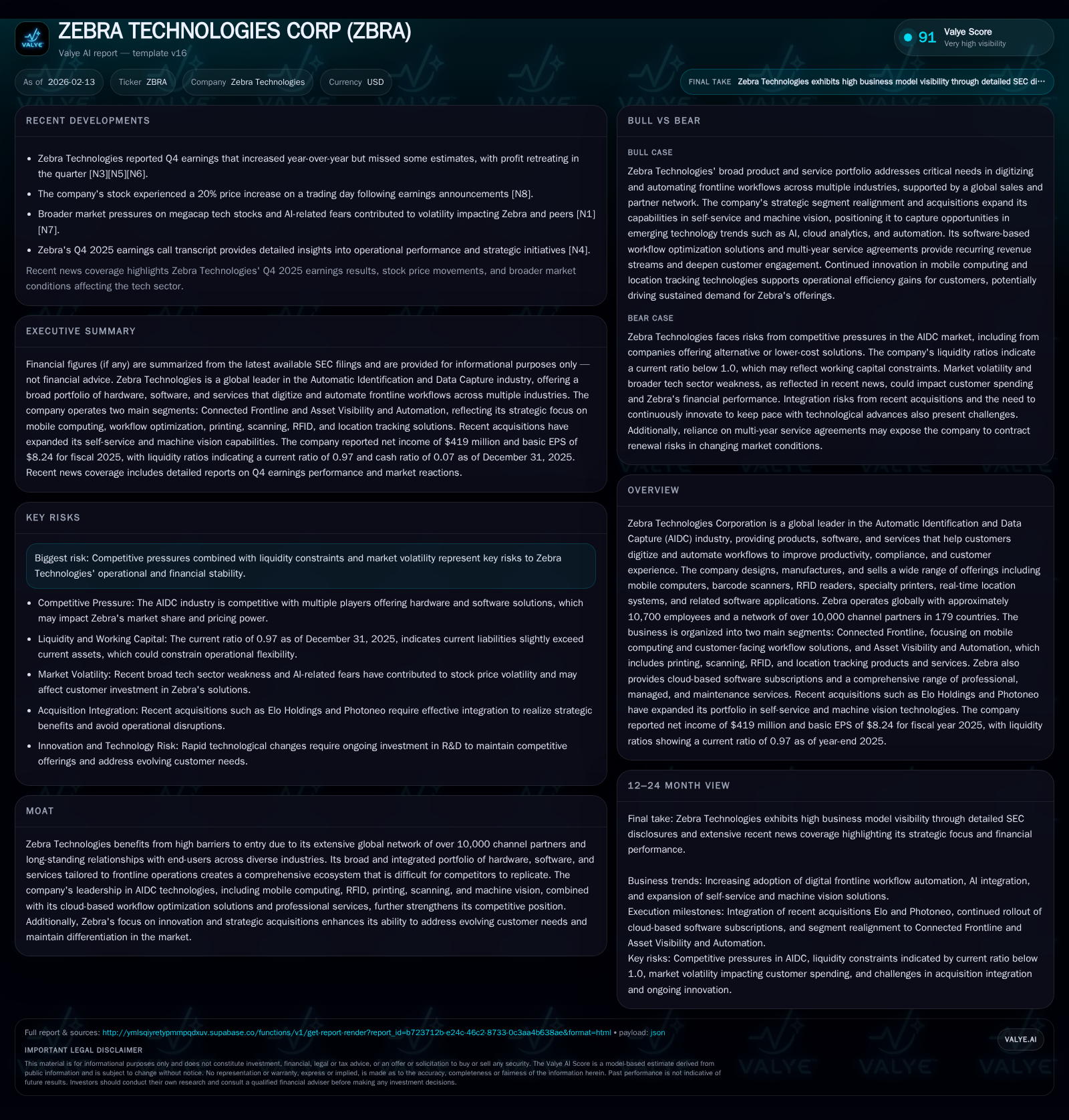
Despite a recent earnings miss that caught market attention, Zebra Technologies remains a dominant player in the automatic identification and data capture (AIDC) industry through its comprehensive product portfolio and global channel network. The company’s dual-segment approach—Connected Frontline and Asset Visibility & Automation—enables it to digitize frontline operations across diverse sectors worldwide. However, increasing operational complexity, competitive pressures, and macroeconomic headwinds pose execution risks, emphasizing the delicate balance Zebra must strike between growth ambitions and real-world constraints. Strategic focus on cloud-based AI solutions and acquisitions shapes its outlook amid market volatility.
From Market Leader to Earnings Miss: Setting the Stage
Zebra Technologies has long been synonymous with automatic identification and data capture innovation, commanding leadership in an industry integral to modern supply chains and frontline workflows. Yet the company’s latest quarterly earnings report painted a more nuanced picture. While revenues grew year-over-year—a testament to ongoing demand for digitizing operational processes—the Q4 earnings miss confounded some investor expectations [N1][N3][N10]. This juxtaposition highlights fundamental tensions facing Zebra: sustaining top-line momentum amid rising operational costs, integration challenges from expansion efforts, and intensifying competition.
Such conflicting signals invite a deeper inquiry into how Zebra balances its leadership status against an evolving competitive environment marked by rapid technological shifts and macroeconomic macro-headwinds. The earnings shortfall is less about faltering demand than about the practical complexities embedded within scaling a richly diverse portfolio worldwide.
Decoding Zebra's AIDC Empire: The Connected Frontline and Beyond
At the heart of Zebra's business is a broad spectrum of offerings spanning hardware, software, and services designed to automate data capture and streamline frontline workflows [S1][valye_report_excerpt]. The company’s two principal segments illustrate this duality:
- Connected Frontline: Centered on mobile computing solutions that enable workers directly interacting with customers or operational environments to access real-time data efficiently.
- Asset Visibility & Automation: Encompasses printing technologies (specialty barcode printers), scanning devices (barcode imagers), RFID readers enabling wireless data collection, real-time location systems (RTLS), supplies such as labels—paired with related software applications.
This integrated ecosystem facilitates everything from tracking factory production lines to enhancing hospital patient management. The scale is remarkable—operating through approximately 10,700 employees leveraging a vast network of over 10,000 channel partners across 179 countries. Such a decentralized yet synchronized distribution model deepens customer penetration globally while providing local market agility.
Growth Complexities: Managing a Global and Expanding Ecosystem
Expansion has not come without cost. Zebra explicitly acknowledges risks arising from increased business complexity driven by organic growth compounded by acquisitions [S1]. Managing an enlarged distribution partner base alongside geographically dispersed supply chains introduces logistical hurdles exacerbated by ongoing geopolitical uncertainties.
Challenges include:
- Coordinating contract manufacturing across multiple suppliers under fluctuating global conditions.
- Expanding product breadth that necessitates new custom development juxtaposed against standard offerings.
- IT infrastructure demands grow exponentially as more sophisticated software and cloud services anchor their portfolio.
- Workforce integration maintaining cohesive culture amid a rapidly growing headcount.
Additionally, geopolitical turmoil—in particular the protracted Russia-Ukraine war leading to suspension of Russian operations since early 2022—continues to ripple through supply availability, pricing pressures due to inflationary labor costs, energy price volatility, import/export clearances delays, and cybersecurity exposures [S1]. These factors collectively heighten operational risk even as demand drivers remain favorable.
Moat Strengths — Channel Reach, Integrated Portfolio, & Innovation
The entrenched moat underpinning Zebra's position stems largely from its expansive sales channel coupled with a uniquely comprehensive portfolio tailored for frontline ecosystems [valye_report_excerpt]. Building such a tightly integrated ecosystem where hardware seamlessly interfaces with cloud-based software subscriptions plus managed services creates formidable barriers. Competitors face not only technological replication challenges—especially integrating machine vision and AI capabilities—but also immense difficulties recreating trusted relationships cultivated over decades with diverse end-user industries.
By consistently investing in innovation including advanced imaging technologies that automatically interpret visual data (machine vision) alongside wearable devices powered by AI agents offering real-time assistance on tasks, Zebra fortifies differentiation well beyond commoditized barcode scanning. This blending of physical asset intelligence with data analytics embodies an evolving paradigm shift where frontline operations become digitally transformed environments generating actionable insights at the edge.
Cloud and AI: Technological Drivers Transforming Frontline Workflows
Zebra’s strategic thrust moves beyond traditional AIDC products into harnessing cloud computing combined with artificial intelligence including machine learning models embedded within devices [S1]. Through digital twins replicating physical assets virtually—and cloud platforms enabling centralized analytics—the company delivers real-time workflow automation optimizing labor efficiency and accuracy.
AI-powered smart companions assist frontline employees by interpreting location signals via RFID or Real-Time Location Systems (RTLS), analyzing image streams to flag anomalies instantly using machine vision algorithms, or predicting maintenance needs. This fusion of on-device intelligence with cloud orchestration marks a significant leap forward enabling enterprises to transition from reactive task execution toward proactive decision-making internally.
In essence, Zebra is evolving into not just a hardware supplier but an end-to-end workflow transformation enabler leveraging emerging tenant technologies shaping Industry 4.0 landscapes.
Risk Radar: Competitive Pressures, Liquidity, and Operational Challenges
Despite these strengths there exist pronounced risks impacting financial resilience alongside strategic execution prospects [S1][F1]. Competitive intensity from legacy hardware vendors pivoting toward software-enabled models plus emerging niche startups innovating narrowly specialized IoT sensing threaten margin sustainability. Simultaneously, the company's current ratio around 0.97 reflects near parity between current liabilities ($1.852B) and assets ($1.796B), signaling constrained short-term liquidity buffers [F1].
Market volatility also complicates acquiring accretive businesses amid inflation-driven cost inflation coupled with rising interest rates dampening deal activity appetite. Geopolitical disruptions continue shaping supply chain reliability; past decisions such as Russia operations suspension exemplify direct impact on geographic risk profiles [S1]. Cybersecurity threats tied to broader digital transformation efforts introduce ongoing vigilance needs around IT infrastructure protection as reliance on cloud expands.
Financial Health Snapshot: Profit Trends, Liquidity, and Efficiency Ratios
Examining year-end fiscal metrics reveals mixed trajectories [F1][N10]. Full-year net income recorded at $419 million underscores robust profitability reflecting scale benefits; however Q4 witnessed profit retreat attributed partly to higher operational expenses amidst supply chain inflationary impacts. Cash reserves at $125 million provide some flexibility but remain modest relative to obligations requiring efficient working capital management.
Maintaining margin discipline while investing heavily in R&D for advanced technologies presents balancing act pressures affecting near-term returns against long-term positioning gains. Operating efficiency ratios underscore dependence on streamlined distribution partner coordination especially given expanded product mixes adding overhead layers.
Strategic Outlook: Acquisition Integration and Market Volatility Navigation
Zebra’s stated ambition involves targeted acquisitions to complement organic growth; yet management is candid regarding integration complexities DQE faces amidst turbulent macroeconomic backdrops [S1]. Identification of suitable acquisition targets becomes challenging when valuations fluctuate sharply due to capital market uncertainty or regulatory approvals slow transaction pipelines.
Effectively assimilating new entities without diluting corporate culture or distracting resource focus remains paramount as sizable M&A undertakings risk operational disruptions undermining customer confidence during transitions. Innovations centered on AI/cloud convergence further demand specialized talent attraction — itself complicated by dynamic labor markets pushing wage inflation higher.
Continuous refinement of internal IT platforms supporting scalable service delivery appears pivotal ensuring agility necessary for competing in fast-moving technology environments while preserving robust governance controls mitigating compliance risks.
Stock Movement Insights: Market Sentiment on the Latest Earnings
Market reactions following Q4 announcements illustrated an intriguing dichotomy [N7][N8][N9]. Despite broader technology sector sell-offs fueled by AI growth concerns impacting indices [N4][N5][N6], Zebra’s stock experienced notable mid-session surges approximating +20%. Technical analysis highlighted bullish moving average crosses indicating short-term positive investor sentiment possibly driven by confidence in underlying long-term fundamentals rather than transient quarterly misses.
This divergence suggests market participants differentiate Zebra’s resilient core positioning within the specialized AIDC niche amid general tech skepticism. Nonetheless sustained stock momentum depends on visible progress reconciling operational efficiencies with innovation-led revenue diversification navigating prevailing macroeconomic uncertainties.
Conclusion — Balancing Transformation Ambitions with Real-World Constraints
Zebra Technologies stands at an inflection where visionary aspirations intersect complex operational realities. Its commanding presence in automatic identification combined with pioneering strides into AI-enabled cloud workflow management establishes it as a key architect shaping next-generation frontline digitization paradigms [valye_report_excerpt][S1][N1]. Yet investors and stakeholders must weigh this promise against palpable headwinds: expanding ecosystem complexity demanding enhanced organizational agility; constrained liquidity profiles amid volatile acquisition environments; global geopolitical tensions influencing supply dynamics; plus intensifying competition pressing margins.
In synthesis, Zebra’s path forward entails harmonizing innovative leadership fostering new value creation with disciplined execution safeguarding financial health under evolving external pressures—a nuanced story blending opportunity with caution emblematic of transformative industrial technology frontiers today.
This analysis is based on publicly available information as of February 2026 including SEC filings and recent news reports. It does not constitute investment advice or recommendations.
Disclaimer: This is research-only, informational analysis and not investment advice. It may include AI-generated interpretation and general industry context. Always verify important details using primary sources.

Comments