
Sabra Health Care REIT: Navigating Healthcare Real Estate Stability amid Regulatory Uncertainties
A detailed exploration of Sabra’s specialized healthcare property portfolio reveals strengths and challenges in a complex market.
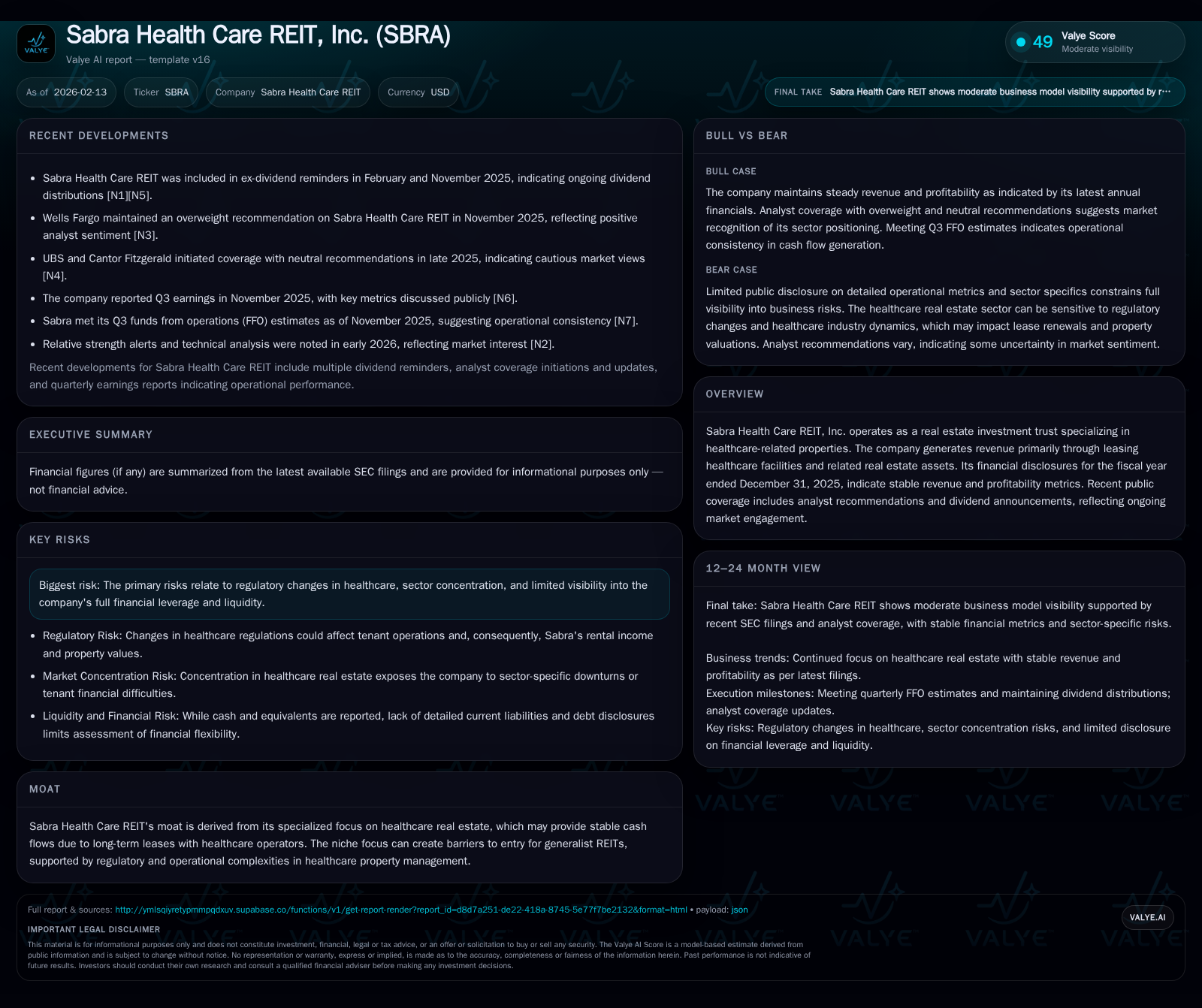
Sabra Health Care REIT, Inc. continues to leverage its niche in healthcare real estate—a sector characterized by operational complexity and regulatory sensitivity—to sustain stable revenue streams and profitability. The 2025 financial results demonstrate resilience with $774.6 million in revenue and $155.6 million net income, supported by primarily triple-net leases underpinning consistent cash flow. However, underlying risks tied to leverage transparency, liquidity constraints, and evolving healthcare regulations add nuance to the stable outlook. Dividend consistency and recent positive relative strength signals reflect ongoing market engagement while prospects hinge on strategic navigation of sector dynamics.
Sabra’s Healthcare Real Estate Niche: An Untapped Moat?
As the U.S. population ages steadily into the coming decade, demand for healthcare services is simultaneously expanding—yet the real estate assets supporting these services remain a specialized domain fraught with operational intricacies. Sabra Health Care REIT (SBRA) has positioned itself squarely within this niche, owning and leasing properties tailored exclusively to healthcare needs—including skilled nursing facilities, senior housing, and other care-related infrastructure [valye_report_excerpt].
This specialization acts as a moat by imposing natural barriers that deter more generalized real estate investors or REITs from encroaching without significant expertise. The multifaceted regulatory environment governing healthcare operations—ranging from federal reimbursement policies to state licensing requirements—adds layers of complexity to tenant credit assessments and lease structuring [S1]. Sabra’s deep sectoral focus invests it with proprietary know-how in creating long-term lease contracts that incorporate these nuances.
Operationally, these factors contribute to durable rental income since healthcare operators tend to lock into extended lease terms secured by their essential service nature. This niche focus inherently reduces volatility risk compared to less specialized commercial real estate categories.
2025 Financials in Focus: Stability or Subtle Signs?
Sabra closed fiscal 2025 with revenues tallying $774.6 million and net income reported at $155.6 million—a result that affirms operational steadiness despite an unpredictable operating backdrop characterized by evolving healthcare regulations and economic pressures [F1], [S1]. Cash and equivalents stood at approximately $71.5 million as year-end liquidity cushions.
While headline figures highlight stability, delving beneath surfaces reveals nuanced signals warranting attention. Revenue composition remained consistent with prior years’ portfolio mix; however, incremental pressure on certain segments such as managed senior housing reflected macroeconomic headwinds.
Meanwhile, profitability metrics sustain positive trends but could be subtly influenced by rising costs associated with property maintenance and compliance requirements intrinsic to healthcare facilities.
Liquidity-wise, the cash reserve appears adequate for near-term obligations; nonetheless, debt maturities clustered in the medium term necessitate vigilant balance sheet management going forward.
Deep Dive into Revenue Streams: Leasing Dynamics
The bedrock of Sabra’s revenue model lies in leasing arrangements dominated by triple-net leases where tenants bear property operating expenses including taxes, insurance, and maintenance [S1], [S2]. These structures align incentives favorably towards stable landlord cash flow while transferring certain cost variability to lessees.
Tenant profiles largely encompass skilled nursing operators and senior care providers whose business models intertwine tightly with regulatory reimbursements (e.g., Medicare/Medicaid). Such tenant dependence on government funding generates counterparty risk aligned with policy shifts but, conversely, also offers lease security due to regulated license requirements keeping operator exit barriers high.
Typical lease terms span multiple years with embedded renewal options granting Sabra visibility into future income streams and mitigating vacancy risk substantially.
Nonetheless, leasing concentration within the healthcare sub-sector exposes Sabra to sector-specific downturns impacting occupancy rates or tenant financial health—a calculated trade-off for specialization benefits.
Leverage and Liquidity: Hidden Risks Beneath the Surface
Examining Sabra’s balance sheet reveals a layered picture of leverage comprising conventional debt complemented by derivative liabilities linked to interest rate management tools [S1], [S2], [valye_report_excerpt]. While gross indebtedness levels are disclosed, complexities arise given partial opacity into off-balance-sheet exposures or contingent liabilities impacting net leverage considerations.
The company’s liquidity position is bolstered by available cash resources reported at $71.5 million year-end; however, aligning this against upcoming debt maturities underscores potential refinancing or capital raise dependencies in less favorable market conditions.
Additionally, derivative exposure introduces earnings volatility risks anchored in interest rate movements detrimental under unfavorable macroeconomic shifts.
Collectively these factors underscore that while headline metrics project solidity, prudent stakeholders should weigh latent financial risk vectors inherent in Sabra’s capital structure alongside operational steadiness.
Dividend Policy and Shareholder Returns: What’s the Signal?
Sabra has maintained a consistent dividend distribution profile reflective of its REIT structure mandating substantial payout ratios designed to pass taxable income through to shareholders tax-efficiently [N1], [valye_report_excerpt]. The recent ex-dividend announcements reinforce commitment towards sustained shareholder returns amid prevailing sector challenges.
Dividend continuity suggests management confidence in underlying cash flow generation despite external pressures. Moreover, reliable dividend streams act as a cornerstone for investor loyalty especially within income-focused investment communities attracted to REIT securities.
However, elevated payout ratios concomitant with limited discretionary free cash flow could constrain maneuverability during downturn cycles requiring capital conservation.
Ultimately, dividends serve as a barometer for corporate health—their steadiness here implies underlying portfolio performance remains intact even as balance sheet leverage demands attention.
Regulatory Headwinds and Sector-Specific Challenges
Sabra operates entrenched within an environment where regulatory flux constitutes a perennial risk factor influencing tenant economics directly translatable to rent collections [valye_report_excerpt], [S1]. Evolving policies around Medicare/Medicaid reimbursement rates or adjustments in state-level care facility licensing can ripple through operators’ bottom lines impacting their solvency or willingness to honor long-term leases.
Moreover, sector concentration amplifies susceptibility to cyclical pressures unique to healthcare services—changes driven by governmental budget priorities or demographic shifts may cause operational disruptions unpleasantly reflected upstream on landlord receivables.
While diversification efforts across subtypes (skilled nursing vs senior housing) mitigate some exposure, Sabra cannot fully insulate from macro regulatory dynamics intrinsic to its business model.
Such volatility underscores why investors must maintain awareness of legislative developments as integral components influencing asset valuations beyond standard real estate market cycles.
Market Sentiment and Relative Strength Insights
Market reception toward SBRA shares recently included Nasdaq issuing a "Relative Strength Alert," highlighting enhanced trading volume trends relative to benchmarks pointing toward renewed investor focus driven partly by fundamental steadiness juxtaposed with sector-wide narratives [N2]. These signals typify moments where market participants reevaluate positioning influenced by earnings releases or dividend assurances.
Analyst commentaries echo this tempered optimism recognizing Sabra’s niche advantages while urging circumspection on balance sheet nuances described earlier.
Thus far, sentiment overlays complement intrinsic business assessments offering dual lenses revealing both opportunities emerging from demographic growth tailwinds as well as caution warranted from financial structure sensitivities.
This dynamic interplay shapes the short- to medium-term trading environment surrounding SBRA shares without divorcing price action from core operating realities.
Looking Ahead: Growth Prospects and Strategic Outlook
Peering forward, Sabra’s future pivot hinges on balancing continued exploitation of its specialized assets against navigating heightened regulatory scrutiny constricting tenant margins [S1], [valye_report_excerpt]. Demographic inertia remains a secular growth driver underpinning demand for healthcare real estate; whether aging populations translate seamlessly into expanded occupancy depends heavily on operator stability shaped by reimbursement trends and cost inflation dynamics.
On capital strategy fronts, maintaining conservative leverage thresholds while optimizing liquidity will be critical for preserving optionality in acquisitions or portfolio enhancements aimed at deepening market presence.
Likewise, potential repositioning into emerging senior care models or ancillary health service properties might unlock incremental value if aligned properly with core competencies mitigating risk amplification through over-diversification.
In sum, Sabra stands at an inflection point where foundational strengths provide a springboard conditioned by vigilant adaptation required to sustain competitive advantage amid shifting macro factors shaping healthcare real estate landscapes going forward.
Disclaimer: This report is informational only and does not constitute investment advice or recommendations. It is intended solely for internal research use based on publicly available information as of February 2026.
Disclaimer: This is research-only, informational analysis and not investment advice. It may include AI-generated interpretation and general industry context. Always verify important details using primary sources.

Comments