
US Foods Holding Corp.: Navigating Scale, Innovation, and Competitive Pressures in U.S. Foodservice Distribution
US Foods leverages scale, digital platforms, and product innovation to serve a broad customer base amid evolving industry dynamics.
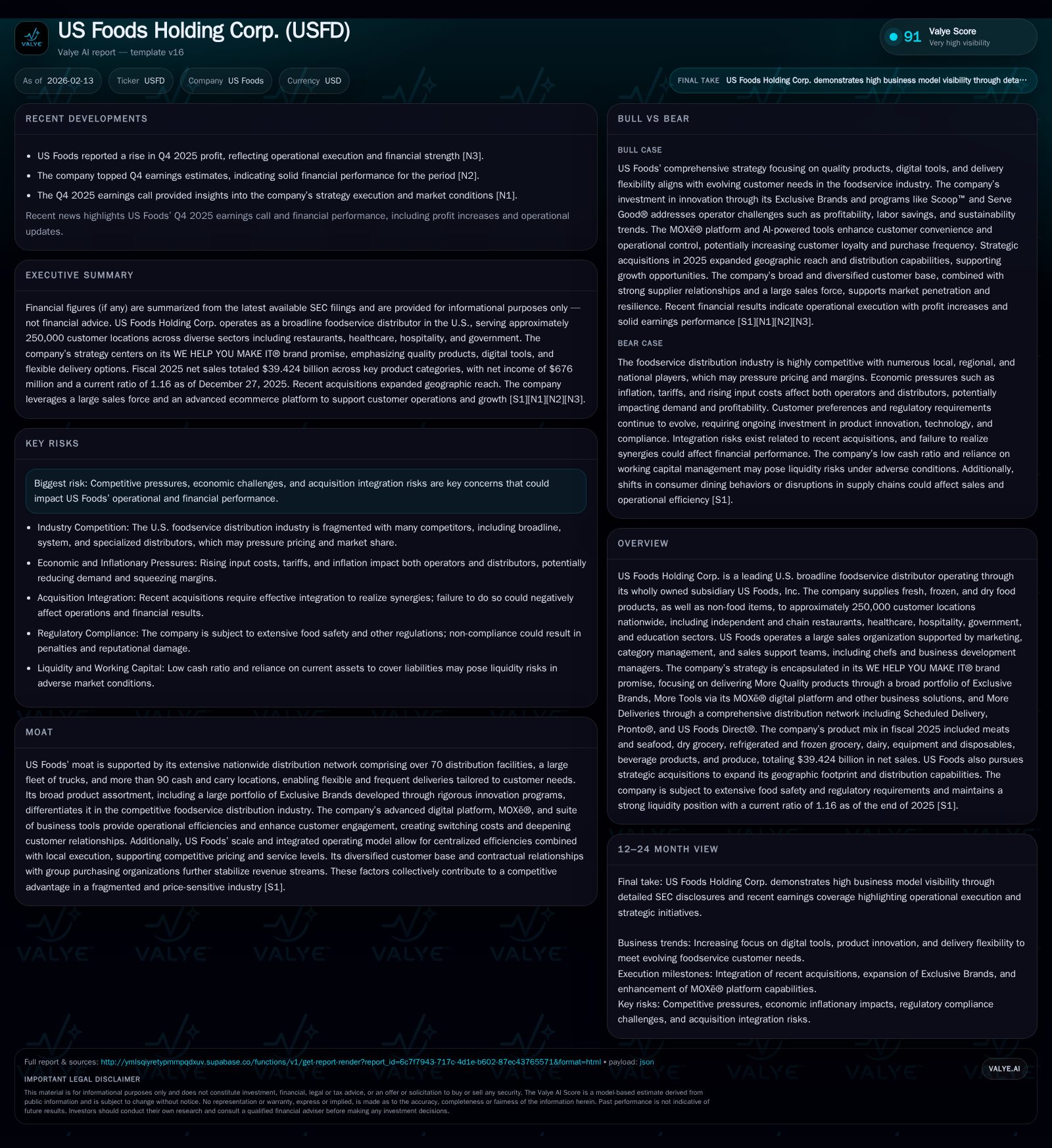
US Foods Holding Corp., a leading broadline foodservice distributor in the U.S., operates an extensive distribution network delivering fresh and diverse food and non-food products to over 250,000 customer locations. Its moat is underpinned by nationwide scale, a proprietary digital platform (MOXē®), and a sizable portfolio of exclusive brands. Recent earnings outperformance underscores operational resilience, though the company faces competitive challenges and economic uncertainties. Centralized scale combined with localized execution remains a core strategic advantage as US Foods evolves in a complex marketplace.
Company Overview
US Foods Holding Corp., through its wholly owned subsidiary US Foods, Inc., stands as one of the premier broadline foodservice distributors in the United States. With roots deeply embedded in empowering chefs and foodservice operators, US Foods targets approximately 250,000 locations nationwide spanning independent restaurants, chain concepts, healthcare institutions, hospitality venues, government bodies, and educational organizations [S1]. The firm prides itself on delivering a comprehensive supply of fresh, frozen, dry foods alongside essential non-food products sourced from thousands of suppliers leveraging an extensive sales force exceeding 4,000 associates.
Operating under the guiding philosophy encapsulated in its WE HELP YOU MAKE IT® brand promise, US Foods seeks to support customers through three critical dimensions: more quality products via a robust portfolio of Exclusive Brands characterized by consistency and innovation; more tools centered on its MOXē® digital commerce platform enabling seamless ordering and inventory management; and more deliveries facilitated through a vast logistics infrastructure including traditional broadline shipments complemented by flexible Pronto® service options [S1]. This integrated approach allows the company to engage customers broadly while tailoring services with local execution.
Strategic Moat and Operating Model
US Foods’ moat is principally constructed around several interlocking capabilities. Foremost is an expansive distribution network consisting of over 70 strategically located distribution centers complemented by a fleet surpassing 6,500 trucks capable of fulfilling complex delivery schedules. Additionally, the company operates over 90 cash-and-carry locations that provide alternative fulfillment methods attractive to certain customer segments requiring immediacy or convenience [valye_report_excerpt][S1].
This physical footprint enables superior flexibility in delivery frequency and timing—key factors driving customer satisfaction in an industry where timely availability can be a differentiator.
On product differentiation, US Foods has invested heavily in developing exclusive branded offerings designed through rigorous innovation processes focusing on freshness standards and unique formulations. These brands foster customer loyalty by offering distinctive value propositions that are difficult for competitors to replicate directly [valye_report_excerpt].
Technological investment with MOXē® forms another cornerstone of competitive advantage. By creating an industry-leading ecommerce ecosystem equipped with order management capabilities and real-time inventory insights as well as analytical tools to support operational decisions at the customer level, MOXē® generates switching costs that deepen engagement and elevate barriers for competitor entry into client accounts [valye_report_excerpt][S1].
Organizationally, US Foods integrates national scale benefits with agile local field teams comprising sales associates supported by chefs, marketing professionals, category managers, and business development personnel enhancing front-line responsiveness while maintaining centralized systems infrastructure for efficiency gains across procurement, warehousing, and logistics [S1]. This duality of scale plus local finesse underpins competitive pricing strategies without sacrificing service quality.
Industry Context
The U.S. foodservice distribution market is highly fragmented marked by various actor types: broadline distributors like US Foods offering extensive product assortments; system distributors oriented toward standardized chain customers; specialized distributors targeting niche verticals or product categories; plus non-traditional players such as cash-and-carry retailers or grocery chains encroaching into service levels previously dominated by distributors [S1]. Customer choices hinge on assortment breadth, product quality assurance (especially freshness), pricing competitiveness influenced by scale economies, timely delivery capabilities, and technological integration into procurement workflows.
Against this backdrop US Foods occupies a preeminent position due to its combined reach across geographies and sectors along with investments in technology-backed service excellence.[analysis] Market trends such as increasing demand for convenience foods post-pandemic recovery dynamics coupled with continued pressure on labor cost inflation have incentivized foodservice operators towards suppliers who can facilitate operational efficiencies—the providers who can integrate digital ordering platforms with reliable fulfillment gain traction.
Financial Performance Highlights
According to the recent fiscal year ending December 27, 2025 data ([F1]), US Foods posted net income of $676 million illustrating solid profitability amidst challenging macro conditions. Liquidity measured through current assets at roughly $4.16 billion against current liabilities near $3.59 billion yields a current ratio around 1.16—reflective of sufficient short-term financial stability but underscoring ongoing working capital intensity inherent in distributorship models due to inventories and payable balances.
Recent quarterly commentary ([N1],[N2],[N13]) evidenced earnings beating analyst expectations driven by operational efficiencies realized via cost containment initiatives alongside steady revenue inflows sustained by large customer contracts —highlighting effective execution amidst sectoral inflationary pressures dampening discretionary demand.
Risks & Challenges
Notwithstanding its strengths US Foods navigates a competitive landscape featuring long-established rivals including regional broadliners as well as specialty niche suppliers aggressively targeting differentiated product or service segments. Economic headwinds remain an overhang impacting discretionary foodservice spending which could pressure volumes or compel pricing concessions [valye_report_excerpt]. Furthermore integration risks arise when assimilating acquired assets or businesses that may temporarily disrupt unified systems or dilute focus.
Supply chain volatility persists as a notable risk area given dependence on numerous suppliers dispersed geographically since issues upstream can cascade downstream affecting freshness guarantees or delivery reliability—a vital consideration given consumer end-market sensitivity.
Technological obsolescence risk exists if competitors accelerate digital transformation beyond MOXē®’s current capabilities thus eroding part of US Foods’ engagement moat which depends significantly on platform stickiness.
Recent Developments & Outlook Signals
Latest quarter results reported February 2026 demonstrated margin expansion alongside revenue growth affirming resilience ([N2],[N13]). Incremental investments into last-mile delivery flexibility like Pronto®, enhancements within MOXē®, together with ongoing innovation pipeline expansions for Exclusive Brands signal active portfolio management aimed at reinforcing market position.[analysis] As supply chain digitization proliferates industry-wide the need for end-to-end visibility continues growing—a domain where US Foods endeavors maintain leadership through incremental tech deployments.
Looking forward operational discipline combined with careful navigation of macroeconomic risks will remain critical pillars determining trajectory while selective M&A could further consolidate fragmented channels fostering scale gains.
Disclaimer: This analysis is intended solely for informational purposes reflecting publicly available data as of early 2026. It does not constitute investment advice or recommendations regarding any securities. Readers should conduct their own due diligence before making any financial decisions.
Disclaimer: This is research-only, informational analysis and not investment advice. It may include AI-generated interpretation and general industry context. Always verify important details using primary sources.

Comments