
Peering Through the Fog: PHINIA INC.'s Financial Opacity and Earnings Puzzle
Despite strong liquidity, PHINIA's opaque disclosures and recent earnings misses cloud assessments of its operational health.
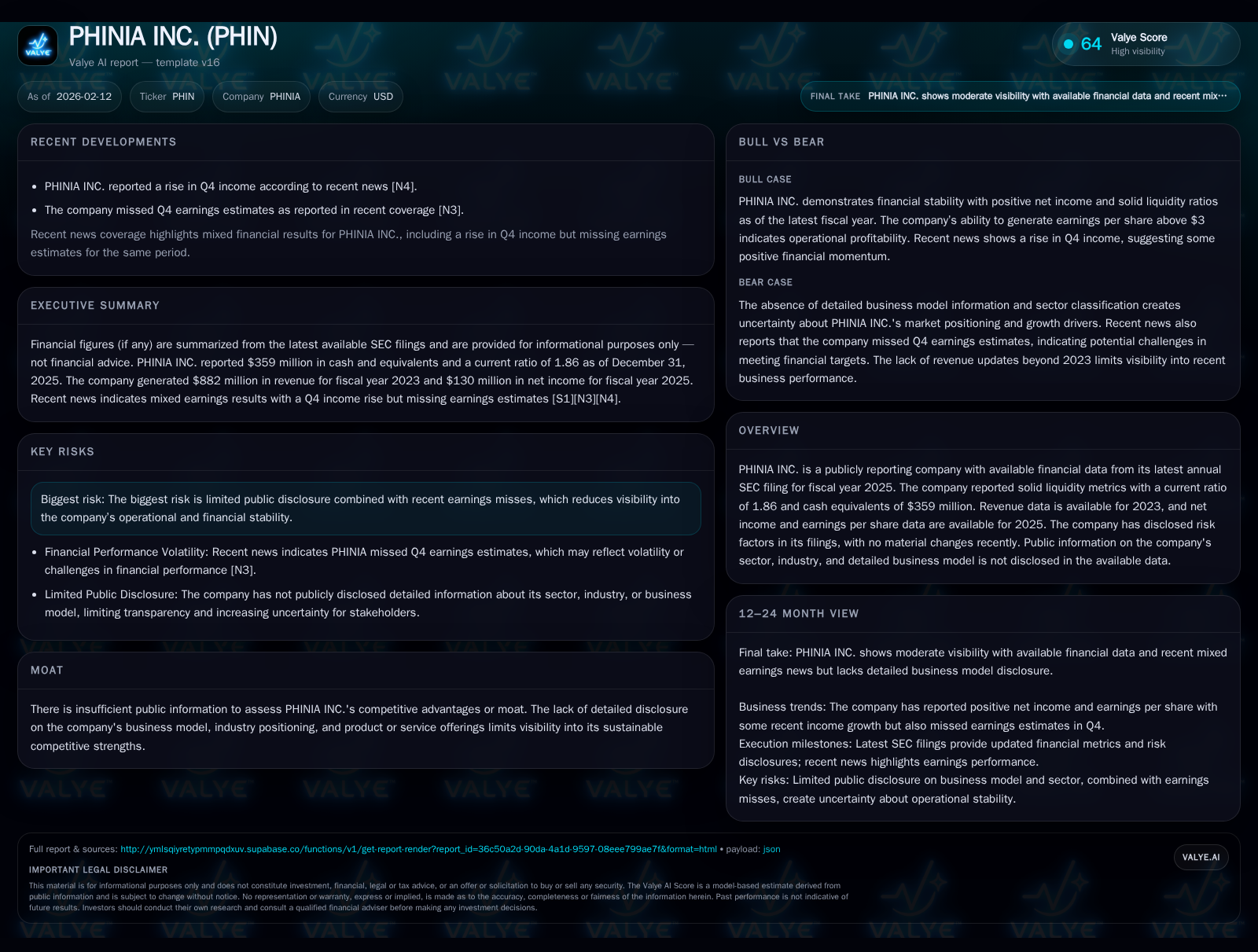
PHINIA INC. presents a paradox of solid financial grounding juxtaposed with limited public insight into its business operations and a recent streak of missed earnings estimates. The company’s liquidity position appears robust with a healthy current ratio and substantial cash reserves, yet these metrics contrast sharply against the uncertainty bred by minimal sector or industry disclosure. This analysis unpacks PHINIA’s latest quarterly performance, financial footing, disclosure gaps, and risk factors, culminating in key questions crucial for understanding future stability.
PHINIA Inc.: A Profile Shrouded in Ambiguity
PHINIA INC. stands as an enigma within the public markets. While it dutifully files annual and quarterly reports that provide hard financial metrics, it simultaneously withholds fundamental details concerning its sector classification, industry affiliations, or underlying business model [S1], [F1]. This opacity is striking in an era where market participants demand clarity to gauge operational competency and strategic direction. Whether due to strategic choice or structural complexity, PHIN’s guarded approach creates an immediate hurdle for analysts attempting to place its performance within a meaningful context.
The company reported revenues of approximately $882 million for calendar year 2023, yet no accompanying narrative exists to explain the sources or stability of these revenues [F1]. The absence of explicit business line information constrains attempts at peer comparison or economic moat assessment. Consequently, even standard categorization — is PHIN in manufacturing, technology, services? — remains speculation rather than fact.
Dissecting the Latest Quarterly Miss: What Does It Tell Us?
Recent headlines painted a mixed portrait: while PHINIA's income rose during Q4, it nevertheless missed consensus earnings estimates [N3], [N14]. The miss places PHIN among several other industrial-related companies experiencing earnings disappointments during this period [N2], [N5], [N6], [N7], pointing toward potential cyclical pressures. Yet unlike Honda or BorgWarner [N1], [N4], which posted earnings beats or revenue growth signaling underlying strength, PHIN’s struggle could suggest company-specific execution issues compounded by an opaque disclosure environment.
Notably, the disparity between rising absolute income and failure to meet expectations hints at either overly optimistic projections by analysts or emerging operational headwinds not yet fully articulated by management. The inability to warranty earnings guidance credibility exacerbates investor caution.
Liquidity Strength vs. Earnings Performance: Analyzing The Numbers
A fascinating contrast emerges in PHINIA's financial health indicators: the balance sheet conveys solid liquidity fundamentals uncommon for a firm navigating earnings turbulence. The current ratio stands at a favorable 1.86, supported by $359 million in readily accessible cash equivalents as of end-2025 [F1]. This liquidity buffer theoretically empowers PHIN to weather near-term operational strains without facing solvency concerns.
Yet net income for fiscal 2025 culminated at $130 million—a figure that while positive may be insufficient to fully reassure stakeholders given recent forecast misses [F1]. The gap between balance sheet strength and volatility in profitability complicates straightforward assessments of business vitality. It suggests that while survival odds appear high in the short run, profit generation momentum may be sputtering.
The Shadow of Limited Disclosure: Implications for Investors
PHINIA’s scant public discussion surrounding its business raises persistent red flags. Risk factor disclosures reiterate known generalities without offering fresh insight or expanded detail on specific vulnerabilities beyond what was filed one year prior [S2], [S1]. No material updates were noted even as earnings faltered.
This withholding of qualitative context cripples fundamental analysis and planning. Investors lack clarity on revenue drivers, cost structures, capital allocation strategies, or competitive threats—critical inputs for forecasting and valuation modeling. The result is a landscape dominated by uncertainty where analytical confidence erodes.
Risk Factors: Stability Concerns Amid Operational Murkiness
The company's formal risk narratives emphasize a gamut of possible adverse influences but are couched in boilerplate language typical for filings with limited public interaction focus [S1], [S2]. While these acknowledgments underscore ongoing exposure to market fluctuations and operational risks, they stop short of illuminating which risks are currently manifesting or intensifying.
This disconnect between granular earnings performance misses and generic risk statements leaves observers without definitive signals about latent shocks or structural weaknesses beneath the surface. It also underscores how critical transparency is when tangible operating realities diverge from headline liquidity strength.
Absence of Moat: Understanding Competitive Positioning Challenges
PHINIA discloses no elements constituting a discernible moat—no hint at patented technologies, entrenched customer relationships, unique manufacturing capabilities, scale economies, or brand power [F1]. Such invisibility raises alarms about sustainable competitive advantage and future profitability resilience.
In industries where differentiation is pivotal for premium pricing or barrier creation against rivals, this blank slate forces reliance purely on balance sheet metrics rather than strategic positioning when evaluating durability. Without publicly accessible proof points supporting any economic moat thesis, long-term growth predictions become speculative exercises rather than grounded analysis.
Contextualizing PHINIA in Its Market Landscape
Examining peers broadly within automotive and industrial sectors reveals a mixed milieu through Q4 reports: companies like Honda [N1] exhibit margins beat amidst revenue softness; others including Ford and Lithia Motors report both earnings misses and revenue declines [N2], [N5]. This pattern indicates external headwinds impacting various players but also suggests firm-specific factors differentiate winners from laggards.
PHIN’s combination of missed expectations despite income gains does not clearly align with prevailing market narratives; instead it blends characteristics both typical of companies under pressure from macroeconomic forces as well as those struggling with internal execution matters. Without knowing its exact operational segment or market exposure due to disclosure gaps, definitive placement remains elusive.
What’s Next? Key Questions and Investor Considerations
As PHINIA navigates this opaque terrain compounded by recent financial underperformance, several questions now loom large:
- Will upcoming SEC filings shed light on previously undisclosed aspects of its business model or strategic initiatives?
- Can management bridge the transparency gap sufficiently to align market expectations more closely with operating realities?
- How sustainably can the company's liquidity strength support reinvestment needs if profit margins continue under pressure?
- Are there structural changes underway internally reflecting shifts in competitive pressures or market conditions that remain obscured today?
Investors keen on deciphering PHINIA’s trajectory must watch future disclosures vigilantly alongside broader macro-industry developments. Transparency leaps will be crucial for reducing informational asymmetry and enabling deeper fundamental scrutiny.
This analysis is based solely on available public filings and reported data as of February 12, 2026. It intentionally avoids speculative assertions beyond verified information.
Disclaimer: This is research-only, informational analysis and not investment advice. It may include AI-generated interpretation and general industry context. Always verify important details using primary sources.

Comments