
United Airlines Holdings at a Crossroads: Leveraging China Route Assets Amid Market Volatility
UAL’s billion-dollar China route authority intangible asset contrasts with significant exposure to fuel, currency, and liquidity risks.
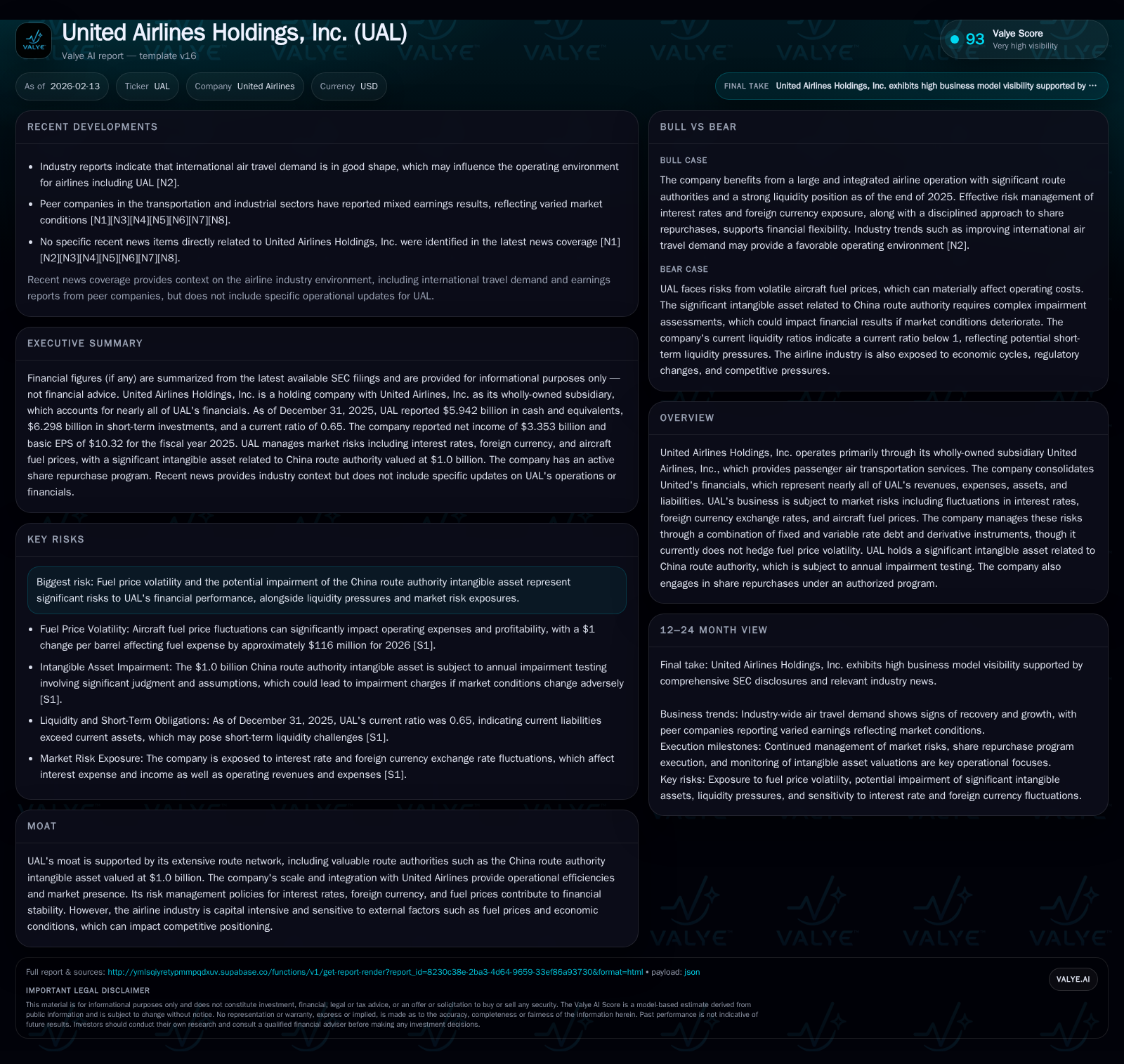
United Airlines Holdings, Inc. maintains a competitive moat heavily anchored by its valuable China route authority intangible asset, estimated at $1.0 billion, which underscores its international network strength yet remains subject to annual impairment risk. Concurrently, the company faces notable operational vulnerabilities tied to volatile jet fuel prices, foreign currency fluctuations, and interest rate movements, all of which materially affect earnings and cash flow stability. With a capital-intensive fleet strategy unfolding alongside cautious share repurchases that signal management confidence amidst liquidity pressures, UAL navigates an intricate balance between growth opportunities and inherent exposures within the challenging airline industry landscape.
Assets That Define UAL's Moat: The China Route Authority
At the heart of United Airlines Holdings’ competitive landscape lies the prominently valued intangible asset representing China route authority — appraised at approximately $1.0 billion according to the latest disclosures [S1], [valye_report_excerpt]. This asset is not merely a balance sheet item but a tangible manifestation of UAL’s extensive global network reach that enables access to one of the world’s most critical long-haul markets. The gatekeeping nature of such route authorities limits new entrants and fortifies incumbent carriers’ positions through entrenched infrastructure, slot allocations, and governmental accords.
However, this asset is also shadowed by inherent risk; it is subject to annual impairment testing contingent on route profitability, geopolitical considerations, bilateral agreements, and broader economic conditions impacting transpacific travel demand [S1]. An impairment event could materially erode intangible asset value and consequently affect reported earnings. Thus, while this Chinese market linkage boosts UAL's moat in the intensely competitive global airline sphere, it also imposes a pronounced focal point for financial vulnerability
Navigating Market Risks: Fuel, Currency, and Interest Rate Exposures
UAL’s operations are particularly sensitive to fluctuations in three principal market variables: jet fuel prices, foreign currency exchange rates, and interest rates.
Fuel Price Volatility
The airline operates with fuel costs comprising a substantial fraction of total operating expenses — an increase or decrease in jet fuel prices directly reverberates through operating margins. According to SEC disclosures [S1], a $1 per barrel change in jet fuel prices translates into an approximate $116 million shift in annual fuel expense projections for 2026 alone. Notably, UAL currently maintains a strategic choice against engaging in derivative hedging transactions for fuel price volatility; rather it opts for exposure absorption with regular reassessment in place [S1]. This approach aligns with some industry practices favoring cost predictability via hedging but subjects UAL directly to market swings.
Foreign Currency Fluctuations
Generating revenues and incurring expenses across multiple currencies — notably Canadian dollar, euro, Japanese yen, Chinese renminbi among others — exposes UAL’s financial results to exchange rate volatility that can significantly alter translated revenues and costs [S1]. Similar to fuel risk policy, UAL does not currently hedge foreign currency exposure but employs regular reviews on such policies [S1]. Given increasingly unpredictable global macroeconomic shifts post-pandemic coupled with geopolitical tensions influencing currency markets, this non-hedged stance introduces episodic earnings variability.
Interest Rate Sensitivities
With substantial leverage underpinning capital-intensive aircraft fleet investments ($12.7 billion fixed-rate debt; $8.5 billion variable-rate debt), UAL faces direct profit-and-loss impacts from shifts in interest rates [S1]. A hypothetical 100 basis point increase would raise projected interest expense on variable rate debt by roughly $63 million annually while pressuring the fair value of fixed-rate debt downward by an estimated $342 million [S1]. Simultaneously higher short-term investment yields could offset some pressure through increased interest income (estimated at ~$140 million per 100 basis points rise) but overall net income remains vulnerable given the scale of outstanding debt obligations.
Strategic Fleet and Network Outlook: Growth or Constraint?
UAL’s fleet strategy is central to sustaining service quality while aligning with evolving market demands and environmental regulatory pressure.
Recently amended purchase agreements for wide-body aircraft such as Airbus A350-900s reflect commitments to modernizing fleet capabilities with enhanced fuel efficiency [S2]. However, integrating these aircraft entails operational complexity including pilot training requirements, maintenance infrastructure upgrades, and potential delays linked to supply chain or technical certification setbacks cited by management as execution risks [S1]. Additionally geopolitical factors — including constraints on certain airspace usage (e.g., Russian airspace suspension due to military conflict) — restrict route flexibility thereby affecting network optimization potential.
Capacity management remains dynamically responsive based on booking trends with planned adjusted flown capacity possibly diverging materially from schedules if market conditions warrant [S2]. This fluid approach mitigates overcapacity risks but introduces forecasting uncertainty.
Shareholder Returns: Analyzing the Share Repurchase Strategy
Notwithstanding industry cyclicality and capital demands, UAL has pursued capital return programs via share repurchases bolstered by board authorization up to $1.5 billion worth of stock purchases instituted since October 2024 [S2], [valye_report_excerpt]. As of late 2025 quarter-end data revealed approximately 8.8 million shares repurchased equating to about $700 million invested at average prices near mid-$80s per share.
This buyback activity demonstrates management confidence in underlying equity value while concurrently calling attention to ongoing liquidity considerations given that repurchases represent significant cash outflow amid large current liabilities ($26.1 billion) relative to current assets ($16.9 billion), signaling a lower solvency buffer (current ratio ~0.65) [F1]. Hence share repurchases appear calibrated rather than aggressive — balancing investor returns against prudent cash management.
Financial Overview: Profitability Amid Capital-Intensiveness
In fiscal year 2025, United achieved net income totaling approximately $3.35 billion on reported operating revenues consistent with historic ranges though influenced by passenger yield fluctuations and cost pressures [F1], [S1]. This profit performance aligns with targeted operational efficiencies driven by extensive fleet utilization and revenue management initiatives.
Liquidity profiling reveals contrasting narratives where increasing cash & cash equivalents ($5.94 billion) provide ample short-term reserves yet remain substantially outweighed by current liabilities ($26.13 billion), underscoring ongoing working capital constraints common in airline sectors subject to ticket sale timing mismatches versus vendor payments [F1]. Such dynamics require vigilant treasury oversight especially amid volatile input costs such as fuel.
Competitive Landscape & Industry Positioning
Within broader sector developments reported recently [N11], heightened international air travel demand — particularly transatlantic routes as seen in Delta Air Lines (DAL) commentary — bodes well for premium carriers like United leveraging expansive networks.
UAL distinguishes itself through characteristics tagged as strong momentum and value propositions by equity analysts citing Nasdaq coverage that spotlight both growth potential catalyzed by network scale alongside reasonable valuation multiples compared to peers [N12], [N14]. Nonetheless competition remains fierce from other legacy airlines and low-cost carriers aggressively pursuing network expansions or cost efficiencies.
Looking Ahead: Management’s Forward-Looking Perspectives
UAL’s latest official filings articulate measured optimism hinged upon realistic acknowledgment of manifold operating uncertainties including macroeconomic conditions affecting demand elasticity; ongoing regulatory compliance burdens; labor relations outlook; aircraft delivery schedules; and persistent fuel price volatility risks [S1], [S2].
Management underscores sensitivity analyses embedded within financial planning reflecting possible adverse scenarios that could compel capacity adjustments or cost realignments while reiterating commitment to leveraging technology advancements and customer service enhancements intended to sustain long-term competitiveness.
Forward-looking statements transparently characterize goals yet simultaneously stress inherent execution risks thus presenting an informed balance for stakeholders parsing future results expectations.
Summation: Balancing Scale with Market Sensitivities
United Airlines Holdings sits at a strategic juncture where its prized intangible assets—chiefly the China route authority—confers measurable moat advantages in international connectivity essential for sustained revenue generation. However these are counterbalanced by pronounced exposure to volatile external factors namely jet fuel pricing swings, foreign currency volatility unhedged presently per company policy, and sizeable indebtedness sensitive to interest shifts compounded by constrained current liquidity ratios.
Efforts surrounding fleet modernization carry both potential growth enhancements through operational efficiencies alongside integration risks impacted further by geopolitical airspace limitations disrupting network fluidity.
Share repurchase initiatives evidence board confidence but remain delicately balanced considering working capital realities highlighted in SEC-reported financial snapshots.
In aggregate, United’s positioning showcases a compelling blend of scale-driven advantage wrapped within multifaceted vulnerability layers underscoring why airline investments overall continue demanding nuanced appreciation of operational cycles intertwined tightly with macroeconomic headwinds.
This analysis synthesizes reported facts from SEC filings and publicly available news sources without extending investment recommendations or price forecasts.
Disclaimer: This is research-only, informational analysis and not investment advice. It may include AI-generated interpretation and general industry context. Always verify important details using primary sources.

Comments