
Navigating Cyclicality and Competition: Cooper-Standard Holdings' Global Auto Parts Strategy and Financial Resilience
A deep dive into how Cooper-Standard maneuvers through automotive industry swings, pricing pressures, and global operational complexities amid financial constraints.
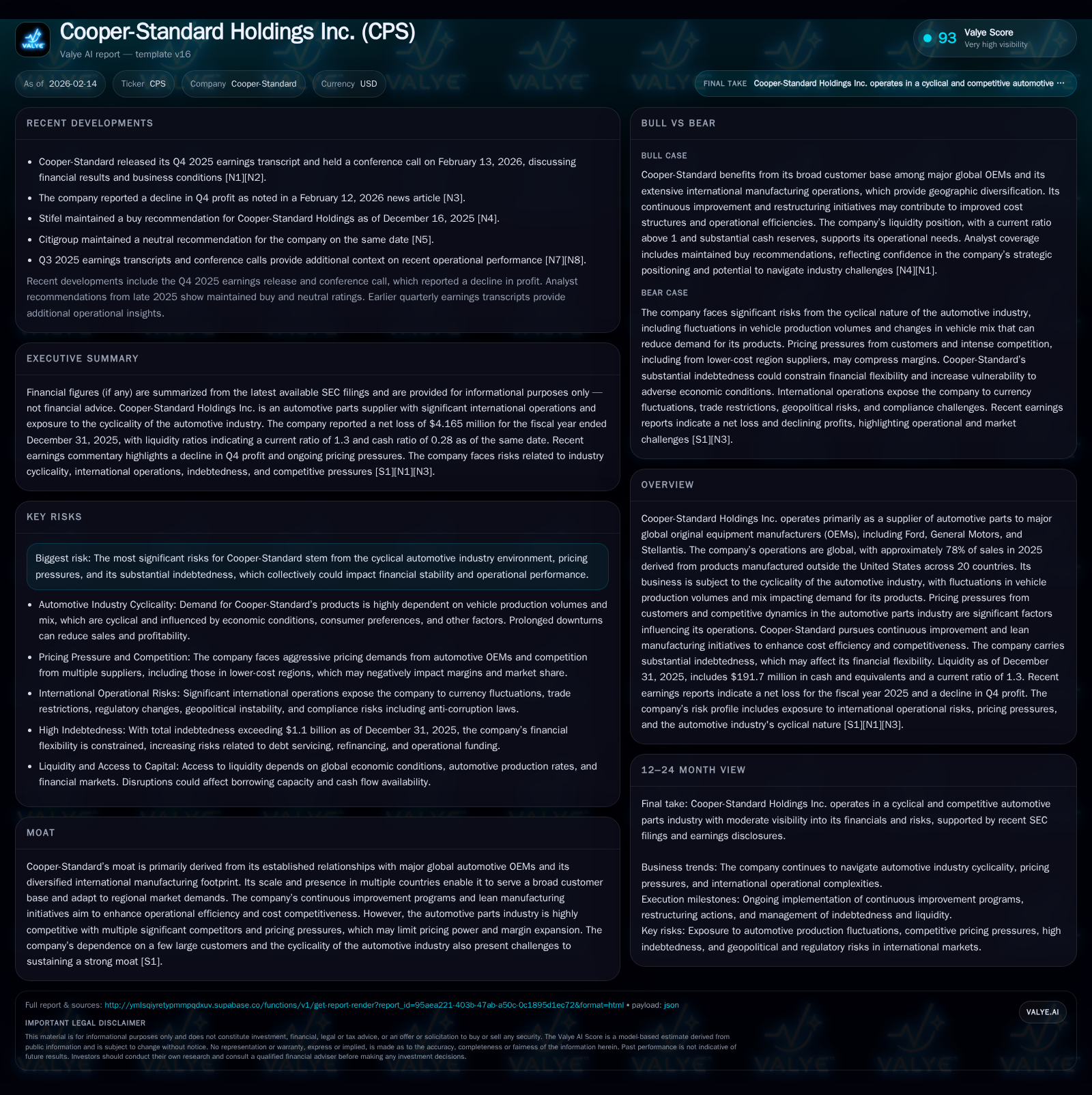
Cooper-Standard Holdings Inc. stands as a significant global supplier to major automotive OEMs, with the vast majority of revenue stemming from international manufacturing across 20 countries. The company faces amplified challenges due to the cyclical nature of auto production, intense pricing pressures from customers, and a substantial debt load that constrains financial flexibility. Lean manufacturing and continuous improvement programs act as critical levers to mitigate margin erosion but contend with fierce industry competition. Navigating geopolitical risks and operational execution amid complex global dynamics remains essential as Cooper-Standard approaches an uncertain industry outlook.
Global Footprint and Customer Cohesion: A Strategic Overview
Cooper-Standard Holdings Inc. is embedded deep within the global automotive supply chain, predominantly as a parts supplier to some of the world’s largest original equipment manufacturers (OEMs) such as Ford, General Motors (GM), and Stellantis [S1]. Its reach spans approximately 20 countries, with about 78% of its sales generated outside the United States in 2025 [S1]. This extensive international footprint positions Cooper-Standard not merely as a regional player but a multinational entity with diversified manufacturing bases. This geographic dispersion provides strategic advantages in proximity to key auto assembly plants worldwide but also subjects it to heterogeneous regulatory environments, foreign exchange volatility, and varying economic conditions.
The reliance on marquee OEM customers shapes both its revenue profile and strategic priorities. These relationships are double-edged: they form the foundation of Cooper-Standard’s business but also concentrate risk exposure because any material change in production or sourcing decisions by these OEMs can significantly impact Cooper-Standard’s order volumes and profitability.
Unpacking the Automotive Industry Cyclicality Impact on Cooper-Standard
The automotive sector’s inherent cyclicality profoundly influences Cooper-Standard’s operational performance. Automotive sales fluctuate with macroeconomic conditions such as GDP growth rates, consumer confidence, fuel price dynamics, employment levels, and financing availability [S1]. Production volume variability translates directly into fluctuating demand for automotive parts.
Furthermore, shifts in vehicle mix — for instance, greater demand for electric vehicles versus conventional models — affect product requirements and pricing dynamics. Forecasting is challenging given fluctuating production schedules; OEMs typically retain rights to resourcing adjustments without penalties [S1]. Consequently, there exists an execution risk wherein actual sales may fall short of projections based on awarded contracts. This unpredictability injects complexity into operational planning and financial forecasting.
Pricing Pressures vs. Operational Efficiency: The Margin Battle
One of the salient challenges facing Cooper-Standard is navigating aggressive pricing pressure imposed by OEM customers seeking cost reductions both upfront during bidding and contract tenure [S1]. These pressures compress sales prices and undermine margin sustainability.
Historically, pricing concessions have negatively impacted profitability; management notes ongoing efforts to counterbalance this trend through lean manufacturing practices and continuous improvement initiatives aimed at cost containment [valye_report_excerpt][S1]. However, the fine balance between absorbing price cuts while maintaining efficient cost structures is precarious given competitors also vie aggressively on price.
This dynamic creates a persistent tension: improvements in operational efficiency must not only match but ideally exceed price declines to prevent erosion of bottom-line results.
Financial Health Check: Debt Burden and Liquidity Dynamics
As of December 31, 2025, Cooper-Standard reported a net loss of approximately $4.17 million USD [F1] alongside substantial liabilities totaling nearly $678 million in current obligations against current assets of $881 million [F1]. The resultant current ratio stands near 1.3, which signals adequate but limited short-term liquidity buffer.
Cash reserves approximated $192 million provide some cushion; however, elevated indebtedness constrains financial agility especially under cyclically pressured revenues [F1][valye_report_excerpt]. The leverage raises concerns about capacity for investment in growth initiatives or weathering prolonged downturns without resorting to costly refinancing or asset divestitures.
This debt profile underscores the importance of prudent cash flow management amid unpredictable market conditions.
Lean Manufacturing and Continuous Improvement: Competitive Shields?
Cooper-Standard’s commitment to continuous improvement programs — driven by lean manufacturing methodologies — serves as a primary strategy to bolster cost efficiency and defend margins against external pricing pressures [valye_report_excerpt][S1].
These initiatives entail systematic elimination of waste, optimization of production flows, supplier integration enhancements, quality improvements, and innovation in manufacturing techniques.
Yet despite these efforts, the intensely competitive auto parts landscape limits how much these operational improvements can offset relentless contracting pressure from demanding OEM clients who wield significant negotiation power.
Hence while such programs are necessary competitive shields providing incremental efficiency gains, they face intrinsic limitations owing to sector dynamics.
Navigating Geopolitical and Regulatory Risks in 20 Countries
Operating across two dozen nations exposes Cooper-Standard to multifaceted geopolitical risks including currency volatility—which complicates hedging efforts—and evolving trade policies that may impose tariffs or restrict imports [S1].
Moreover, regulatory compliance challenges abound—from adherence to anti-bribery laws such as the Foreign Corrupt Practices Act (FCPA) to managing labor laws differing widely by jurisdiction. Certain operating regions present heightened corruption risks increasing legal exposure [S1].
Political instability including social unrest or armed conflict within specific locales can disrupt supply chains or jeopardize physical assets. Repatriation limits on profits add further complexity impacting global cash flow management.
These externalities accentuate operational unpredictability beyond internal control measures.
Q4 2025 Earnings Insights: Reality Check Against Market Expectations
The most recent quarter ended December 2025 presented notable headwinds with reported profit declines compared to prior periods [N3]. Earnings conference calls reveal management candidly acknowledging the continuing burden from lower vehicle production volumes coupled with ongoing aggressive price concessions demanded by key customers [N1][N2][N3].
Despite these challenges, commentary indicates ongoing execution of efficiency initiatives as vital mitigation tactics. While short-term results disappoint relative to forecasts or historical benchmarks, management signals cautious optimism contingent on stabilization in auto production rates.
Thus Q4 results crystallize prevailing cyclical pressures while underscoring disciplined cost management as core response.
The Durable Moat Question: Can Relationships and Scale Sustain Growth?
Cooper-Standard’s moat largely derives from entrenched strategic partnerships with major global OEMs combined with its broad international footprint enabling localized supply chain integration [S1][valye_report_excerpt]. These relationships facilitate preferred supplier status on high-volume platforms—a difficult position for competitors to replicate easily.
However, this protective moat is not impregnable. Customer concentration risk looms large; losing even one dominant OEM client or platform could substantially derail revenue streams. Moreover, steadfast price discipline enforced by OEMs caps margin expansion potential despite scale benefits.
Additionally, cyclical industry swings regularly unsettle steady growth surges leaving sustained moat protection contingent upon adaptability rather than complacency.
Risk Factors Deep Dive: From OEM Dependence to Currency Exposure
An array of interlinked risk vectors challenge Cooper-Standard's stability:
OEM Dependence: Heavy reliance on a relatively concentrated customer base spells vulnerability if those customers pivot sourcing strategies or cut production sharply. Awarded business is not guaranteed until actual orders materialize creating fulfillment uncertainty [S1].
Currency Fluctuations: With majority revenues generated abroad but expenses incurred globally in disparate currencies, exchange rate movements can materially impact reported earnings—hedging opportunities are imperfect safeguards [S1].
Geopolitical Instability: Political turmoil or regulatory changes may restrict operations or disrupt supply chains unexpectedly across multiple jurisdictions [S1].
Pricing Dynamics: Continued erosion due to customer demands for price reductions threatens margins unless offset by innovation or cost savings [S1].
Collectively these factors necessitate vigilant risk management frameworks integrated into strategic planning processes.
Outlook & Strategic Imperatives: Positioning for a Turbulent Future
Looking ahead, Cooper-Standard must continue leveraging its international scale while deepening operational excellence programs targeting efficiency gains beyond incremental levels. Preserving customer loyalty through quality leadership amidst fierce price competition will be critical. Financial discipline focusing on deleveraging will enhance resilience against automotive downturns or unforeseen shocks.
Continued monitoring of geopolitical developments alongside agile adaptation strategies will also be pivotal given exposure across diverse regulatory landscapes. Innovation adapting products for evolving vehicle technology trends such as electrification could open new avenues mitigating cyclicality rooted in traditional vehicle platforms.
In sum, balancing proactive cost control amid cyclical headwinds against maintaining strategic partnerships underpins Cooper-Standard’s effort to sustain competitiveness through an inherently volatile automotive ecosystem.
Disclaimer: This analysis is for informational purposes only and does not constitute investment advice or recommendations.
Disclaimer: This is research-only, informational analysis and not investment advice. It may include AI-generated interpretation and general industry context. Always verify important details using primary sources.

Comments