
Equity Residential’s Strategic Fortitude Amid Market Headwinds and Earnings Pressure
An in-depth analysis of Equity Residential’s positioning as it contends with evolving urban rental dynamics and recent financial challenges.
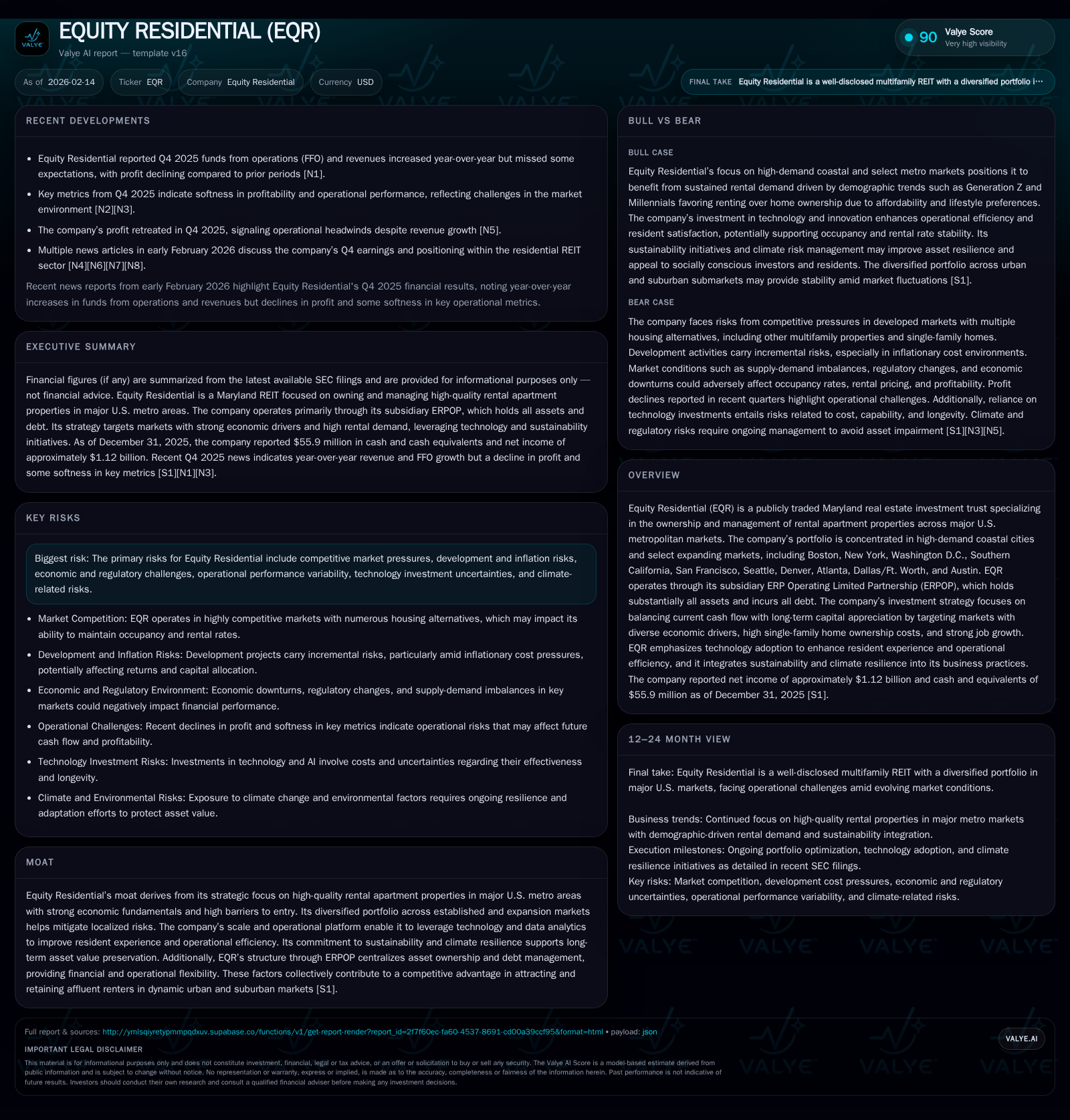
Equity Residential remains a dominant player in upscale U.S. apartment rentals, leveraging its concentrated coastal portfolio and centralized operating structure to navigate complex market environments. Despite a recent earnings miss that sparked scrutiny, EQR's disciplined geographic strategy, tech-driven operations, and sustainability initiatives provide resilience. However, rising inflationary costs, regulatory risks, and intensified competition underscore the operational challenges ahead. How EQR balances short-term performance hiccups with long-term growth objectives will define its trajectory in the crowded residential REIT sector.
Navigating Coastal Megacities: EQR’s Geographic Moat
Equity Residential stands out among residential REITs largely due to its laser focus on premier coastal metros known for their economic dynamism and steep housing costs. According to the company’s latest disclosures, its holdings span Boston, New York City, Washington D.C., Southern California hubs (Los Angeles, Orange County, San Diego), San Francisco, Seattle, alongside selected growth markets such as Denver, Atlanta, Dallas/Fort Worth, and Austin [S1]. This mix is no accident—it reflects a deliberate strategy to concentrate in markets with proven economic engines that attract high-income renters priced out of homeownership.
The high single-family home ownership costs in these areas create sustained demand for upscale rentals. Coupled with dense employment centers tied to knowledge-based industries — technology, finance, healthcare — these metro areas present formidable barriers to entry for competitors. Local zoning complexities and land scarcity amplify these barriers further.
This geographic moat is pivotal; it buffers EQR against localized downturns and fosters more predictable occupancy rates and rental growth compared to markets reliant on cyclical or commoditized properties. This concentration allows EQR to leverage scale efficiencies in property management while maintaining a premium position attractive to affluent tenants [S1].
Financial Pulse Check: Dissecting the Latest Earnings Miss
Despite this strong positioning, Equity Residential's Q4 2025 financial performance underscored emerging challenges within the broader urban rental landscape. News coverage highlights that EQR missed analysts’ estimates for Funds From Operations (FFO) and revenues yet reported year-over-year increases in both metrics [N11]. Specifically, while absolute financials climbed compared to prior years, the shortfall against projections raised investor eyebrows.
Further reporting detailed a retreat in net income compared to previous quarters [N12][N14], pointing toward margin compression likely stemming from inflationary pressure on operating expenses and slower-than-expected rent escalations. The company's core operating environment is tightening as competition intensifies and tenant preferences evolve post-pandemic.
From a financial standpoint, this presents nuanced complexity: robust demand sustains top-line growth but rising costs weigh on profitability margins. Cash reserves remain adequate with approximately $56 million on hand as of December 2025 [F1], supporting liquidity amid headwinds. Yet the path to restoring consensus-beating metrics may require operational agility or strategic recalibration.
The ERPOP Operating Model: Centralized Control as a Competitive Edge
A distinguishing feature underpinning EQR’s strategic flexibility lies in its ownership structure centered around ERP Operating Limited Partnership (ERPOP). EQR holds approximately 97.6% ownership in ERPOP which owns virtually all assets and bears all indebtedness [S1]. This consolidated operational model departs from many REITs that segment ownership or operate through multiple legal entities exposed to independent debt obligations.
By funneling property ownership and liabilities into ERPOP while EQR itself holds no external debt independently, the company streamlines capital deployment decisions and risk management. This confers benefits such as:
- Enhanced negotiation power with lenders via consolidated borrowing.
- Simplified capital allocation processes allowing quicker asset acquisitions or dispositions.
- Improved transparency over asset-level performance within the partner entity structure.
Such centralized control enables management to react nimbly amidst market turbulence or pursue development selectively. It also fosters alignment between governance bodies overseeing the REIT parent entity and underlying operating partnership [S1].
Market Trends & Risks: Balancing Growth Amid Inflation and Competition
Real estate industry dynamics continue shifting under macroeconomic influences that directly impact operational execution for operators like EQR. Inflation has pushed up materials and labor costs involved in property maintenance and development projects. Regulatory landscapes grow more complex with varying jurisdictions increasing compliance burdens related to zoning changes or rent control considerations [S2]. Meanwhile, competition among luxury apartment landlords is fierce—escalating marketing spend and resident incentives.
EQR explicitly acknowledges such risks including:
- Development cost overruns eroding projected returns.
- Potential slowdowns in leasing velocity driven by affordability constraints in premium segments.
- Climate change effects imposing retrofitting expenses or exposure adjustments.
These factors can pressure margins or slow portfolio growth if unchecked [S1][S2]. Strategically navigating these requires balancing prudent capital expenditures against tenant acquisition efforts while maintaining profitability thresholds.
Tech-Enabled Tenant Experience and Operational Efficiency
In an increasingly tenant-centric market where convenience can dictate retention rates among affluent renters, Equity Residential invests significantly in technology integration across its operations. The company employs sophisticated data analytics platforms designed to:
- Optimize leasing processes through digital tools reducing friction for prospective tenants.
- Enhance residents’ experiences via smart-home technologies and streamlined service requests.
- Drive operational efficiencies by harnessing predictive maintenance algorithms lowering downtime/costs.
This tech-forward posture positions EQR favorably versus peers who may be slower adopters or less focused on premium customer service differentiation [S1]. As urban renters become more selective with amenities coupled with seamless interactions expected digitally, these investments support stabilized occupancy levels even amid macroeconomic uncertainties.
Sustainability at Scale: Resilience and Long-Term Asset Value
Aligning physical asset stewardship with environmental imperatives offers another layer of competitive defense for Equity Residential. The company emphasizes sustainability practices aimed at enhancing climate resilience—an increasingly critical factor given intensified weather events affecting coastal properties.
Key sustainability commitments include energy efficiency upgrades across properties, water conservation measures, waste management improvements, and resilience planning for flood or fire risks [S1].
Beyond ethical drivers, these measures help mitigate potential insurance cost spikes or regulatory penalties linked to environmental non-compliance. They also preserve market appeal among eco-conscious renters while potentially unlocking tax incentives.
This sustainability focus contributes materially to preserving long-term asset values amid broad shifts toward ESG-aligned investment criteria within real estate capital markets.
Beyond Earnings: What EQR’s Strategy Signals for Future Returns
While recent earnings have produced some disappointment relative to analyst expectations [N11], underlying strategic initiatives imply confidence in balancing immediate cash flows alongside capital appreciation over extended horizons [S1][F1]. Their targeted exposure to knowledge-center metros — hubs characterized by economic diversity and sustained job creation — provides structural rent-growth catalysts despite short-term volatility.
The tension between delivering near-term profitability improvements versus funding technology upgrades or sustainability projects underscores a deliberate trade-off reflecting management’s prioritization of durable competitive advantages over quick fixes.
Navigating this balance successfully will be critical as shifting renter demographics seek urban convenience yet value comparative affordability amid rising single-family home prices characteristic of their key markets [S1].
Peer Benchmarking: How EQR Stacks Up Among Residential REITs
Comparisons with fellow residential REITs such as AvalonBay Communities (AVB), Essex Property Trust (ESS), Mid-America Apartment Communities (MAA), and Camden Property Trust (CPT) reveal common themes yet distinctive nuances impacting relative performance prospects heading into earnings season [N3][N4][N9][N10].
EQR benefits notably from scale—the breadth of coastal holdings creates diversification less vulnerable to market-specific shocks than some peers focused heavily on Sun Belt suburbs or interior markets. However, peers may exhibit stronger near-term FFO growth due to differing exposure or cost structures.
Moreover, sector-wide challenges such as slowing rent acceleration echo across competitor results previews highlighting shared headwinds including inflationary pressures impacting operating expenses broadly among multifamily landlords [N3][N4]. Recognition of these parallels tempers isolated critique directed at EQR’s Q4 miss while reinforcing sector cyclical elements requiring strategic vigilance.
Disclaimer: This analysis is provided solely for informational purposes based on publicly available data as of February 2026. It does not constitute investment advice or recommendations to buy or sell securities. Readers should conduct their own due diligence before making investment decisions.
Disclaimer: This is research-only, informational analysis and not investment advice. It may include AI-generated interpretation and general industry context. Always verify important details using primary sources.

Comments