
Weyerhaeuser's Resilient Timberlands and Wood Products Model Faces Q4 Challenges and Carbon Opportunity
An in-depth look at how Weyerhaeuser balances its sustainable forestry legacy with cyclical market pressures and emerging environmental segments in early 2026.
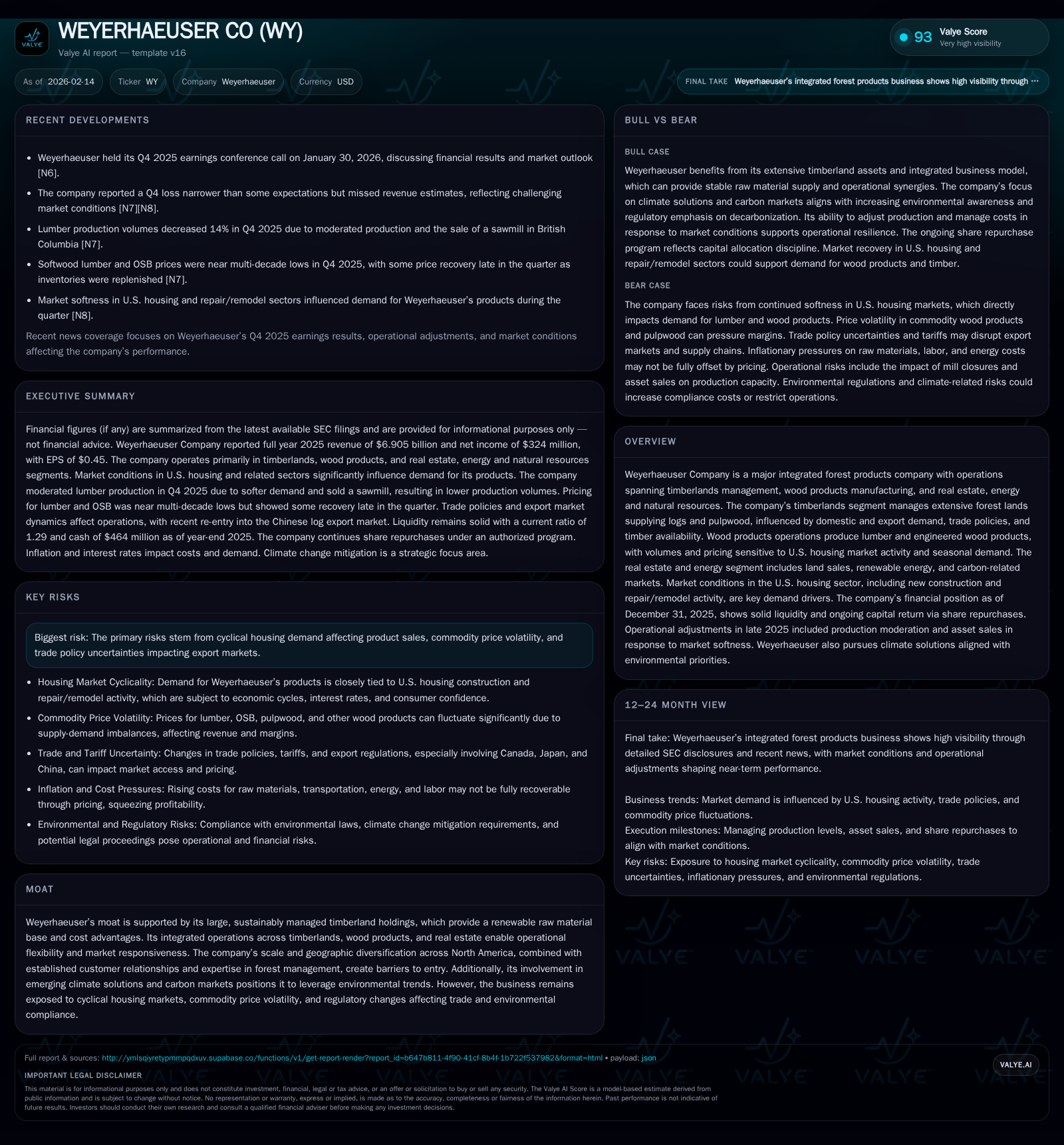
Weyerhaeuser Company leverages its vast, sustainably managed timberlands and integrated operations to maintain a durable competitive moat, even as Q4 2025 earnings reflect the downturns typical of housing market cyclicality. While wood product sales closely follow U.S. housing activity, the company is expanding its footprint in carbon markets and renewable energy to diversify revenue streams. Strong liquidity and a continued commitment to share repurchases signal financial discipline amid external headwinds, including trade policy uncertainties and commodity price swings. Comparisons with peers reveal sector-wide pressures, underscoring Weyerhaeuser’s strategic emphasis on scale and sustainability as key levers going forward.
Rooted in Timber: The Backbone of Weyerhaeuser’s Moat
Weyerhaeuser’s identity is deeply entwined with the forests it manages—spanning millions of acres across North America. These vast timberlands serve as the company’s core asset base, supplying renewable raw materials crucial for wood product manufacturing. The sustainable management of these lands not only ensures ecological stewardship but also confers significant cost advantages versus competitors who must procure lumber from third parties or more fragmented sources. This integration creates an operational ecosystem where timberland stewardship feeds directly into wood products outputs and downstream real estate activities.
The company's SEC disclosures emphasize this integrated model ([S1]), detailing how geographic diversification across multiple regions dampens the impact of localized disruptions such as wildfire or pest outbreaks. Moreover, by coupling timberlands with wood products manufacturing and real estate/energy assets, Weyerhaeuser can pivot fluidly between segments responding to differing demand conditions.
This long-rooted heritage—the “backbone” if you will—is not merely historical but a living moat that shapes cost structures and market agility. It allows the company to weather volatility better than more narrowly positioned competitors or pure-play wood product manufacturers.
Digging Into Q4 2025: Earnings Misses Amid Market Cyclicality
The tail end of 2025 brought headwinds that laid bare the cyclical undercurrents shaping Weyerhaeuser's near-term performance. Despite posting a loss narrower than some estimates ([N13], [N14]), the company missed revenue expectations ([N7], [N8]). Sales totaled approximately $6.9 billion for fiscal 2025 ([F1]), but Q4 revenue softness reflected sluggish demand in key residential construction sectors alongside pricing pressures.
Market reports highlight that while the loss was less severe than anticipated, it still marks a reminder of heightened sensitivity to macroeconomic fluctuations ([N6], [N7]). Analysts had flagged this vulnerability in previews ahead of the earnings release ([N10], [N11], [N12]). The contrast between Weyerhaeuser’s durable asset base and transient market softness paints a nuanced picture: entrenched structural advantages are tested by cyclical swings.
Such episodic earnings pressures are emblematic of the broader timber and building materials space during periods of cooling housing activity as inventory build-ups weigh on pricing and volumes. Yet, even as revenues lagged projected marks, management maintained firm guidance on capital allocation priorities including buybacks, signaling confidence in medium-term prospects ([S1]).
Wood Products and Housing Demand: A Seasoned Market Pulse
Wood product volumes and prices are closely tethered to the rhythms of U.S. housing activity. New residential construction—including single-family homes—and repair/remodel projects constitute primary consumption drivers for lumber and engineered wood products produced by Weyerhaeuser ([valye_report_excerpt], [S1]). Seasonality further colors these dynamics with winter quarters traditionally softer due to colder climates suppressing building starts.
As recent data show, a slowing housing market—partly driven by higher financing costs—has dampened new builds in late 2025, exerting downward pressure on lumber demand. However, repair/remodel segments have shown more resilience although generally involve lower absolute volumes compared to new construction. Weyerhaeuser must therefore navigate this mixed landscape where top-line growth is finely balanced between these drivers.
Further compounding complexity is the influence of export demand—both volume and pricing—that can act as partial offsets when domestic markets soften but remain vulnerable to trade policy shifts (discussed below).
Carbon and Renewable Energy: Growth Frontiers Beyond Timber
Beyond timber harvesting and wood products manufacturing lies a less visible yet increasingly critical frontier for Weyerhaeuser: carbon markets, renewable energy projects, and real estate development anchored in sustainability principles ([valye_report_excerpt], [S1]).
The company has embraced participation in emerging climate solutions through forest carbon sequestration credits—leveraging its expansive land assets not only as raw material sources but as environmental service providers. This dual use exemplifies how natural resource companies can unlock alternate value streams tied to decarbonization goals increasingly prioritized by corporates and governments alike.
Renewable energy projects situated on managed properties further diversify income bases while aligning with global energy transition imperatives. Together these efforts position Weyerhaeuser favorably within environmental markets poised for growth amid heightened regulatory focus on climate mitigation.
Though still nascent relative to core segments, these initiatives foreshadow longer-term strategic pillars supporting resilience against cyclical downturns common in commodity-linked operations.
Financial Health Check: Strong Liquidity and Capital Allocation
Despite reported Q4 challenges, Weyerhaeuser entered 2026 with sturdy financial footing. As per year-end filings ([F1]), cash & equivalents stood at $464 million complemented by current assets totaling approximately $1.65 billion against current liabilities near $1.28 billion—yielding a healthy current ratio of roughly 1.29.
This liquidity cushion affords flexibility navigating cyclical troughs or latent investment opportunities without immediate capital constraints. Notably, the company continued active share repurchases during Q4 2025—buying back over 427 thousand common shares at an average price of $23.39 per share—demonstrating an intent to return capital amidst challenging conditions while maintaining investor confidence ([S1]).
Moreover, with nearly $938 million remaining authorized under the new repurchase program authorized in mid-2025, management signals sustained commitment toward shareholder value preservation balancing organic growth funding needs simultaneously.
Navigating Risk: Trade Policies, Price Volatility, and Regulatory Landscape
Operating across natural resources exposes Weyerhaeuser to risk vectors related to both macro cycles and regulatory regimes ([valye_report_excerpt], [S1], [S2]). Chief among these are:
- Cyclical Housing Demand: Variations in residential construction fundamentally drive product sales volumes subjecting earnings to macro sensitivities.
- Commodity Price Volatility: Lumber prices fluctuate significantly impacting margin stability due to input cost swings entwined with supply-demand imbalances.
- Trade Policy Uncertainty: Export channels experience disruptions from tariffs or trade negotiations that can abruptly alter competitive positioning or access.
- Environmental Compliance: Increasingly stringent regulations impose costs tied to sustainable forest practices or emissions compliance potentially elevating operating expenses.
- Legal Contingencies: Environmental proceedings constitute potential contingent liabilities requiring disclosure above material monetary thresholds ([S1]).
These factors create an environment necessitating adaptive management capable of anticipating policy shifts while leveraging diversified segment operations as buffers against isolated shocks.
Comparative Landscape: Weyerhaeuser vs. Peers in Timber & Building Materials
Industry peers such as Martin Marietta ([N2]) and Masco ([N3]) recently released quarterly results illustrating varied responses to similar macro pressures affecting construction-related sectors. Martin Marietta reported earnings misses linked directly to demand softness while Masco posted an earnings beat albeit with sales slightly behind forecasts ([N3], [N4]).
This mosaic of outcomes highlights sector-wide cyclicality tempered by individual company positioning nuances such as product mix diversity or operational efficiency gains. Against this backdrop, Weyerhaeuser’s integrated model spanning timberlands through finished wood products places it among those better equipped for flexibility yet remains exposed similarly when downstream demand wanes.
Differences also emerge through geographic exposure variation since local market conditions can diverge markedly within North America impacting peer comparability but reinforcing the benefit of scale-driven geographic diversification employed by Weyerhaeuser.
Future Outlook: Leveraging Scale and Sustainability in an Uncertain Environment
Looking forward into 2026, Weyerhaeuser faces the challenge of navigating ongoing housing market cyclicality alongside broader economic uncertainties ([valye_report_excerpt], [N10], [N11], [N12]). The near-term trajectory suggests continued top-line pressures moderated somewhat by stable operational leverage inherent to its vertically integrated model.
However, growth prospects receive amplification from strategic engagements in carbon sequestration markets and renewable energy expansion increasingly valued amid global decarbonization efforts. This dual emphasis between preserving core forestry-derived cash flows while developing sustainability-driven revenue streams evidences a prudent risk-mitigated growth approach embraced by management.
Capital allocation decisions—such as resizing share repurchase programs post-completion of prior authorization—reflect deliberate balancing between rewarding shareholders presently versus fueling innovation pathways aligned with ESG considerations critical for future competitiveness.
Ultimately, Weyerhaeuser’s expansive timberland resource coupled with integration across forest products manufacturing plus real estate/energy ventures creates a scenario akin to a deeply rooted forest system offering resilience against short-run storms while gradually advancing new regenerative branches yielding longer-run value for stakeholders alike.
Disclaimer: This analysis is provided solely for informational purposes referencing publicly available information up to February 14, 2026; it does not constitute investment advice or recommendations regarding any securities mentioned herein.
Disclaimer: This is research-only, informational analysis and not investment advice. It may include AI-generated interpretation and general industry context. Always verify important details using primary sources.

Comments