
Morningstar, Inc.: Technology Integration and Regulatory Navigation Define Its Investment Research Leadership
Morningstar balances legacy strengths with AI innovation amid complex global regulations to sustain competitive advantage.
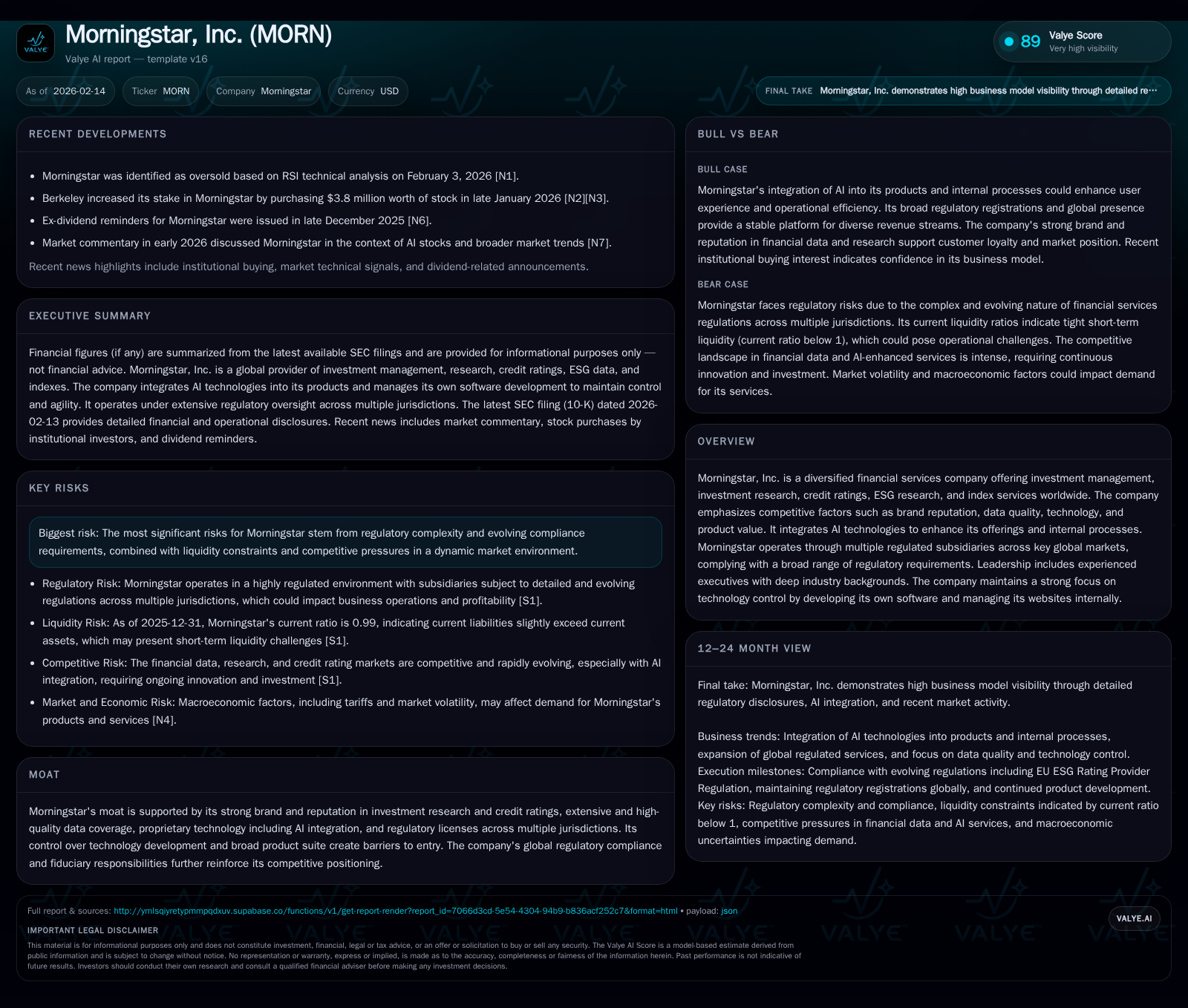
Morningstar, Inc. stands at a pivotal intersection of tradition and modernity, leveraging its renowned brand and extensive data assets while aggressively embedding artificial intelligence across its products and internal operations. Despite facing a challenging regulatory landscape that spans multiple jurisdictions and business lines, the company maintains robust compliance structures that both protect and empower its offerings. Recent insider buying combined with technical oversold conditions suggests market participants are recognizing intrinsic value amidst transient sector headwinds. Morningstar's commitment to proprietary technology development and cybersecurity governance reinforces its moat in a competitive investment research environment.
Navigating Legacy Strengths and Market Sentiment
Morningstar has long been synonymous with authoritative investment research and credit ratings. In today’s volatile software sector environment, where AI and data-driven platforms dominate investor discourse, Morningstar embodies an intriguing mix of resilient legacy appeal and progressive technology adoption. Recent technical analysis highlights the stock as oversold according to RSI measures on Nasdaq’s platform [N2], suggesting short-term price pressures. Yet counterbalancing this is Berkeley Investment Group’s substantial purchase of $3.8 million worth of shares last month [N3][N5], signaling institutional belief in the company's underlying fundamentals.
This dual narrative frames Morningstar as a misunderstood name caught in transient downturns but backed by long-term value drivers – chiefly its respected brand, extensive data assets, and ongoing AI transformation. Such institutional accumulation during technical dips often preludes renewed momentum if catalysts align.
A Deep Dive into Morningstar's Business Model and Product Ecosystem
Morningstar's diverse product suite spans multiple pillars: investment management, detailed investment research across asset classes, credit ratings through its DBRS entities, ESG research methodologies, and index licensing services [valye_report_excerpt]. Each business line benefits from the company’s hallmark emphasis on data quality, reliability, and trusted analytics—factors it identifies as critical competitive determinants.
Their offering is uniquely integrated; for example, ESG data complements traditional credit ratings while indexes support portfolio construction initiatives reliant on Morningstar’s extensive datasets. This breadth not only solidifies client reliance but also creates interconnected revenue streams that bolster overall stability.
Maintaining this ecosystem depends heavily on the company’s ability to continually enhance product value through cutting-edge technology deployment while safeguarding compliance across diverse regulatory regimes.
Technology as a Catalyst: AI Integration and Proprietary Development
A notable strategic pillar for Morningstar is its deliberate control over technology development [S1]. Rather than outsourcing core software functions, it builds and manages its own platforms internally—a choice that confers agility when incorporating fast-evolving AI capabilities. The company deploys AI in multiple dimensions: improving user accessibility to research via intuitive interfaces, automating data acquisition processes, enhancing analytical depth within products, and increasing employee productivity.
This technology-forward approach includes leveraging both internally created AI algorithms alongside select third-party models integrated thoughtfully within workflows. The result is a differentiated user experience that simplifies complex financial information consumption while trimming operational inefficiencies.
By embedding AI deeply rather than superficially layering it atop legacy systems, Morningstar positions itself competitively against peer offerings more reliant on vendor partnerships or less integrated architectures.
Regulatory Landscape: Compliance as Both Shield and Challenge
Operating across numerous global markets necessitates navigating an intricate web of regulations impacting credit ratings (where entities act as Nationally Recognized Statistical Rating Organizations or equivalent), investment advisory activities, ESG disclosures, and index provision [S1]. Each subsidiary typically complies with licenses tailored to local rules—DBRS Inc.’s registration with the US SEC being a prime example.
While these frameworks impose stringent operational demands—triggering costly examinations and supervision—they simultaneously reinforce trust among clients who demand transparency and accountability from financial information providers. Compliance thus serves as both a formidable barrier deterring new entrants lacking resources for such oversight and a reputational safeguard preserving existing market standing.
Morningstar explicitly acknowledges ongoing legislative uncertainties could alter future operating conditions. Their adaptive governance structures are designed for continuous monitoring against this dynamic backdrop.
Financial Performance and Capital Allocation Insights
According to the 2025 fiscal year close [F1], Morningstar reported revenues approaching $2.45 billion — illustrating considerable scale within its niche financial service sectors. Despite macroeconomic pressures felt across software-oriented stocks generally [N1], the company maintains near parity between current assets ($1.038 billion) and current liabilities ($1.053 billion), reflected by a current ratio slightly below one at approximately 0.99.
This balanced liquidity profile indicates working capital is carefully managed without excessive borrowing or cash hoarding tendencies—a prudent position given potential regulatory cost increases or investments in technology expansion.
Though net income figures lag behind recent years’ peaks (last complete disclosure in 2018), operational focus seems oriented toward reinvesting in innovation rather than aggressive short-term profitability maximization.
Risk Management Framework and Cybersecurity Oversight
Morningstar’s cybersecurity program exemplifies mature governance [S1]. An InfoSec team led by a highly qualified Chief Information Security Officer with over 15 years’ domain expertise oversees all aspects—from IT risk governance through incident detection to disaster recovery protocols.
The approach features multiple layers: continual monitoring via a dedicated 24/7 Security Operations Center (SOC), rigorous escalation channels involving CIO/CISO leadership upon significant events, plus involvement of an executive-level Cyber Incident Disclosure Committee comprising legal, communications, privacy officers alongside operational leads.
Post-incident analyses fuel improvements ensuring vulnerabilities are proactively addressed. Additionally, collaboration with external incident response specialists adds depth when intrusion complexity exceeds internal capacities.
Such comprehensive procedures are vital given the sensitivity of financial data entrusted by clients worldwide—and integral to sustaining stakeholder confidence amid escalating cyber threats targeting financial service firms broadly (analysis).
Competitive Positioning Within the Investment Research Industry
Morningstar's moat integrates multiple reinforcing elements detailed earlier: distinguished brand recognition rooted in decades of consistent output; unparalleled breadth of high-quality datasets spanning creditworthiness metrics to environmental-social indicators; proprietary technologically advanced platforms enhanced by AI; plus regulatory licenses enabling trusted status in regulated domains globally [valye_report_excerpt].
These factors collectively erect substantial barriers for competitors attempting entry or expansion—particularly newcomers lacking comparable scale or compliance sophistication. Even evolving industry challenges like increased automated retail analytics tools do not replicate Morningstar’s comprehensive foundational infrastructure immediately.
Competitors include other rating agencies or niche ESG providers but few match Morningstar's multi-angle approach coupling data depth with analytical insight delivered on controlled technological fabrics.
Investor Behavior and Near-Term Valuation Dynamics
The juxtaposition between technical indicators pointing toward an oversold condition for MORN shares [N2] versus active accumulation by entities like Berkeley [N3][N5] frames an intriguing near-term valuation debate. While momentum traders may shy away due to recent price softness typical during broader software sector weakness [N1], informed investors appear positioning ahead of anticipated inflections possibly linked to accelerating AI-enabled growth or clarity around regulatory evolution.
This dynamic underscores how market sentiment can diverge temporarily from fundamental valuation drivers rooted in business model resilience and innovation trajectories.
Catalysts potentially unlocking positive re-rating include successful product rollouts showcasing tangible AI benefits or easing legislative burdens stabilizing compliance cost outlooks.
Outlook: Growth Prospects and Innovation Trajectory
Looking forward, Morningstar appears well-positioned to capitalize on its strengths while confronting inherent challenges head-on. Continued AI integration forms the cornerstone for enhancing both client-facing products and internal operational efficiency—a strategy likely essential to maintain differentiation as peer entities increase tech investments.[valye_report_excerpt][S1]
Simultaneously navigating shifting regulatory environments demands sustained vigilance but also offers opportunity: demonstrating proactive compliance can further cement client trust in an era emphasizing transparency.[N1]
Investment into risk management—particularly cybersecurity—fosters resilience necessary amid intensified digital threats prevalent throughout financial services sectors.[S1]
While macroeconomic variables pose external uncertainties common across software-focused market participants,[N1] Morningstar’s blend of legacy reputation allied with forward-looking innovation should underpin measured optimism about its trajectory near term.
Disclaimer: This analysis is for informational purposes only. It does not constitute investment advice or recommendations regarding Morningstar securities.
Disclaimer: This is research-only, informational analysis and not investment advice. It may include AI-generated interpretation and general industry context. Always verify important details using primary sources.

Comments