
MSA Safety Inc in 2025: Revenue Gains Shadowed by Q4 Profit Contraction Amidst Strong Liquidity
Despite robust revenue growth and solid balance sheet metrics, MSA Safety's late-year earnings stumble and mixed market signals warrant closer scrutiny.
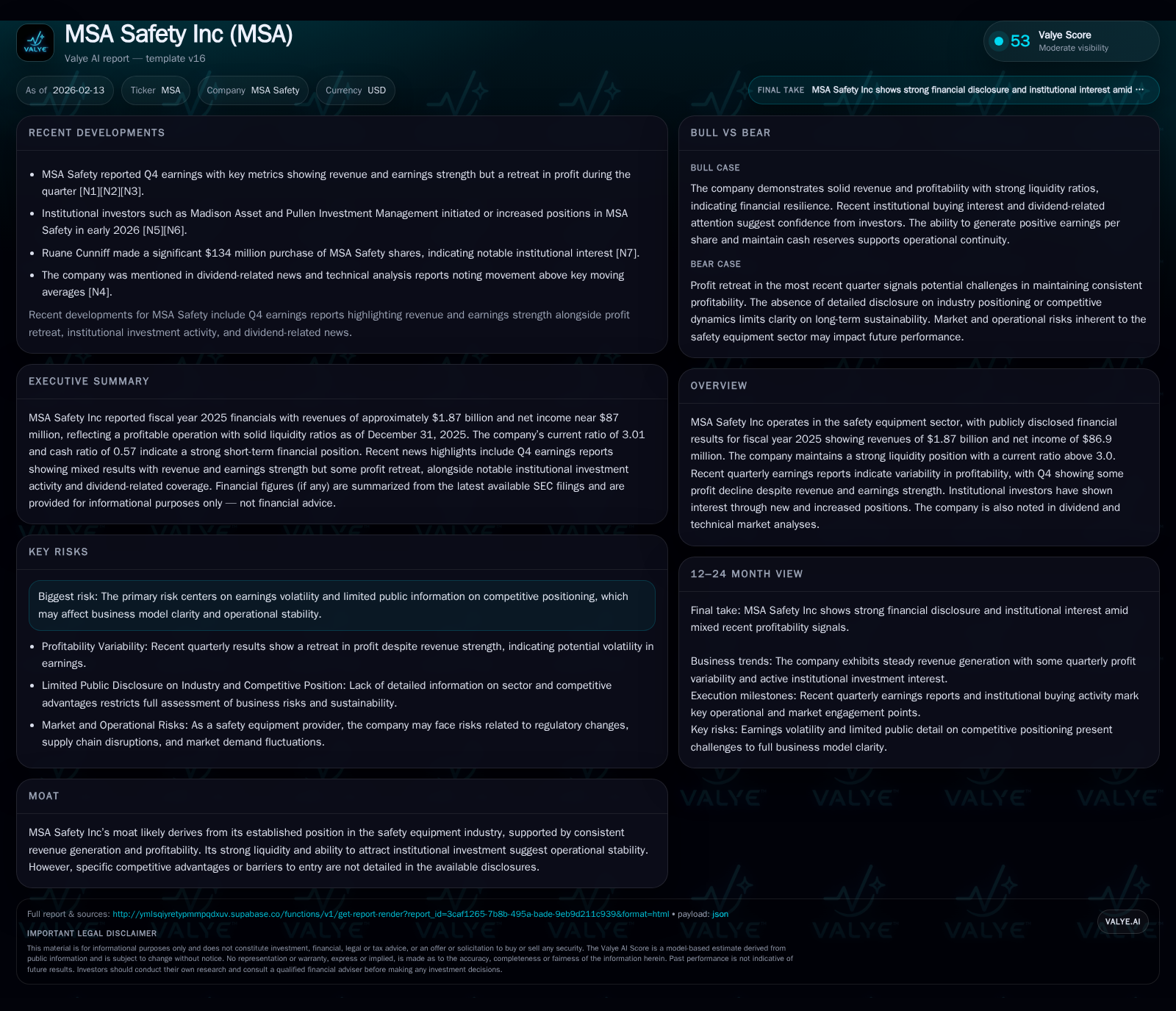
MSA Safety Inc delivered $1.87 billion in revenues for fiscal 2025 but faced a decline in net income particularly during Q4, signaling some pressure on profitability despite topline strength. The firm's liquidity remains a stronghold with a current ratio above 3.0, underscoring operational resilience through variability. Institutional investors have recently shown interest by initiating and adding positions, suggesting nuanced confidence amid profit uncertainty. While MSA’s moat appears rooted in steady sales and financial stability, limited disclosure on competitive advantages alongside earnings swings present challenges to full clarity on sustainability.
MSA Safety’s 2025 Financial Snapshot: Thriving Revenue vs. Profitability Challenges
MSA Safety Inc closed fiscal year 2025 with revenues tallying $1.87 billion, affirming its ability to generate substantial top-line growth within the safety equipment domain [F1]. Yet beneath these healthy sales figures lies a more nuanced profitability story: net income for the full year stood at $86.9 million, and notably, the fourth quarter exhibited a marked retreat in profits despite beating revenue expectations [N1][N2][N3]. This juxtaposition between robust revenue expansion and earnings contraction sets the analytical stage—do these trends suggest transient headwinds or deeper structural pressures?
The Q4 profit dip raises questions about cost controls or market dynamics impacting margin profiles even as sales remain resilient. It underscores that while MSA excels at capturing business volume, converting that into proportionate bottom-line gains is more challenging presently.
Takeaway: MSA's strong revenue underpins its market presence but the late-year profitability softness reveals operational complexities demanding further exploration.
Liquidity Strength and Balance Sheet Resilience: More Than Just Numbers
Beyond income statement swings, MSA's balance sheet paints a picture of financial robustness crucial for sustaining operations amidst earnings variability. The company reported current assets of approximately $869 million against current liabilities near $289 million as of December 31, 2025 [F1][S1], resulting in a current ratio exceeding 3.0. This liquidity measure suggests ample short-term asset coverage over liabilities—an important guardrail allowing the firm flexibility to weather episodic profit softness.
Available cash and cash equivalents stood at about $165 million [F1], further emphasizing ready resources on hand to support working capital needs or strategic investments without reliance on external financing under stress.
Operationally, such liquidity safeguards can translate into better capacity to manage supply chain disruptions, invest in product development, or absorb market shocks—particularly relevant given quarterly earnings volatility.
Takeaway: MSA’s strong liquidity ratios serve as critical buffers that underpin business continuity and strategic agility amid fluctuating quarterly performance.
Institutional Buying Patterns: A Confidence Indicator or a Contradiction?
Paradoxically contrasted against Q4 profit declines is notable recent institutional investor activity suggesting selective market confidence. Madison Asset initiated a position in MSA Safety [N5], shortly followed by Pullen Investment Management establishing new stakes totaling approximately $2.6 million [N6]. These moves point to deliberate accumulation by professional investors familiar with sector cycles and company fundamentals.
However, this influx comes amidst an environment where headline earnings warnings temper enthusiasm—a possible interplay between strategic entry prior to anticipated rebounds or differentiated views on longer-term durability versus short-run pressure.
This contrast could also reflect varying investment horizons; institutions might prioritize MSA’s strong balance sheet and product positioning over near-term margin fluctuations.
Takeaway: Institutional buying amid profit softness suggests nuanced conviction bred from fundamental analysis rather than pure momentum-driven enthusiasm.
Decoding the Earnings Volatility: What Caused Q4’s Profit Retreat?
MSA’s Q4 earnings presentation revealed an intriguing disconnect: revenue beat analyst forecasts while net income contracted noticeably [N1][N3]. The company commentary during earnings calls hinted at elevated input costs and supply chain inefficiencies weighing on margins [S2]. Additionally, unforeseen operational expenses or mix shifts toward lower-margin products may have contributed.
Such dynamics are not uncommon in industrial safety equipment manufacturing where raw material costs can fluctuate sharply and product cycles require continual innovation investment. The challenge lies in balancing price strategies without sacrificing competitive positioning.
Moreover, macroeconomic trends including inflationary pressures during late 2025 possibly exacerbated cost absorption challenges.
Takeaway: The profit retreat appears driven primarily by rising operational costs and market complexities rather than fundamental demand erosion—highlighting areas for managerial focus going forward.
Dividend Dynamics in a Mixed Performance Landscape
Maintaining shareholder returns seems prioritized despite uneven profitability results; dividend reminders around Q4 ex-dates confirm ongoing payout commitments [N4]. Such behavior often signals management confidence in underlying cash flows even when net income exhibits quarter-to-quarter gyrations.
While dividend consistency supports investor trust and can stabilize valuation perceptions, it must be balanced against maintaining sufficient reinvestment capital amid evolving competitive landscapes.
MSA’s approach suggests an attempt to preserve both the appeal to income-focused shareholders and reinvestment capacity necessary for long-term growth initiatives.
Takeaway: Dividend policies underscore management’s intent to reward shareholders even through cyclical performance swings though monitoring sustainability remains prudent.
Moat Musings: Unpacking MSA’s Competitive Position in Safety Equipment
MSA Safety’s moat concept rests largely on its entrenched industry presence coupled with stable revenue streams and sound operational footing outlined in recent disclosures [valye_report_excerpt.moat]. However, unlike technology firms with identifiable patents or network effects, MSA’s protective barriers appear less explicitly defined publicly—raising questions about differentiation beyond brand reputation and product reliability.
Steady revenues suggest satisfied customer bases reliant on safety-critical gear—a sector where quality standards impose implicit hurdles for new entrants. Yet such moats may be susceptible to competitive erosion absent clear innovation leadership or scale advantages discussed openly by management.
The absence of detailed commentary on proprietary technologies or exclusive partnerships leaves room for interpretation that competitive defenses are modestly subtle rather than overt.
Takeaway: While MSA likely benefits from reputation-based durability, full clarity on sustainable competitive edges requires deeper transparency or external validation beyond reported financial metrics.
Risks on the Radar: Earnings Fluctuations and Information Gaps
Primary risks confronting MSA involve the volatility seen in quarterly profits coupled with limited public insight into strategic defenses [valye_report_excerpt.risks]. Such opacity creates difficulty for stakeholders attempting precise operational assessments or forecasting beyond headline numbers.
Earnings variability can introduce investor uncertainty affecting valuation multiples or funding conditions if prolonged. Meanwhile, sparse disclosures hinder evaluation of how effectively management mitigates competitive threats or adapts to sector shifts like increased automation or digital integration within safety systems.
Transparency improvements could thus materially impact perceptions of risk versus opportunity balance for MSA moving forward.
Takeaway: Earnings swings combined with informational limitations represent tangible obstacles that may weigh on sustained market confidence absent further clarity initiatives from leadership.
Technical & Market Sentiment: ETF Flows and Price Action Contextualized
Contrasting institutional accumulations is reported notable ETF outflow involving MSA shares around early 2026 [N7]. Exchange-Traded Fund selling can stem from various factors including rebalancing effects unrelated directly to company performance but often impacts short-term price action adversely.
This divergence embodies complex sentiment layers where passive fund dynamics collide with active investors’ confidence signals—producing mixed trading patterns that can obscure trend readability.
Understanding such flows alongside broader technical indicators helps contextualize share price moves without relying solely on fundamentals—which remain pivotal but insufficient alone during volatile environments.
Takeaway: ETF outflows amid institutional buying paint a mixed sentiment picture requiring multi-dimensional analysis for comprehensive interpretation of market reception towards MSA shares.
Disclaimer: This report synthesizes publicly available information up to February 2026 without providing investment recommendations. It aims to present an analytical overview for informational purposes only. Investors should conduct independent due diligence before making any financial decisions related to MSA Safety Inc.
Disclaimer: This is research-only, informational analysis and not investment advice. It may include AI-generated interpretation and general industry context. Always verify important details using primary sources.

Comments