
Rivian's AI-Driven EV Ambition Confronts Profitability and Production Hurdles
A detailed analysis of Rivian’s integrated approach merging cutting-edge autonomy with electric vehicle manufacturing amid mounting financial and market pressures.
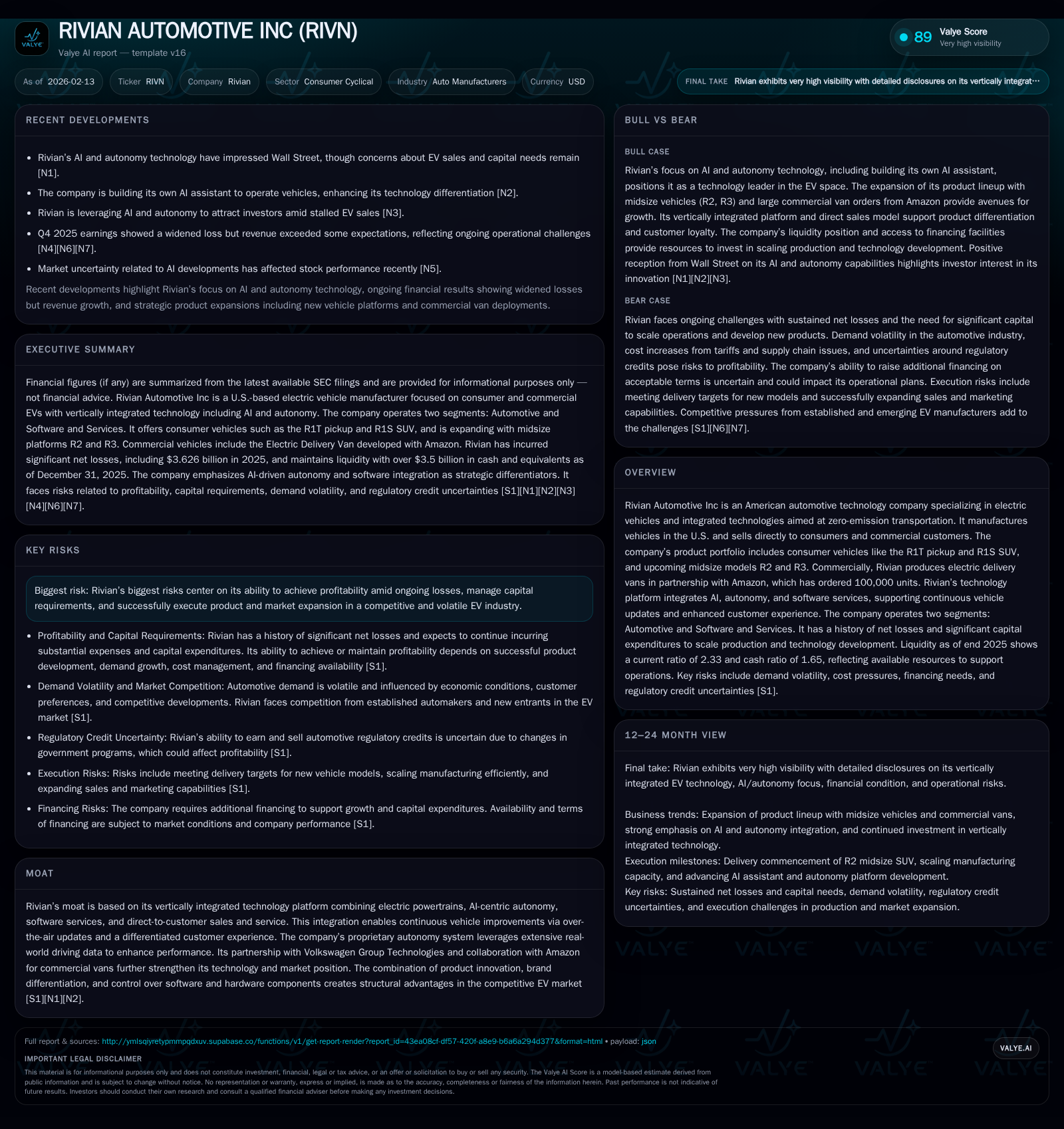
Rivian Automotive Inc pursues a dual mission: electrifying both adventurous consumer vehicles and commercial fleets with proprietary AI-autonomy technology. Its vertically integrated platform, combining hardware and software, offers potential differentiation in a fiercely competitive EV market. However, the company continues to grapple with significant net losses and the complexities inherent in scaling production and maintaining liquidity. Strategic partnerships and expanding product lines reflect growth ambitions, yet profitability remains elusive amid cost pressures and industry volatility.
Rivian’s Bold Vision: Electrifying Adventure and Commerce
Rivian Automotive Inc has positioned itself as an ambitious disruptor in the electric vehicle arena by simultaneously targeting two distinct yet complementary segments—adventure-oriented consumer vehicles and large-scale commercial fleets. The company’s mission goes beyond transportation; it aims to "preserve the natural world for generations to come" through zero-emission platforms crafted for both work and play [S1].
Launching initially with the R1 platform—the R1T pickup truck for outdoor utility enthusiasts and the R1S SUV catering to families—the company seeks to cultivate brand loyalty rooted in rugged capability fused with electric innovation. Moreover, Rivian’s pivot into commercial vehicles via its contract to deliver 100,000 electric vans for Amazon underscores its intent to scale impact in fleet electrification simultaneously [S1][N1]. This dual focus differentiates Rivian from peers that often specialize either in consumer or commercial segments exclusively.
Vertical Integration as a Moat: Technology Meets Manufacturing
Rivian’s moat is firmly anchored in its vertically integrated business model where control over critical elements—from electric powertrains to embedded AI software—creates substantial barriers against competitors [S1][N1]. Such integration allows seamless coordination between hardware engineering and advanced software features including vehicle digital experience management.
Importantly, Rivian operates direct-to-consumer sales and service channels which deepen customer engagement while enabling rapid feedback loops that inform product improvements. Over-the-air updates continuously refine vehicle performance long after sale—an advantage afforded only through owning both software ecosystems and manufacturing process [S1].
This architectural strategy aids in optimizing manufacturing complexity while cultivating product differentiation. For instance, Rivian’s zonal network architecture supports efficient component failure isolation and modular upgrades—a technical nuance underscoring their engineering sophistication [S1].
AI and Autonomy: Core Differentiators Setting Rivian Apart
At the heart of Rivian's technology stack lies its AI-centric autonomous driving platform designed from the ground up using proprietary machine learning models trained on its growing fleet's real-world driving data [S1][N5][N8]. This system powers "Autonomy+," which promises fast-paced innovation cycles far exceeding traditional automotive software update cadences.
The decisive bet on custom self-driving chips reflects a strategic move away from third-party providers toward tailored silicon optimized for powering neural networks onboard [N5]. Industry analysts applauded this shift as it could lower latency, reduce energy consumption, and enhance safety.
Nevertheless, while Wall Street praises the technological promise of Rivian’s autonomy efforts [N8], underlying challenges persist on operational fronts including regulatory approval processes and hardware-software integration within demanding real-world conditions. The interplay between AI development ambition and manufacturing realities thus frames one of Rivian's defining tensions.
Product Portfolio Expansion: From R1 to Mid-Size Platforms
Building on the R1T/R1S flagship success—and lessons learned—the company announced plans for a new midsize platform (MSP) designed to improve cost efficiency while broadening market appeal globally [S1][N2]. The upcoming R2 model—a five-seat midsize SUV aiming for a balance of everyday usability with adventure credentials—exemplifies this next wave initiative.
Early revenue beats reported in Q4 2025 suggest growing market traction [N2]. However, the transition toward more affordable offerings will test whether Rivian can maintain brand prestige while achieving production scale without compromising quality or margins.
Strategic Partnerships: Amazon and Volkswagen Ventures
Collaborations form pillars supporting Rivian's growth trajectory. Most notably is the ongoing partnership with Amazon which involves building an all-electric delivery van fleet capped at 100,000 units under a multi-year agreement [S1]. This contract guarantees steady commercial volume while providing valuable data streams for autonomous tech refinement.
Additionally, the joint venture with Volkswagen Group Technologies leverages shared intellectual property around software-enabled features aimed at serving diverse global markets across platforms [S1]. Recent industry reports also highlight developmental cooperation with Ford as part of broader alliance dynamics within the EV ecosystem [N14].
These partnerships mitigate some execution risk by pooling resources yet also require careful coordination across corporate cultures and competing priorities.
Financial Headwinds: Navigating Losses Amid Capital Demands
Despite technological prowess and growing production output, Rivian remains unprofitable. The company recorded a net loss of $3.63 billion in 2025—reflecting heavy spends on R&D, manufacturing capacity expansion, marketing efforts, and infrastructure investments [F1][S1].
Liquidity metrics show a current ratio of 2.33 as of year-end 2025 indicating adequate short-term financial health; however, absence of profitability demands continual capital infusion or cash flow improvement [F1]. Government incentives that historically bolstered margins have diminished or disappeared entirely adding pressure on unit economics.
Tariffs imposed on raw materials inflate costs further; if not managed proactively these could erode competitiveness or depress demand especially under uncertain macroeconomic conditions [S1][N10]. The widening quarterly losses documented recently reaffirm these headwinds persist despite revenue growth [N10].
Operational Scale-Up: Production and Market Expansion Challenges
Rivian’s pivot from a start-up manufacturer to established EV maker hinges critically on smooth scaling—a challenging endeavor given complex supply chains and high-tech assembly processes involved [S1][N13].
Capital-intensive projects such as constructing the Stanton Springs North facility near Atlanta represent leaps forward but come with execution risk particularly under volatile input costs or labor shortages [S1]. Recent stock price volatility partly attributed to concerns over production delays and operational execution reflect investor vigilance on this front [N13].
Successful market penetration will also require nimble go-to-market strategies including retail presence optimization though direct-sales methods offer some control over customer experience [S1]. Balancing growth speed against cost discipline remains a key internal dilemma.
Industry Comparisons: Rivian’s Position in the EV Race
Relative to legacy automakers making aggressive EV pushes (e.g., Ford), Rivian's fully integrated tech-software stack constitutes both an asset and liability. Unlike established giants who leverage scale but suffer organizational inertia, Rivian moves faster innovating but lacks deep pockets or proven mass-market manufacturing expertise yet [N3][N14].
Harley-Davidson’s recent Q4 loss amid transitioning product lines parallels some challenges faced by niche manufacturers attempting bold reinventions within constrained timelines [N3]. Partnerships like Ford-Rivian collaborations indicate recognition by incumbents of startup innovation potential but also foreshadow competitive pressures from larger oil-and-gas fueled automakers shifting gears rapidly [N14].
Thus, while the moat around integrated autonomy software sets Rivian apart materially today, sustaining this edge requires relentless execution amidst intensifying rivalry.
Outlook and Risks: The Road Towards Profitability
Looking forward, Rivian’s journey encapsulates both exceptional opportunity linked to cutting-edge EV/AI convergence—and profound uncertainty surrounding pathway to enduring profitability. Analysts anticipate potential upside if new model launches succeed coupled with autonomy monetization scaling meaningfully [N4][N11].
However, prolonged losses raise caution flags about capital adequacy especially if demand slows amid economic headwinds or regulatory shifts alter subsidy landscapes negatively [S1][N13]. The stock’s sharp drops following earnings releases underscore market sensitivity to execution gaps or cost overruns [N13].
Inherent risks extend beyond finances to include supply chain fragility, regulatory compliance hurdles for autonomous vehicle deployment, evolving competitive tactics from premium rivals as well as mass-market entrants seeking volume dominance.
In sum, while Rivian embodies compelling innovation marrying electrification with AI-driven autonomy under one roof—a powerful vision with differentiated products—the path remains arduous laden with typical early stage capital consumption plus emerging industry turbulence. Navigating this dynamic will define whether Rivian evolves into a durable auto-tech powerhouse or stumbles amid rising expectations.
Disclaimer: This report is strictly informational reflecting public disclosures as of February 2026; it contains no investment advice or recommendations.
Disclaimer: This is research-only, informational analysis and not investment advice. It may include AI-generated interpretation and general industry context. Always verify important details using primary sources.

Comments