
Navigating Strategic and Financial Complexities at Healthcare Realty Trust Inc in 2026
Healthcare Realty Trust balances growth ambitions with tenant risk and reinvestment challenges amid a leadership transition and shifting market dynamics.
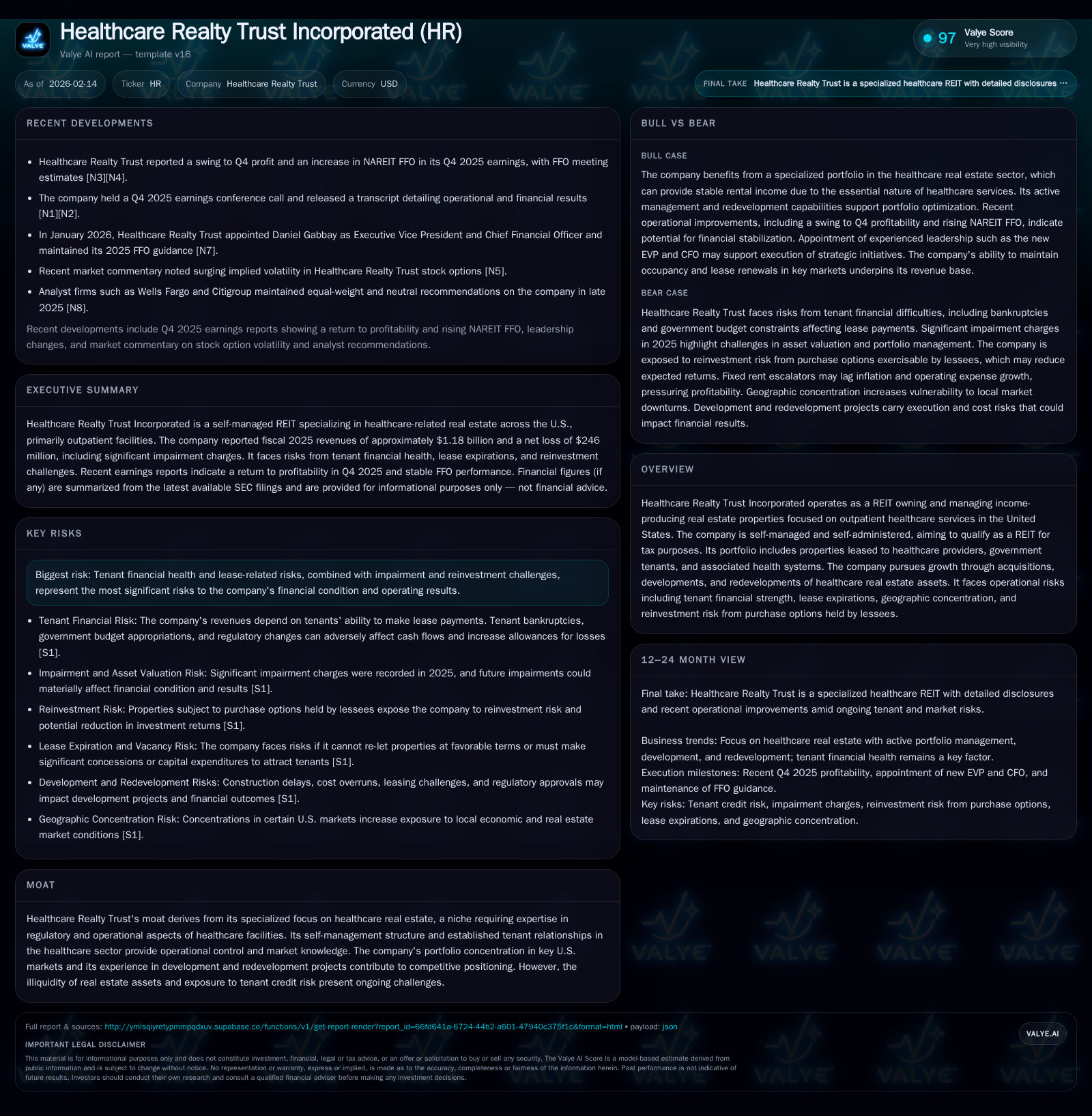
Healthcare Realty Trust Incorporated (HR) operates as a self-managed REIT specializing in outpatient healthcare real estate across the U.S. Amid Daniel Gabbay’s recent appointment as CFO, the company reported Q4 2025 profitability contrasted by full-year net losses, underscoring operational pressures from tenant credit issues and portfolio reinvestment demands. Key risks remain centered on tenant financial health, leasing dynamics in single-tenant properties, and managing over $1 billion in exercisable purchase options that complicate capital deployment decisions. Market indicators such as surging implied stock volatility hint at investor uncertainty even as HR maintains steady FFO guidance. The company faces strategic imperatives to balance capital efficiency, tenant stability, and regulatory changes while preserving its niche moat in healthcare real estate.
Healthcare Realty Trust at a Glance: A Specialty REIT in Focus
Healthcare Realty Trust Incorporated (HR) functions as a self-managed and self-administered real estate investment trust dedicated predominantly to outpatient healthcare facilities across the United States [valye_report_excerpt; S1]. This niche market requires sophisticated understanding of both commercial real estate dynamics and the regulatory complexities intrinsic to healthcare delivery environments. HR’s portfolio consists of income-producing properties leased to an array of healthcare providers including government tenants and affiliated health systems.
The company's business model emphasizes acquisition, development, and redevelopment geared towards outpatient services, supporting a moat built on operational expertise within this specialized sector. The self-management structure grants HR direct control over leasing strategies, property maintenance, and financial discipline—a crucial advantage given the unique demands of medical office buildings.
Notably, HR's footprint aligns with key U.S. markets where outpatient demand exhibits resilience compared to traditional commercial sectors [valye_report_excerpt]. Despite these strengths, real estate illiquidity combined with dependence on financially sensitive tenants introduce material risks requiring continuous management attention.
Leadership Transition: The Rise of Daniel Gabbay as CFO
In January 2026, Healthcare Realty announced the appointment of Daniel Gabbay as Executive Vice President and Chief Financial Officer [N1]. His arrival shortly before the fiscal year-end suggests intent to reinforce financial leadership through an experienced executive familiar with capital markets nuances affecting REITs focused on healthcare assets.
Gabbay’s stewardship coincides with HR maintaining its previously issued 2025 Funds From Operations (FFO) guidance, signaling an approach balancing stability with cautious optimism rather than marked strategic overhaul [N1]. Given his dual role as EVP, he may influence broader operational integration alongside financial policies including risk management related to tenant credit and capital allocation.
The timing indicates an emphasis on ensuring consistent execution amid evolving sector challenges without disrupting ongoing portfolio initiatives or growth plans.
Decoding Q4 2025: Profitability Amid Operational Pressures
The Q4 2025 earnings season brought a nuanced picture for HR as it swung to quarterly profitability after years struggling with impairments primarily related to tenant bankruptcies [N6; F1]. While the full-year net income recorded a sizeable loss of $246 million largely due to non-cash charges linked to credit events among tenants such as Prospect Medical [F1; S1], operational cash flows aligned more closely with expectations.
Reported normalized NAREIT FFO met estimates reflecting stable rent collections from renewed leases despite increased rent abatements totaling $20.9 million—a rise from prior years indicating negotiation concessions possibly required by weakened tenant demand or credit concerns [N5; S1]. Earnings commentary underscored confidence in underlying property income but flagged ongoing challenges managing lease transitions amid market pressures [N2].
Cash and equivalents remained modest at $26 million year-end though balanced by solid long-term lease contracts extending weighted average remaining term approximately five to six years for most single-tenant buildings—a core contributor to revenue predictability while also anchoring risk exposure [F1; S1].
Tenant Financial Health and Lease Dynamics: The Core Risk Vector
Tenant viability dictates HR's top-line sustainability given nearly exclusive leasing to healthcare operators subject to regulatory reimbursement fluctuations and economic cycles [valye_report_excerpt; S1]. The bankruptcy filing of Prospect Medical in early 2025 exemplifies risks inherent to this specialization where operator performance wields disproportionate influence on cash flow metrics.
Prospect Medical leased roughly 80,900 square feet until Hartford HealthCare acquired those assets mid-year, renewing direct leases for about 65,500 square feet—mitigating vacancy but demonstrating volatility tied to individual tenant fortunes [S1; N2]. Additionally, ten single-tenant buildings face lease expiration in 2026 with half already renewed; ongoing negotiations suggest management's proactive stance although outcomes remain uncertain [S1].
Rent abatements have risen each year since 2023 reflecting landlords’ need for induced concessions amidst tightening tenant credit conditions or competitive leasing environments. Meanwhile, weighted average lease lengths in single-tenant structures (11.6 years initially but only about 5.7 years remaining) create rollover risk particularly if renewals falter or tenants default midway through long commitments [S1].
Capital Deployment and Tenant Improvements: Growth vs. Cost Efficiency
A distinctive feature of HR’s strategy entails significant investment into tenant improvements (TIs), distinguished between first generation build-outs for new space and second generation refreshes upon renewals or restructurings [S1]. In 2025 alone, expenditures reached approximately $90.2 million for first generation TIs—nearly double prior year—and $46.9 million for second generation upgrades representing 6.4% of total cash net operating income.
Such outlays are essential for maintaining facility competitiveness especially in specialized outpatient settings necessitating tailored medical infrastructure. However, rising TI costs pressure margins especially as leasing commissions similarly climbed from $47.1 million in 2024 to $54.8 million in 2025—amounting to over 7% of cash NOI by year-end [S1]. This juxtaposition frames an operating tension: sustaining asset quality to attract or retain tenants versus curbing expenditure amid revenue uncertainties.
Landlord recoupment strategies include amortizing excess TI costs over lease terms or charging interest when tenants opt for financed overages—with amortizations contributing roughly $10 million annually back into rental income streams—illustrating creative financing approaches within lease contracts [S1].
The Burden and Opportunity of Purchase Options in Property Portfolio
Healthcare Realty holds purchase options on approximately $55.7 million worth of properties exercisable currently plus an additional near $1 billion subject to future option exercise stretching through the next decade and beyond [S1]. These options provide tactical flexibility but simultaneously represent latent obligations complicating capital planning.
The extended horizon—with some options exercisable well into the 2030s—injects uncertainty over timing of potential acquisitions or forced sales impacting liquidity management. Valuation methodologies for these options vary between appraised fair market value bases or predetermined capitalization rates creating potential disparities between book values and market realities especially amid fluctuating real estate cycles.
Effectively navigating these options requires balancing reinvestment capacity against projected return hurdles while mitigating downside risk from unexercised rights potentially crystallizing unexpectedly during adverse market phases [S1]. This stewardship influences HR’s overall financial posture alongside its growth pipeline.
Market Signals: Stock Volatility and Technical Patterns Explored
Recent equity trading narratives reveal heightened implied volatility surging among Healthcare Realty’s stock options suggesting increasing investor nervousness perhaps driven by mixed operating results juxtaposed against macroeconomic concerns impacting healthcare sectors generally [N7]. Concurrently, technical analysis notes share price crossing below critical moving averages further underscore near-term skepticism or cautious positioning among market participants [N8].
Such signals reflect broader uncertainty regarding HR’s ability to sustain growth momentum while managing embedded credit risks related to specific tenants who underpin cash flows. Option market activity often foreshadows anticipated event risks or earnings surprises warranting close monitoring even absent concrete catalysts.
Taken together these technical patterns complement fundamental risk vectors emphasizing vigilance in financial modeling frameworks employed by shareholders or analysts following HR’s story.
The Road Ahead: Strategic Imperatives in an Uncertain Healthcare Landscape
Looking forward into 2026 and beyond Healthcare Realty must reconcile competing demands: preserving stable rental revenue streams from tenants under financial pressure; prudently deploying capital amidst reinvestment obligations including cumbersome purchase options; maintaining asset quality through calibrated TI spending; all while navigating healthcare regulatory evolutions affecting provider reimbursement frameworks that ultimately bear down on tenant solvency.
Operational discipline combined with proactive lease structuring—including measures such as financing TI overages amortized into rents—illustrates management’s efforts at mitigating margin compression attributable partly to elevated leasing incentives [valye_report_excerpt; S1; N2]. Continued diversification away from overly concentrated single-tenant exposures might reduce renewal risks although current weighted lease metrics still favor medium-term visibility.
Given its niche positioning Healthcare Realty can leverage domain-specific expertise enabling adaptation within outpatient real estate segment seen as moderately resilient versus other commercial types during economic shifts. Nonetheless macro factors including interest rate environments influencing cap rates coupled with persistent supply-demand imbalances require vigilant capital stewardship.
Ultimately maintaining REIT qualifying distributions while managing cash flow volatility emanating from tenant credit developments will define HR’s strategic posture going forward alongside selective growth via acquisitions or developments fitting strict underwriting criteria aligned with risk tolerance thresholds outlined herein.
This analysis consolidates multiple data sources including company filings up to February 14, 2026 ([S1], [S2]), recent corporate news releases ([N1-N8]), and integrated factual company metrics ([F1]). Opinions herein do not constitute investment recommendations but aim to deepen understanding of Healthcare Realty Trust's operating environment, leadership dynamics, financial performance nuances, risk profiles, and market behavior within the specialized healthcare real estate sector.
Disclaimer: This is research-only, informational analysis and not investment advice. It may include AI-generated interpretation and general industry context. Always verify important details using primary sources.

Comments