
JFrog Ltd’s Evolution as a Software Supply Chain Powerhouse in the AI-Driven Era
JFrog steers enterprises through the Liquid Software revolution with a unified platform integrating DevOps and AI workflows amid robust growth and complex market demands.
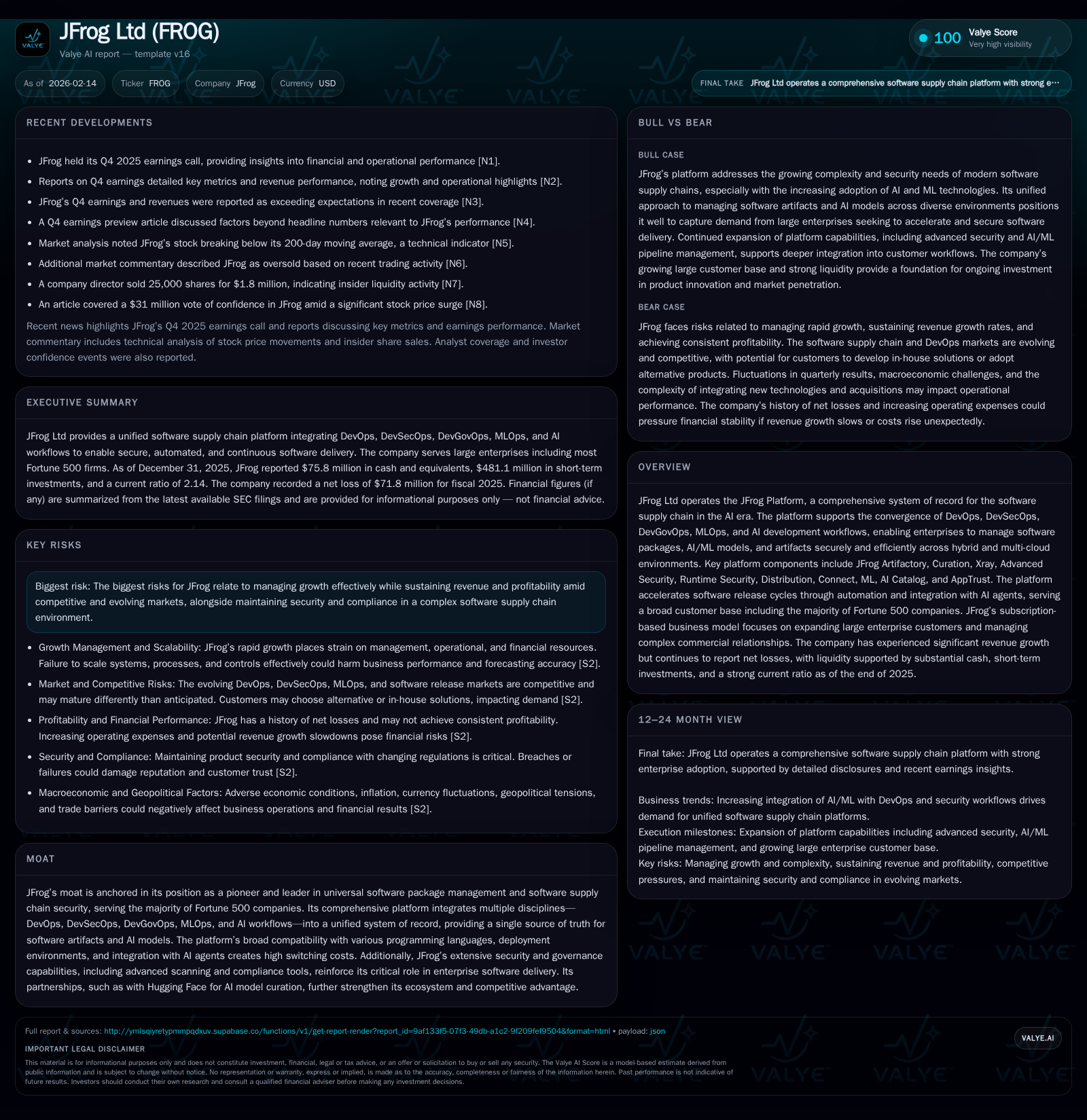
JFrog Ltd has positioned itself at the forefront of next-generation software delivery by unifying software supply chain management in an AI-enabled landscape, powering the majority of Fortune 500 companies. Its comprehensive platform melds development, security, governance, and AI model curation to accelerate software release cycles while navigating intricate compliance and competitive pressures. Despite impressive 24% revenue growth in 2025, the company balances ambitious expansion with ongoing net losses and operational risks characteristic of fast-evolving software markets.
JFrog’s Vision: Architecting the Future of Liquid Software
In today’s accelerated software landscape, JFrog Ltd is architecting what it calls "Liquid Software"—a state where software updates, security fixes, and AI model deployments flow seamlessly from any user to any destination with agility and trust. This vision addresses an enterprise reality increasingly defined by hybrid cloud environments and cross-disciplinary teams: developers, security professionals, AI/ML engineers, and autonomous AI agents all collaborating under one platform umbrella [S1].
The company's comprehensive platform approach encompasses a suite of interconnected products such as Artifactory for artifact management, Xray for advanced security scanning, Advanced Security modules addressing runtime risks, alongside AI-specific tools including ML pipelines and an AI Catalog governed by trust standards. By enabling a unified system of record spanning DevOps to MLOps workflows, JFrog tackles emerging challenges from burgeoning software volumes and digital footprints reshaped by artificial intelligence integration [S1][N1].
This strategic framing extends beyond simple software distribution; it anticipates the future where updating an AI model or microservice component individually expediates release velocity while upholding compliance—ultimately empowering businesses to respond rapidly to customer needs and security imperatives.
Platform Leadership at the Intersection of DevOps and AI
JFrog’s moat is distinctly shaped by its universal package management combined with an expansive security and governance framework fortified with AI capabilities. The platform supports multiple programming languages and deployment environments without locking customers into proprietary constraints—a freedom essential for modern enterprises juggling multi-cloud deployments [S1].
Moreover, this extensibility generates high switching costs: deep integrations within organizations’ CI/CD pipelines mean migrating away would disrupt critical workflows. JFrog’s partnership ecosystem further cements its leadership; notably, collaboration with Hugging Face enhances AI model curation capabilities integrated within the JFrog Platform's AI Catalog module [S1].
Such alliances materially elevate the platform’s ecosystem gravity by converging traditional DevOps processes with emerging AI development paradigms—addressing hybrid teams’ needs holistically rather than through fragmented tooling [N3]. This intersection creates resilient competitive advantage amid an intensifying market landscape.
Decoding Financial Growth and Investment Dynamics
Financially, JFrog posted $531.8 million in revenue for fiscal 2025, marking a substantial 24% year-over-year increase from $428.5 million in 2024—a continuation of strong growth trends that speak to rising enterprise adoption and product expansion [S1][F1][N2]. However, this top-line strength coexists with sustained net losses: a $71.8 million deficit in 2025 slightly expanded from $69.2 million in 2024 [F1].
This pattern reflects heavy reinvestment aimed at extending technology leadership—developing novel features across its hybrid universal platform—and broadening its footprint internationally (40% of revenue derived outside the U.S.). The firm maintains solid liquidity with a current ratio exceeding 2.1x ($873 million current assets vs. $408 million liabilities), providing flexibility for continued R&D and sales initiatives [F1].
Growth in SaaS revenue—from 39% in 2024 to 46% in 2025—underscores strategic progress toward recurring higher-margin subscription revenue streams that offer scalable economics [S1][N3]. Meanwhile, increased revenue contribution (56%) from Enterprise Plus subscription tiers illustrates deepened account penetration through comprehensive feature uptake.
Enterprise Adoption and Expansion: Fortune 500 as Proof Points
Embedding the JFrog Platform into mission-critical infrastructure across roughly 6,600 global customers—including approximately 83% of Fortune 100 firms—validates its pivotal role in enterprise digital transformation journeys [S1]. Among these are leaders in technology sectors as well as financial services, retail (8 out of top 10), healthcare, and telecommunications industries [S1][N4].
The company recently revised its customer logo accounting methodology to consolidate subsidiaries under single holdings—simplifying sales motions but also indicating complex organizational footprints it supports internally [S1]. This speaks to growing demand for unified contract structures that ease enterprise consumption.
Upselling strategies focus on moving customers from self-managed license models toward SaaS deployments where increased usage rates post-migration have been observed. Such expansions foster richer interactions between support teams and clients while accelerating adoption curves across broad teams per organization.
Navigating Complex Challenges: Security, Compliance, and Competitive Pressures
While JFrog profits from wide adoption, it operates amid intensifying risk vectors tied to software supply chain integrity—a critical concern given recent high-profile breaches industry-wide. The platform must maintain robust real-time scanning capabilities (Xray), runtime protection layers (Advanced Security), and ensure compliance with evolving regulatory regimes surrounding data privacy and digital governance [S1][S2].
Competition is fierce—not only from traditional DevOps stalwarts but also fresh entrants targeting niche segments such as Kubernetes-native artifact management or specialized MLOps tooling — compelling continuous innovation cycles from JFrog [S2].
Additionally, risks tied to geopolitical tensions (tariffs/non-tariff barriers) along with macroeconomic uncertainties—ranging from inflationary pressures to potential recessions—pose challenges for sustaining global sales momentum [S1][S2]. Effective risk management thus remains core to balancing growth ambitions against operational stability.
The SaaS Migration and Subscription Model Evolution
JFrog’s journey toward greater SaaS penetration aligns with broader cloud-native enterprise trends emphasizing flexible consumption models. SaaS now forms nearly half (46%) of total revenues compared to prior years signaling successful market shifts [S1][N3].
Notably, the Enterprise Plus subscription tier grew to represent approximately 56% of total revenue in 2025 from around 51% in prior periods—reflecting clients’ preference for end-to-end solutions addressing their entire software supply chain lifecycle needs under a single contractual umbrella [S1].
This evolution enhances customer intimacy via monthly-to-multi-year contract options fostering predictable cash flows while enabling scalable delivery models that accommodate surges typical in modern agile development cycles.
Strategic Partnerships and Ecosystem Strengths
Strategic alignments shape much of JFrog’s expansion narrative. Beyond core product innovation lies ecosystem enrichment exemplified by partnerships like Hugging Face which integrates model curation services into the AI Catalog feature set within JFrog’s platform fabric [S1].
Such collaborations extend functional breadth addressing emerging requirements unique to AI development workflows while augmenting existing strengths across traditional package management spheres. These synergistic expansions differentiate the platform by offering comprehensive tooling that resonates strongly with hybrid teams navigating converged DevSecOps/MLOps landscapes.
This leveraged ecosystem strategy not only improves stickiness but also fuels network effects as partners contribute innovation accelerating overall platform value.
Managing Risks in a Fast-Evolving Software Economy
JFrog acknowledges substantial risks tied to scaling operations amidst rapid market evolution. Managing infrastructure complexity without sacrificing efficiency or security remains challenging as new product innovations roll out alongside geographic diversification efforts [S1][S2][F1].
Profitability hurdles persist given ongoing investments necessary to safeguard intellectual property rights while complying with regulatory mandates spanning data handling practices internationally [S1][S2]. Macroeconomic headwinds inject further uncertainty impacting customer purchase behavior.
Operational discipline focusing on governance systems—including internal financial controls—and talent retention are vital levers ensuring resilience during volatile cycles documented in filings highlighting significant risk disclosures related to competitive threats and legal contingencies [S1][S2].
Market Sentiments and Recent Movements in FROG’s Share Trends
JFrog shares recently breached below their pivotal 200-day moving average marking technical weakness suggestive of oversold conditions according to market analyses dated February 2026 [N5][N6]. This event may reflect investor caution amid balance sheet considerations tied to continued net losses despite growth achievements.
Concurrently a director’s sale of approximately 25,000 shares worth $1.8 million earlier this year adds nuance; insider selling often prompts debate regarding near-term confidence even if routine portfolio activity is typical among executives [N7]. Such movements feed into market psychology influencing short-term volatility though they coexist alongside positive fundamentals anchored by broad enterprise adoption.
Disclaimer: This report is for informational purposes only. It does not constitute investment advice or recommendations regarding securities transactions.
Disclaimer: This is research-only, informational analysis and not investment advice. It may include AI-generated interpretation and general industry context. Always verify important details using primary sources.

Comments