
Utz Brands at a Crossroads: Heritage Strength Confronts Consolidation and Innovation Pressures
An incisive look at how Utz’s storied regional legacy and distribution model face fierce retail consolidation, evolving consumer tastes, and intensifying competitive dynamics.
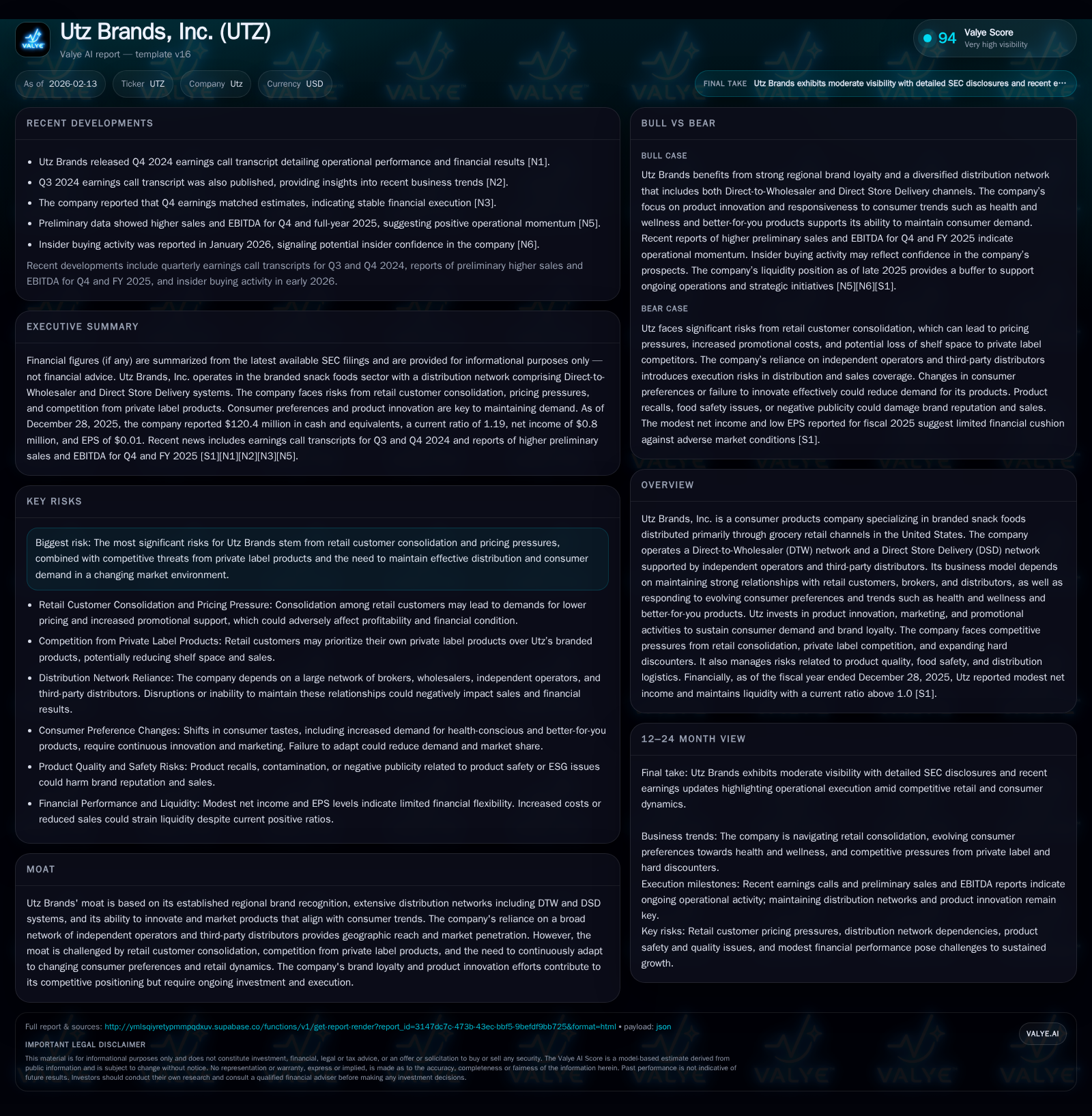
Utz Brands, Inc. leverages a deeply rooted regional identity and a dual-distribution network to maintain its foothold in the U.S. snack foods market. However, increasing retailer consolidation, private label competition, and shifting consumer preferences toward better-for-you (BFY) snacks present acute challenges. Utz’s innovation efforts and marketing investments seek to sustain brand loyalty amid pricing pressures and complex retailer demands. Financially, the company demonstrates modest profitability with constrained margins and manageable liquidity, while intellectual property protections and cybersecurity assume strategic importance amid technological risks and evolving legal frameworks.
Utz at a Crossroads: Heritage Faces Modern Market Forces
For nearly a century, Utz Brands has cultivated an image synonymous with authentic regional snack flavor—an embodiment of nostalgia for many American consumers who associate it with trusted taste and quality. This deeply ingrained brand heritage has anchored Utz as a formidable player within eastern U.S. markets. Yet, today's snack food landscape tells a very different story — one marked by accelerating retailer consolidation, aggressive private label incursions, and swift shifts in consumer behavior toward healthier snacking options.
These realities are tearing at the fabric of Utz's longstanding moat. Although its trademarks enjoy robust recognition regionally, the company confronts mounting headwinds as major grocery chains demand more favorable pricing and promotional support while prioritizing their own private-label brands [S1][N1]. The tension between preserving cherished traditions and quickly adapting to evolving market imperatives frames Utz’s current strategic dilemma.
Distribution Dynamics: Leveraging DTW and DSD Amid Consolidation
Central to Utz's operational architecture are its dual distribution models — the Direct-to-Wholesaler (DTW) system targeting broad coverage through independent operators (IOs), alongside a Direct Store Delivery (DSD) network that ensures timely shelf stocking via third-party distributors [valye_report_excerpt]. This hybrid setup enables penetration into diverse retail channels including grocery stores, convenience outlets, and clubs.
However, these distributed networks also expose Utz to vulnerabilities. The reliance on IOs and third-party logistics partners provides geographic reach but introduces complexity amidst shifting retailer demands for delivery timelines, volume consistency, and return policies [S1][N5]. Under industry consolidation — where fewer but larger retailers wield increased negotiating power — maintaining service quality across such distributed networks without incurring disproportionate costs becomes increasingly challenging.
Strategic focus thus partially pivots towards tightening coordination across these channels while exploring efficiencies or alternative routing to preserve margin integrity.
Decoding Consumer Taste Shifts: Innovation in Better-for-You Snack Products
Consumer appetites have evolved beyond traditional salty snacks toward better-for-you (BFY) options promising nutritional benefits without sacrificing flavor [valye_report_excerpt][S1]. Recognizing this paradigm shift, Utz has prioritized investment in product innovation — introducing items aligning with dietary trends such as reduced sodium, organic ingredients, and novel seasoning blends [N2]. Marketing campaigns increasingly spotlight these attributes alongside established favorites to retain existing customers while attracting health-conscious consumers.
Nonetheless, the competitive landscape surrounding BFY snacks heightens intensity. Emerging brands backed by venture capital often accept narrower margins to rapidly build share through aggressive promotions or product differentiation [S1]. Against this backdrop, sustaining innovation requires delicate balancing between R&D expenditure, scale economies, and careful channel placement strategies.
Navigating Retailer Muscle: Price Pressures and Shelf-Space Battles
Retail consolidation concentrates purchasing power within a shrinking group of dominant chains that command price concessions from suppliers like Utz [S1][valye_report_excerpt]. These customers often leverage their position to extract hefty promotional fees including product placement charges, advertising co-investments, volume rebates, and penalties linked to returns or damages.
Moreover, retailers' expanding private-label portfolios compete directly against branded products for coveted shelf space. Without long-term volume purchase agreements—typical for many of Utz's accounts—the company faces uncertainty around order volumes alongside inflexible fixed costs [S1]. This dynamic can suppress pricing power and compress operating profits.
The interplay between sustaining compelling promotions to drive consumer demand versus limiting expensive allowances remains an ongoing negotiation wherein missteps may erode profitability or market presence.
Financial Pulse Check: Growth, Margins, and Liquidity in FY25
Examining Utz's fiscal 2025 performance reveals signs of steady yet restrained progress. Net income hovered near $800 thousand despite top-line sales growth reported in Q4 earnings [F1][N3][N5]. Operating margins show pressure from intensified promotional spending coupled with inflationary input cost increases—including commodities such as potatoes and packaging materials highlighted in SEC risk factors [S1].
Liquidity stands at $120 million in cash equivalents against $323 million in current liabilities—a current ratio of approximately 1.19—indicating adequate but cautious financial flexibility [F1]. Such a ratio suggests operational resilience yet underscores limited room for substantial unplanned expenditures absent additional financing or cash flow improvements.
A visual table juxtaposing revenue growth against margin trends could provide clarity here (referencing F1 data).
Intellectual Property and Cybersecurity: Hidden Pillars of Brand Defense
Beyond physical goods distribution lies the subtle battleground of intangible asset protection. For Utz, intellectual property — primarily trademarks representing decades of brand value — constitutes a vital defensive asset [S1]. Yet evolving technologies such as artificial intelligence introduce novel legal complexities around trademark infringements or dilution that could impair distinctiveness or lead to costly litigation.
Simultaneously, cybersecurity risks loom large. Frequent sophisticated cyberattacks threaten not only business continuity but also sensitive operational data spanning manufacturing systems to financial controls [S1]. While Utz maintains security protocols supplemented by insurance for certain cyber incidents, vulnerabilities persist that could disrupt operations or damage reputation with suppliers and retailers alike.
Hence proactive IP management paired with robust cyber defenses forms an underappreciated but critical resilience pillar amidst broader market turbulence.
Risk Map: Climate, Supply Chain, and Competitive Headwinds
Environmental factors inject substantial uncertainty into raw material sourcing. Climate change effects—ranging from droughts affecting potato yields to increased incidence of natural disasters impacting production sites—pose risks detailed extensively in regulatory disclosures [S1].
Likewise, legal developments around greenhouse gas regulations may compel greater operational expenditures or necessitate facility upgrades impacting cost structures.
Supply chain disruptions—whether due to geopolitical events or transportation bottlenecks—compound these worries by threatening just-in-time inventory models crucial for rapid retail replenishment.
Lastly, intensifying competition from multinational conglomerates wielding deeper pockets further complicates maintaining stable market share under shrinking margins.
Looking Ahead: Strategic Stakes and Market Opportunities
Management commentary reflects cognizance of an unforgiving marketplace demanding continuous adaptation via diversified snack offerings targeted at BFY segments coupled with refined marketing tactics harnessing digital channels effectively [N1][N2][valye_report_excerpt].
Further exploration into optimized distribution partnerships seeks efficiencies balancing reach against cost amid retailer exigencies.
As industry consolidation is expected to persist—and consumer preferences evolve rapidly—Utz’s future trajectory hinges on sustaining its heritage identity while decisively leaning into innovation-led growth strategies supported by prudent financial stewardship.
Continuous surveillance of competitor moves especially disruptive entrants backed by venture capital will be essential to validate assumptions about attainable profit pools.
This analysis synthesizes publicly available information from company filings and earnings transcripts without constituting investment advice. Readers should conduct further due diligence tailored to their individual objectives before forming conclusions regarding Utz Brands’ prospects.
Disclaimer: This is research-only, informational analysis and not investment advice. It may include AI-generated interpretation and general industry context. Always verify important details using primary sources.

Comments