
Innovative Neurostimulation and Market Leadership Define Inspire Medical Systems’ OSA Treatment Trajectory
Inspire Medical Systems pioneers minimally invasive neurostimulation for obstructive sleep apnea, balancing robust clinical validation with evolving reimbursement and operational challenges.
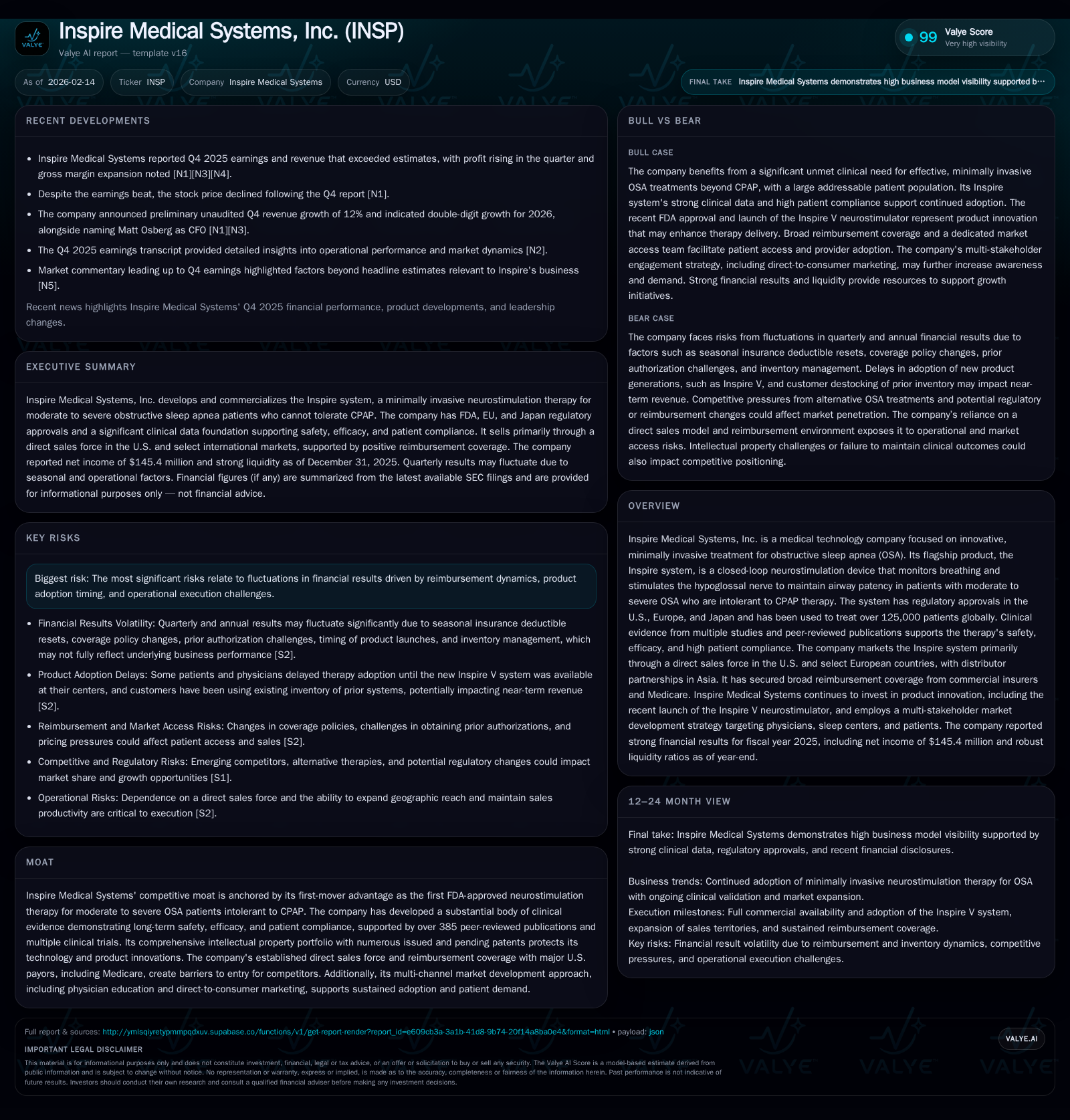
Inspire Medical Systems (INSP) has established itself as a market leader in treating moderate to severe obstructive sleep apnea (OSA) patients intolerant to CPAP through its proprietary hypoglossal nerve stimulation technology. The company’s therapy benefits from a solid foundation of extensive clinical evidence, intellectual property protection, and regulatory approvals across major geographies. However, nuanced reimbursement code transitions and evolving coding clarity create revenue volatility and influence physician adoption timing. Recent financial reports confirm sustained double-digit growth prospects, supported by expanding sales infrastructure and strategic leadership appointments amid ongoing risks related to reimbursement uncertainty and operational execution.
From Mask Discomfort to Revolutionary Therapy: Defining Inspire’s Clinical Breakthrough
For many patients suffering from moderate to severe obstructive sleep apnea (OSA), the nightly ritual of donning a continuous positive airway pressure (CPAP) mask can be an ordeal marked by discomfort, noise, skin irritation, and claustrophobia. Consider the journey of a hypothetical patient who has tried CPAP but found the regimen intolerable—frequently removing the mask during sleep, undermining therapy efficacy. For such individuals, traditional options have historically been limited to invasive surgeries which often carry unpredictable outcomes and considerable recovery burdens.
Inspire Medical Systems has transcended this therapeutic gap with its flagship product—the Inspire system. This innovative device employs closed-loop neurostimulation that continuously monitors breathing patterns during sleep and selectively stimulates the hypoglossal nerve to prevent airway collapse without requiring cumbersome external apparatus. As disclosed in the 2026 Form 10-K [S1], this technology represents a significant leap forward as the first FDA-approved neurostimulation therapy specifically indicated for moderate to severe OSA patients who are intolerant of CPAP.
Backing this innovation is an extensive body of clinical evidence comprising more than 385 peer-reviewed publications demonstrating safety, efficacy, and superior patient adherence compared to prior alternatives. Notably, treatments using Inspire have reached over 125,000 patients globally across the U.S., Europe, and Asia [S1]. This level of clinical validation establishes both physician confidence and patient trust—key drivers behind adoption in a historically challenging segment.
The Business Backbone: Financial Health and Market Position Anchored in Innovation
The financial narrative of Inspire Medical Systems reveals a company benefiting materially from its innovative product leadership. According to recent disclosures [N1,N4,N2], Q4 2025 preliminary revenue increased by approximately 12% year-over-year—a reflection of mounting procedure volumes despite industry-wide reimbursement uncertainties. Concurrently, gross margins expanded while net income demonstrated solid growth supported by operational leverage.
From SEC filings [F1], as of year-end 2025 Inspire held approximately $105 million in cash and equivalents against current liabilities just under $96 million—yielding a robust current ratio north of six times. This liquidity buffer underscores prudent balance sheet management facilitating ongoing investments in commercial infrastructure expansion.
Underlying these figures is a carefully orchestrated commercialization strategy targeting hospitals and ambulatory surgery centers as customers—entities reimbursed on a per-patient basis through diverse payer contracts spanning commercial insurers and government programs including Medicare. This integrated approach aligns with broader market dynamics favoring minimally invasive solutions over traditional surgical interventions.
Unpacking the Reimbursement Puzzle: Coding Complexities and Their Impact on Revenue
A persistent headwind for Inspire lies in the complexities surrounding reimbursement coding—a critical determinant of revenue recognition timing and procedure economics. Over time, differing procedural Current Procedural Terminology (CPT) codes have been applied to various generations of Inspire devices: notably CPT 64582 for Inspire IV implants transitioning into CPT 64568 for the newer Inspire V device [S1].
This transition is further complicated by the introduction of modifiers such as -52 intended to adjust professional fees downward by roughly 10% to 50%, adding layers of ambiguity affecting physician compensation expectations [S1]. Such nuances contribute directly to variable willingness among implanting physicians to schedule procedures promptly.
Management has acknowledged ongoing confusion within governing bodies including CMS (Centers for Medicare & Medicaid Services) and Medicare Administrative Contractors (MACs), with definitive guidance pending broader claims data accrual [S1]. From quarterly filings [S2], these reimbursement-related uncertainties have tangible effects on short-term revenues due to delayed procedures or shifting purchasing behaviors at treatment centers.
Competitive Moat Built on Intellectual Property and Clinical Evidence
Beyond first mover status secured with initial FDA premarket approval in 2014 [S1], Inspire has fortified its competitive position through an expansive intellectual property portfolio protecting both core neurostimulation technology and incremental product innovations. This IP shield extends across multiple territories including U.S., EU under MDR compliance, and Japan following PMDA approval since 2018 [S1].
Complementing patents is an unmatched clinical research repository underscoring long-term safety profiles alongside efficacy benchmarks documented in prominent journals such as The New England Journal of Medicine. This convergence anchors a durable moat by raising barriers for competitors attempting either direct technological replication or alternative non-invasive treatment approaches.
Such comprehensive regulatory clearances facilitate seamless market access in key geographies while enabling continued investment confidence from stakeholders monitoring both innovation pipelines and real-world evidence accumulation.
Navigating Market Dynamics: Sales Execution, Adoption Patterns, and Patient Access
Strategic commercialization at Inspire leverages a dual-pronged approach combining an expert U.S.-based direct sales team engaging ear-nose-throat (ENT) physicians and specialty sleep centers with distributor partnerships handling select Asian markets including Singapore, Hong Kong, and Thailand [S1].
According to earnings call commentary [N3], onboarding requirements for implanting physicians concerning training criteria for the newest device generation (Inspire V) impact geographic diffusion velocity—patients often defer treatment until local centers meet these standards thereby creating phased adoption curves.
Furthermore, aggressive direct-to-consumer marketing initiatives provide educational outreach promoting awareness about OSA risks alongside therapeutic alternatives beyond CPAP. This top-down infusion aiming at physician referral networks combined with bottom-up patient empowerment acts as demand multipliers reinforcing steady procedure volume growth trajectories.
Risks on the Radar: Operational Challenges and Reimbursement Volatility
Despite notable strengths, management highlights several risk vectors threatening quarterly earnings consistency. Seasonal variation linked primarily to insurance deductible cycles leads to heightened fourth-quarter procedure volumes followed by typical first-quarter softening due to deductible resets forcing higher out-of-pocket expenses for patients explains some earnings unevenness experienced recently [S2].
Additionally problematic are potential delays from elective surgery rescheduling—as observed during health crises in past years—and fluctuations stemming from evolving reimbursement policies or payor coverage interpretations [S2]. Practically this manifests via decreased willingness among physicians if professional fees erode due to coding modifiers or payment uncertainty persists.
Operational risks also encompass pressure points around salesforce retention/productivity alongside pricing competition dynamics reflective of broader medtech sector trends. Management’s transparent disclosure of these issues adds credibility amidst sector peers grappling with similar external factors impacting execution precision.
Leadership Shifts and Strategic Guidance Amid Double-Digit Growth Outlook
A significant corporate development occurred with Matt Osberg’s appointment as CFO announced January 2026 reflecting deliberate succession planning aligned with scaling aspirations amid competitive landscapes [N1]. Osberg’s background presumably equips him with expertise relevant for navigating complex financial modeling under volatile reimbursement frameworks.
Management commentary during Q4 earnings releases underscores confidence toward sustained double-digit revenue growth into calendar year 2026 despite acknowledged headwinds—signaling continued faith in product-market fit combined with operational enhancements driving margin improvements [N4].
This balanced guidance demonstrates mature stewardship prioritizing long-term value creation without ignoring short-term cyclical disruptions inherent within medtech commercialization cycles.
Global Footprint and Regulatory Milestones Powering International Reach
Inspire's commercial footprint extends well beyond U.S borders facilitated by critical international regulatory clearances: early EU deployment post-2011 coupled with PMDA approval awarded in Japan circa 2018 supports strategic diversification reducing sole reliance on domestic sales dynamics [S1].
Distributor partnerships enable penetration within economically relevant yet complex markets like Singapore or Thailand allowing local stakeholders access while maintaining central control over brand positioning.
Ongoing compliance with evolving EU MDR requirements showcases organizational commitment toward quality assurance meeting stringent international standards—a prerequisite for extended institutional acceptance across healthcare systems internationally.
Looking Forward: Technology Evolution, Pipeline Potentials, and Market Expansion
While explicit details about next-generation devices remain sparse beyond current public disclosures [S1,N3], it is reasonable based solely on observed delays attributable partly to staging new product launches that continued innovation efforts persist as focal points internally. Deliberate onboarding criteria may also signal added workflow sophistication accompanying feature enhancements or integration capabilities designed to further differentiate offerings versus emerging competitors.
Future growth hinges not only on improving device iterations but also extending clinical indications potentially addressing broader populations or more diverse anatomical phenotypes within OSA subtypes.
Investment into continued robust clinical data generation remains instrumental—serving dual roles as market validation pillars while generating payer support critical amid shifting reimbursement landscapes.
Disclaimer: This analysis synthesizes publicly available information from regulatory filings ([S#]) and recent news ([N#]) without providing investment advice or recommendations. Readers should independently verify all facts before making any decisions related to Inspire Medical Systems or its securities.
Disclaimer: This is research-only, informational analysis and not investment advice. It may include AI-generated interpretation and general industry context. Always verify important details using primary sources.

Comments