
NETGEAR Inc.’s Cybersecurity Governance and Financial Resilience Amid Profit Challenges
NETGEAR balances operational strength and stringent cyber risk oversight despite fiscal year losses.
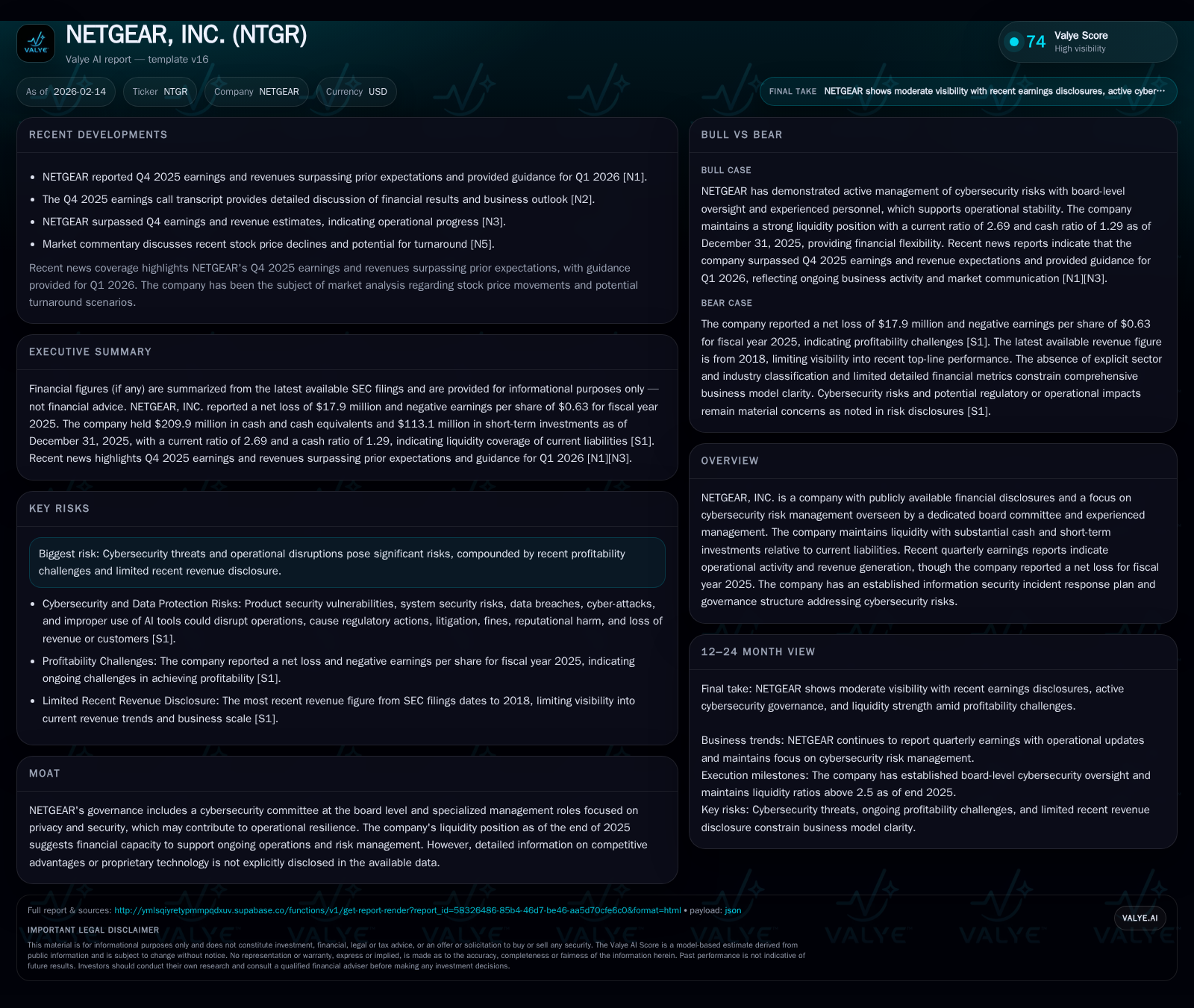
NETGEAR, Inc. recently reported a Q4 earnings beat juxtaposed against a net loss for fiscal year 2025, highlighting operational momentum shadowed by profitability challenges. The company’s governance architecture—including a dedicated board cybersecurity committee and seasoned management—underpins its approach to managing an evolving spectrum of cyber risks. Solid liquidity with a current ratio of approximately 2.7 provides a financial buffer, while international revenue trends indicate growth pockets amid global uncertainties. This analysis dissects how NETGEAR’s layered cybersecurity governance and leadership expertise may serve as stabilizing factors in turbulent times.
From Numbers to Narrative: Decoding Q4 Surprises and Fiscal Year Loss
NETGEAR’s latest financial results reveal a nuanced story. For Q4 2025, the company exceeded both earnings and revenue expectations — a positive signal of underlying operational momentum [N2][N3][N4]. This beat, however, contrasts with the broader picture for the fiscal year ended December 31, 2025, where NTGR reported a net loss of $17.9 million [F1]. The juxtaposition of short-term gains against full-year losses sets the stage for dissecting how the company manages its business amid competitive pressures and evolving technology demands.
Revenue drivers in Q4 suggest that sales channels remain active and demand persists within NETGEAR’s core networking segments. Still, the company faces margin compression and cyclical factors that contributed to overall yearly losses—factors not uncommon in hardware-centric industries where innovation cycles pressure pricing.
Unpacking these results points to an operating environment where top-line growth is achievable but balancing costs remains challenging. This dynamic pushes focus onto other facets of operational resilience beyond pure financials, notably governance frameworks.
The Boardroom’s Cyber Shield: Inside NETGEAR’s Cybersecurity Governance
One of NTGR's defining strengths lies in its approach to cybersecurity risk management. The company's board of directors integralizes cybersecurity into its oversight responsibilities via a dedicated cybersecurity committee [S1]. This structure signals heightened vigilance consistent with growing industry emphasis on safeguarding products, customer data, and corporate infrastructure.
This committee does more than nominal oversight; it receives regular written and verbal updates from the Cybersecurity Team about significant threats and mitigation strategies. Quarterly reports further keep governance informed on systemic vulnerabilities affecting both internal systems and product lines.
At the helm of day-to-day execution is NETGEAR’s General Counsel & Chief Privacy Officer (GC & CPO). Having been engaged in privacy and cybersecurity since 2008, her role entails personnel hiring decisions, budget approvals related to security, integration of cybersecurity into overall risk management, and incident preparedness planning—a comprehensive portfolio underscoring the seriousness with which NTGR treats this domain [S1].
The company also maintains an information security incident response plan tailored to escalate incidents promptly up to the board level when appropriate. This layered governance empowers swift action minimizing damage from cyber events.
Risk Reality Check: Navigating Vulnerabilities in an Evolving Threat Landscape
The risk factors outlined in NTGR’s filings present a sober view: product security vulnerabilities, system breaches, AI misuse risks, potential regulatory infractions due to privacy or security lapses—all constitute tangible dangers [S1][S2]. These issues threaten not only operational continuity but could lead to litigation, regulatory penalties, customer attrition, and reputational harm.
Given NETGEAR’s market niche supplying networking hardware increasingly targeted for exploitation attempts, vigilance is paramount. The potential complexity introduced by AI tools adds nuance to security postures; improper use may amplify threat vectors or complicate incident detection.
NTGR acknowledges this evolving landscape candidly within disclosures. Such transparency implies mature risk management culture oriented towards proactive defense rather than reactive firefighting.
Liquidity Advantage: Cash Reserves as the Bedrock of Operational Stability
A key pillar supporting NETGEAR through profit volatility is its liquidity position. As of December 31st, 2025, NTGR held approximately $210 million in cash and cash equivalents compared with current liabilities around $250 million [F1]. This yields a healthy current ratio near 2.7—a metric indicating short-term assets substantially cover obligations.
For context, companies operating at or below a ratio of 1 risk near-term cash shortages if liabilities come due sooner than expected assets materialize. NTGR’s cushion enables investment in risk mitigation strategies such as cybersecurity infrastructure while weathering periods of negative net income.
Such financial flexibility signals that management has prioritized solvency preservation alongside innovation efforts amidst industry headwinds.
Geographic Footprints: Dissecting International Revenue Momentum and Outlook
International markets provide a vital growth avenue for NETGEAR amid saturated or competitive domestic segments. Recent analyses reveal encouraging momentum particularly across Asia-Pacific regions where expanding broadband infrastructure and smart home device adoption bolster demand for networking solutions [N1].
However, global economic uncertainties—ranging from trade tensions to currency fluctuations—and varying regional cybersecurity regulations cloud outlooks somewhat.
Still, diversified geographic exposure positions NTGR better than purely domestic competitors who lack cross-border revenue streams mitigating localized downturns.
Leadership Layers: Spotlight on Management Roles Driving Security and Strategy
Beyond corporate governance committees resides an experienced leadership cadre actively shaping NTGR’s strategic defenses.
The General Counsel & Chief Privacy Officer stands out with over fifteen years entrenched in privacy and security matters prior to joining NETGEAR [S1]. Her remit includes critical responsibilities such as budget approval for cybersecurity initiatives; hiring skilled personnel; overseeing security assessments; prepping for incidents; and ensuring processes align with best practices.
Supporting roles such as Head of Corporate Security and Head of Product Security also carry significant expertise drawn from prior public company experiences focused on cyber risk reduction.
Together this team enacts policies reflective not just of compliance checkboxes but integrated corporate culture prioritizing resilience against cyberthreats.
Balancing Act: How Governance May Buffer Financial Headwinds
While NETGEAR lacks explicitly detailed proprietary technologies conferring strong moats publicly disclosed [F1], its governance robustness emerges as an intangible competitive advantage worth noting.
Strong oversight structures mitigate risks that could otherwise exacerbate financial turmoil via costly breaches or regulatory sanctions. This operational discipline may allow NTGR greater latitude during profit headwinds where weaker peers might falter under pressure from reputational damage or loss of customer trust.
Consequently, investors viewing cyber risk management frameworks as strategic assets might interpret NTGR's layered governance backdrop as partial insulation amidst industry churn.
Comparative Industry Context: What Peers Reveal About NTGR’s Positioning
Examining peers such as Viavi Solutions sheds light on prevailing network infrastructure market dynamics [N5]. Viavi has demonstrated robust earnings beats driven by service solutions catering to telecom operators adjusting networks for 5G rollouts.
While Viavi operates in adjacent spaces emphasizing testing equipment rather than consumer networking devices like NETGEAR, performance contrasts highlight diverse pressures within technology supply chains.
NTGR faces commoditization challenges impacting margins differently compared to companies benefitting from high-value service contracts. Understanding these nuances reinforces why strong governance layers are vital as financial buffers rather than relying solely on product differentiation.
Looking Ahead: Guidance Insights and Investor Implications
Q1 guidance issued on the recent earnings call projects modest revenue growth tempered by persistent investment needs into product development and security enhancements [N2][N3].
Management articulated cautious optimism anchored by incremental improvements in operational execution balanced against ongoing macroeconomic uncertainty including supply chain constraints that remain non-trivial.
This measured tone aligns well with observed governance priorities emphasizing steady cyber risk controls combined with pragmatic financial stewardship—a combination signaling deliberate navigation through turbulent waters rather than aggressive expansion gambits.
Disclaimer: This analysis is provided solely for informational purposes referencing publicly available data including SEC filings and news sources without offering investment advice or recommendations. Readers should conduct their own due diligence before making financial decisions related to NETGEAR or its industry peers.
Disclaimer: This is research-only, informational analysis and not investment advice. It may include AI-generated interpretation and general industry context. Always verify important details using primary sources.

Comments