
Comprehensive Analysis of Uber Technologies Inc: Navigating Growth, Challenges, and Market Dynamics
Uber's evolution as a global technology platform is shaped by its expansive multi-segment network, regulatory complexities, and competitive pressures.
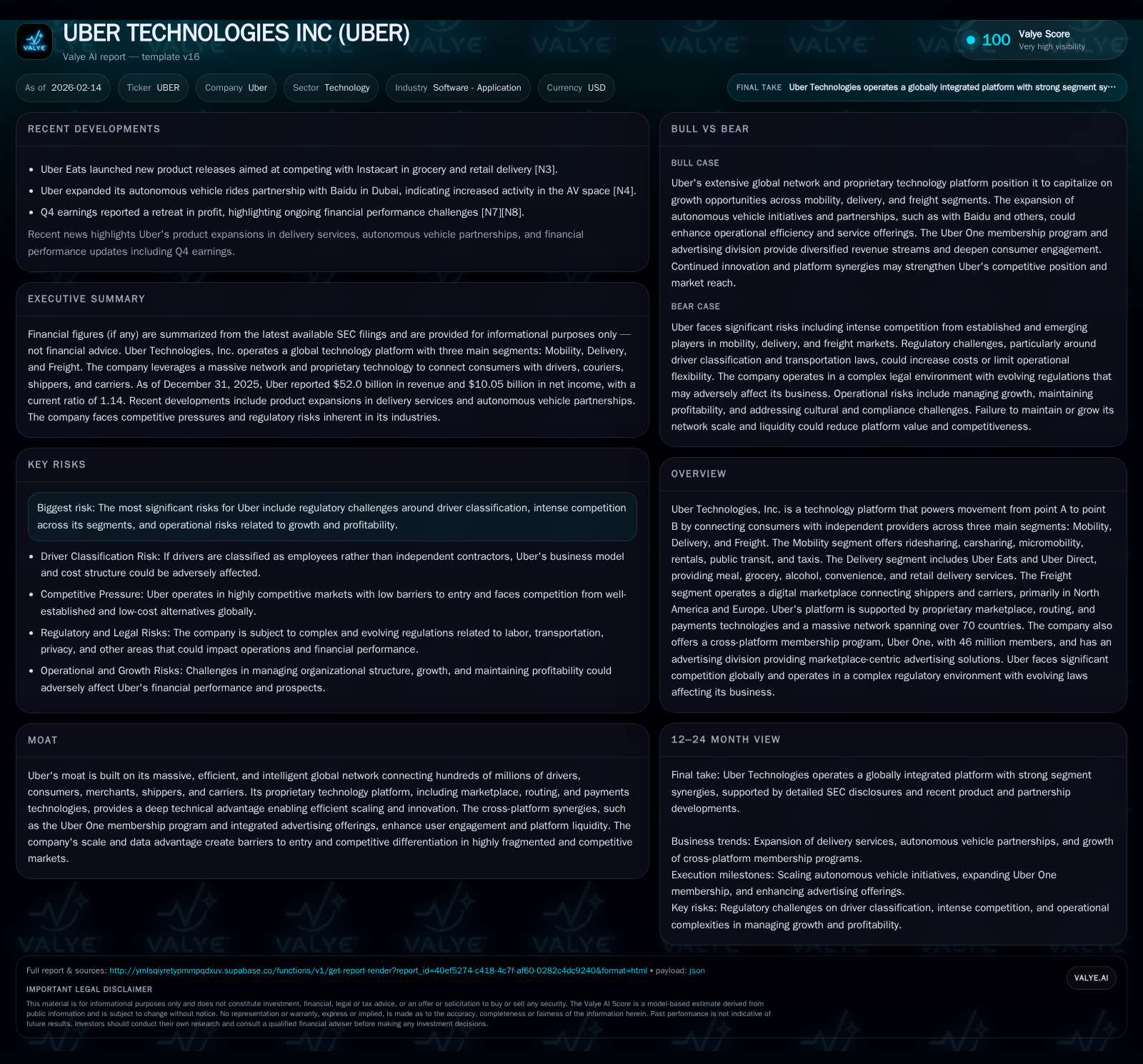
Uber Technologies Inc operates a multi-faceted platform across Mobility, Delivery, and Freight segments, leveraging proprietary technology to connect consumers with service providers worldwide. The company demonstrated robust growth in user engagement and financial results through 2025, supported by innovations like Uber One and integrated advertising offerings. However, persistent risks such as regulatory scrutiny over driver classification, intense competition, and operational scaling challenges remain critical. Strategic technology investments and global expansion underpin Uber’s sustained market leadership amid evolving industry dynamics.
Company Overview
Uber Technologies Inc is a leading global technology platform that facilitates the movement of people and goods from point A to point B through its proprietary applications. These applications connect consumers with independent providers across three operating segments: Mobility (ridesharing, carsharing, micromobility), Delivery (meal delivery via Uber Eats plus grocery and retail deliveries), and Freight (a digital marketplace linking shippers to carriers primarily across North America and Europe) [S1].
With presence in over 70 countries including key regions such as the United States, Canada, Latin America, Europe excluding Russia, the Middle East, Africa, and Asia Pacific excluding China and Southeast Asia, Uber serves diverse geographic markets leveraging scale advantages [S1].
Business Segments
Mobility
This core segment connects riders with drivers offering an array of transportation options beyond traditional ridesharing—encompassing carsharing services, electric scooters/bikes (micromobility), rental cars, public transit integration, and taxis. Uber claims technical superiority through its massive network data set enabling superior routing algorithms and marketplace efficiencies that enhance both rider experience reliability and driver earnings potential [S1].
Delivery
Delivery comprises the Uber Eats platform alongside Uber Direct which caters to non-restaurant retail deliveries including groceries and alcohol. This segment targets the fast-growing convenience economy by connecting consumers (Eaters) with merchants using flexible couriers. The company recently intensified competition against established players like Instacart through new product releases aiming to capture grocery delivery demand [N13].
Freight
Uber Freight operates as a digital facilitation layer for shippers seeking logistics capacity with carriers. Primarily focused on large markets such as North America and Europe where freight transportation is traditionally fragmented, the segment aims to improve efficiency using data-driven matching algorithms. This line extends Uber’s marketplace expertise into B2B logistics services [S1].
Financial Performance Highlights
In fiscal year 2025, Uber reported strong growth metrics:
- Monthly Active Platform Consumers (MAPCs) rose to 202 million (Q4 figure), an 18% increase year-over-year.
- Trips increased by 20%, driven by gains in Mobility but also supported by Delivery expansion.
- Gross Bookings reached $193.45 billion (+19%), translating into revenues of $52.0 billion (+18%).
- Income from operations nearly doubled to approximately $5.6 billion.
- Net income attributable to the company was $10 billion.
- Adjusted EBITDA improved substantially by 35% to about $8.7 billion.
- Operating cash flow grew by 42% to over $10 billion supporting free cash flow generation of approximately $9.8 billion [S1][F1].
These metrics reflect continued momentum across all segments bolstered by strategic innovations like the cross-platform Uber One membership program which boasts 46 million subscribers enhancing customer loyalty and monetization.
Competitive Moat and Technology Edge
Uber’s competitive advantage hinges on several pillars:
- Scale & Network Effects: The sheer volume of drivers, consumers, merchants, shippers, and carriers creates liquidity that rivals find difficult to duplicate.
- Proprietary Technology: Advanced marketplace pricing/routing engines optimize matching efficiency reducing wait times and increasing utilization rates.
- Cross-platform Synergies: Membership programs unify consumer engagement across services while integrated advertising offerings create additional revenue streams utilizing platform data.
- Global Footprint: Widespread international presence enables diversified revenue sources adapting to local market dynamics.
Together these create high switching costs for users due to convenience and entrenched relationships while generating significant data advantages allowing continuous iterative improvements [S1].
Regulatory Landscape & Risks
A paramount risk factor is the ongoing legal scrutiny around driver classification globally. Courts and regulators dispute whether drivers qualify as independent contractors or employees/workers entitled to wage guarantees, benefits, social security contributions, taxes, etc. Noteworthy is litigation in California initiated in May 2020 alleging misclassification yielding potential monetary penalties [S1].
If legislative or judicial outcomes force reclassification:
- Significant increases in labor costs will occur impacting profitability.
- Driver supply could shrink due to reduced flexible working conditions causing booking shortfalls.
- Financial reporting might require material adjustments affecting revenues or expenses presentation. Uber acknowledges costs related to compliance (e.g., minimum earnings floors under Proposition 22) but does not expect a material overall impact currently [S1].
Additional risks include:
- Intense competition necessitating fare reductions or promotions that can compress margins.
- Potential failure to attract/retain critical mass on either side of the platform undermining network effects.
- Operational complexities associated with scaling balanced against investment in innovation.
- Brand reputation management especially related to safety incidents or negative media coverage which could deter users or drivers.
- Emerging cybersecurity threats compromising user data or platform integrity [S1].
Industry Competitive Dynamics
Mobility markets are crowded with entrenched taxi services competing alongside rival rideshare companies. Similarly delivery faces major incumbents like DoorDash or regional grocery platforms challenging Uber Eats’ growth trajectory. In freight logistics numerous traditional brokers operate alongside new digital entrants vying for technological superiority [analysis].
Success depends heavily on rapid scaling capabilities enabled by capital resources combined with continual algorithmic improvements that drive down costs while improving user satisfaction metrics. Partnerships—such as those expanding autonomous vehicle testing in Dubai via collaboration with Baidu—signify ongoing attempts at disruptive innovation positioning [N6].
Strategic Initiatives & Innovations
Uber invests substantially in expanding product features such as seamless public transit integrations enhancing urban mobility options as well as broader financial partnerships tied into driver earnings enhancing platform stickiness [S1]. The growing advertising division leverages marketplace data delivering targeted promotions complementing core business lines. Autonomous vehicles represent a long-term transformative opportunity but face execution uncertainty relative to competitors [S1][N6].
Additionally recent product launches enhancing grocery delivery capabilities seek direct competition with leaders such as Instacart indicating aggressive moves into broader convenience delivery verticals [N13].
Operational Challenges & Organizational Considerations
Managing a vast global operation requires constant refinement of organizational structure to optimize costs without sacrificing responsiveness or innovation speed. Workforce retention remains pivotal; turnover in key personnel could disrupt momentum especially in technology development or regulatory affairs functions [S1].
Safety issues tied to criminal or violent incidents pose reputation risks threatening user trust essential for sustainable growth. Cybersecurity investment must keep pace with increasingly sophisticated threats including exploitation attempts on AI models integral to marketplace decisions [S1].
Outlook & Risk Mitigation Considerations
While financials show strong growth trends backed by diversified revenue pools across segments at scale generating positive operating cash flows suggesting durable economics—the landscape demands ongoing vigilance:
- Continuous engagement with regulators globally is imperative to shape favorable frameworks around driver labor classifications.
- Investment balancing between innovation efforts (AI-powered tools/autonomous vehicles) versus near-term profitability maintenance requires prudent capital allocation.
- Competitive response strategies must anticipate price pressures while enhancing differentiated service quality remain focal points.
- Climate-related physical disruptions or transitions could influence regional demand patterns necessitating adaptive operational flexibility [S1].
Conclusion
Uber Technologies Inc stands as a quintessential example of modern platform economics blending massive network effects powered by cutting-edge algorithmic infrastructure spanning mobility, delivery, and freight logistics. The company exhibits impressive scale-driven growth validated by strong financial performance through 2025 alongside significant operational breadth enabling multi-pronged value creation pathways. Nonetheless material regulatory uncertainties surrounding gig worker treatment coupled with intensifying competition underscore fundamental strategic challenges ahead. Success will depend on leveraging its technical edge prudently while safeguarding brand equity amidst evolving macroeconomic realities. Investors should monitor developments across regulatory rulings impacting driver status along with competitive innovations particularly in autonomous mobility deployments that could reshape future market dynamics dramatically.
Disclaimer: This report is for informational purposes only based on publicly available data as of early 2026; it does not constitute investment advice or recommendations.
Disclaimer: This is research-only, informational analysis and not investment advice. It may include AI-generated interpretation and general industry context. Always verify important details using primary sources.

Comments